dailynewsnblog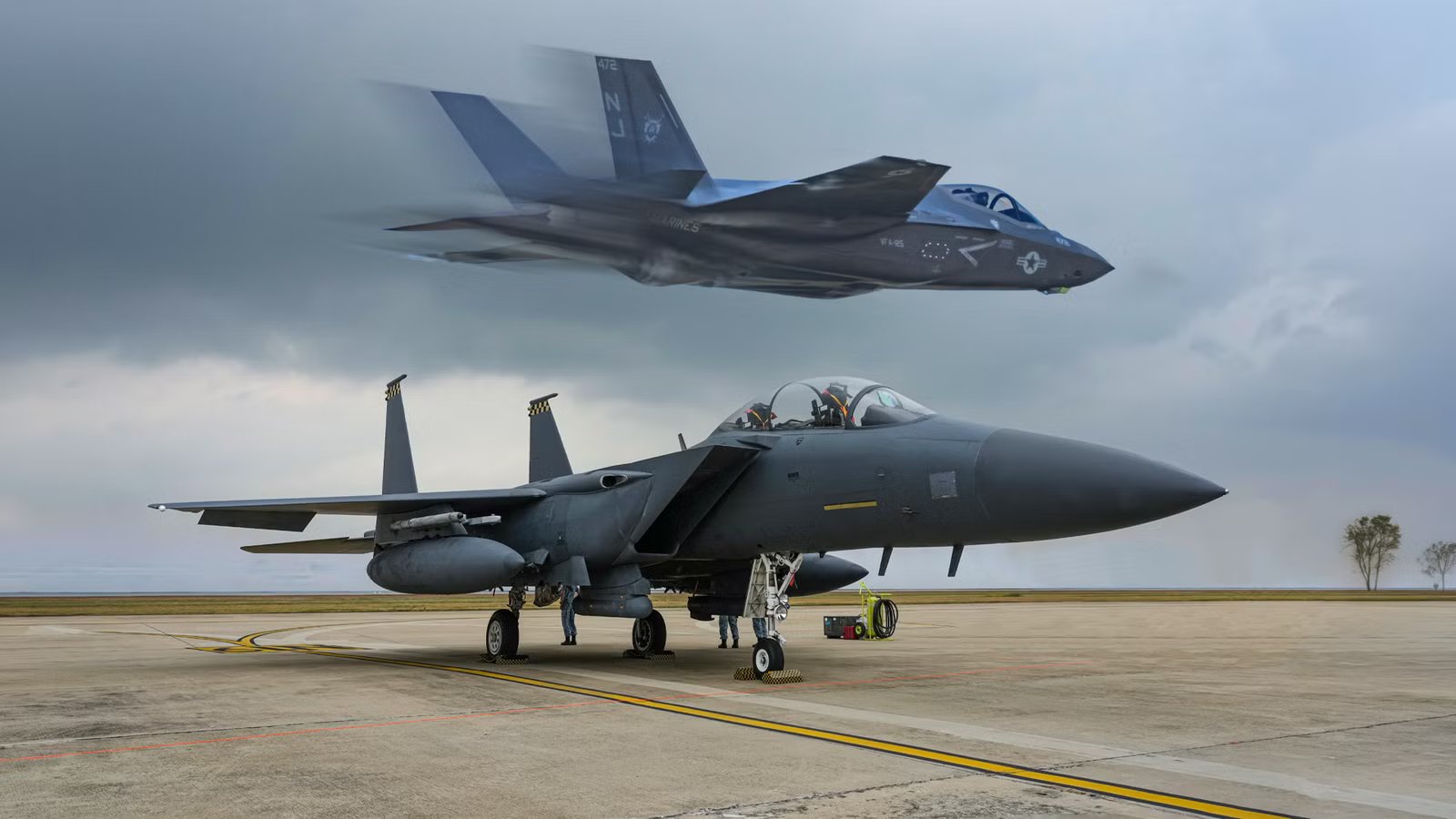
The McDonnell Douglas F-15 Eagle and the Lockheed Martin F-35 Lightning II represent two very different eras and philosophies of fighter aircraft design. Introduced in the 1970s, the F-15 was built to achieve absolute air superiority through speed, power, and maneuverability. Over nearly five decades of service, the aircraft has built an extraordinary combat record, with more than 100 aerial victories and zero combat losses in air-to-air engagements, making it one of the most successful fighter jets ever produced. Modern variants such as the Boeing F-15EX Eagle II continue to upgrade the platform with advanced avionics, radar, and expanded weapons capacity, to ensure the aircraft’s continued relevance.
The F-35 Lightning II, by contrast, reflects the priorities of modern warfare in the 21st century. Developed by Lockheed Martin as part of the multinational Joint Strike Fighter program, the aircraft emphasizes stealth, sensor fusion, and network-centric combat rather than raw speed. Equipped with advanced radar, infrared sensors, and data-sharing systems, the F-35 can detect and track threats from long distances while remaining difficult for enemy radars to see. While the F-15 and F-35 differ dramatically in design and capabilities, modern air forces increasingly operate them together, combining the F-15’s stealth and information dominance with the powerful payload and the F-15’s long-range strike capacity.
Design Philosophy And Generational Difference

The McDonnell Douglas F-15 Eagle was designed in the late 1960s and entered service in 1976 as a dedicated air-superiority fighter. Developed by McDonnell Douglas (before its amalgamation with  Boeing), the aircraft was built around the principle that superior speed, climb rate, and maneuverability would guarantee dominance in aerial combat. Its large wings, powerful engines, and lightweight structure gave it an exceptional thrust-to-weight ratio and allowed it to outperform many contemporary fighters.
Over the decades, the F-15 platform evolved into several variants, culminating in the modern Boeing F-15EX Eagle II. The F-15EX incorporates advanced digital fly-by-wire controls, a modern glass cockpit, and the powerful AN/APG-82 AESA radar. Despite these upgrades, it still retains the core design philosophy of the original F-15: overwhelming performance and the ability to carry large amounts of weapons.
The Lockheed Martin F-35 Lightning II represents a fundamentally different approach to air combat. Developed by Lockheed Martin as part of the Joint Strike Fighter program, it is a fifth-generation aircraft built around stealth, sensor fusion, and network-centric warfare. Instead of focusing primarily on dogfighting performance, the F-35 was designed to detect threats earlier, share data with allied forces, and strike targets before being detected.
Speed, Power, and Flight Performance

One of the most noticeable differences between the aircraft is their raw performance. The F-15’s twin Pratt & Whitney F100 (original) or GE F110 (F-15EX) turbofan engines produce roughly 29,000–29,500 lbs of thrust each with afterburners, giving a combined thrust of nearly 58,000–59,000 lbs. This allows the F-15 to reach speeds of approximately Mach 2.5 (around 1,875 mph/3,018 km/h) and climb at rates exceeding 50,000 feet per minute.
The F-35 uses a single Pratt & Whitney F135 turbofan engine producing about 43,000 pounds of thrust with afterburner, making it the most powerful single-engine fighter engine currently in service. However, the aircraft’s design prioritizes stealth and efficiency rather than maximum speed. As a result, the F-35’s top speed is approximately Mach 1.6 (about 1,200 mph/1,930 km/h).
In terms of altitude, the F-15 has a service ceiling of 60,000 feet (18,000 meters), compared with about 50,000 feet (15,000 meters) for the F-35. Pilots often describe the F-15 as feeling extremely powerful and responsive, particularly during high-speed climbs. The F-35, while still highly maneuverable, emphasizes stability and computer-assisted flight control rather than raw acceleration.

Why Does The US Air Force Still Fly The F-15?
Discover how the Eagle remains vital in modern warfare and why the new F-15EX will keep it flying for decades!
Stealth And Survivability

Stealth technology is where the F-35 holds its greatest advantage. Its airframe was designed with carefully angled surfaces that scatter radar waves, while radar-absorbent materials further reduce the aircraft’s radar signature. Weapons are carried internally during stealth missions, which prevents external stores from increasing the aircraft’s radar cross-section.
The F-35’s radar cross-section is estimated to be roughly the size of a golf ball, making it extremely difficult for enemy radar systems to detect. This low observability allows the aircraft to penetrate advanced air defense networks and engage targets while remaining largely unseen.
Category | F-15 Eagle / F-15EX | F-35 Lightning II |
|---|---|---|
Generation | 4th / 4.5 generation fighter | 5th-generation stealth fighter |
First Flight | 1972 | 2006 |
Primary Role | Air superiority/heavy strike | Multirole stealth fighter |
Top Speed | Mach 2.5 (~1,875 mph / 3,018 km/h) | Mach 1.6 (~1,200 mph / 1,930 km/h) |
Engines | 2 × Pratt & Whitney F100 turbofan | 1 × Pratt & Whitney F135 turbofan |
Total Thrust | 58,000 lb (with afterburner) | 43,000 lb |
Combat Radius | 1,100 miles (1,770 kilometers) | 670 miles (1,080 kilometers) |
Service Ceiling | 60,000 feet (18,000 meters) | 50,000 feet (15,000 meters) |
Maximum Payload | 29,500 lb (13,380 kg) | 18,000 lb (8,160 kg) |
Stealth Capability | None (large radar signature) | Very low radar cross-section |
In contrast, the F-15’s large wingspan of 42.8 feet (13.05 m) and external weapons pylons make it highly visible on radar. Although modern variants include electronic warfare systems and radar-jamming equipment, they cannot match the inherent stealth of the F-35. As a result, the F-35 is often deployed in the earliest stages of conflict to neutralize enemy air defenses.
Sensors And Situational Awareness

One of the defining features of the F-35 is its advanced sensor suite. The aircraft integrates radar, infrared cameras, electronic warfare systems, and data links into a single unified display through a process known as sensor fusion. This allows pilots to receive a clear, real-time picture of the entire battlefield.
Key systems include the AN/APG-81 AESA radar, the AN/AAQ-37 Distributed Aperture System, and the AN/AAQ-40 Electro‑Optical Targeting System. Together, these sensors provide 360-degree coverage, missile warning detection, infrared tracking, and long-range target identification.
Instead of a traditional head-up display (HUD), F-35 pilots use the F-35 Helmet Mounted Display System, which projects flight data and targeting information directly onto the visor. This helmet costs roughly $400,000 (€343,000) and allows pilots to see data without looking down at instruments. While the F-15EX also features modern displays and the AN/APG-82 radar, its systems are less integrated compared with the highly automated data fusion in the F-35.

How Many F-35s Are In Service With The US Air Force?
The US Air Force has over 400 and perhaps closer to 500 F-35s in inventory, while Lockheed has delivered over 1,000 F-35s in total.
Weapons And Payload Capacity

The McDonnell Douglas F-15 Eagle has long been known for its exceptional weapons capacity, making it one of the most heavily armed fighter aircraft ever built. The newest version, the Boeing F-15EX Eagle II, can carry up to 29,500 pounds (13,380 kg) of weapons across up to 23 external hardpoints under its wings and fuselage. This large payload allows the aircraft to carry far more missiles and bombs than many other fighter jets, enabling it to deliver massive firepower during a single mission.
For air-to-air combat, the F-15EX can carry up to 12 AIM-120 AMRAAM long-range radar-guided missiles, along with shorter-range weapons like the AIM-9X Sidewinder for close dogfights. It can also perform ground attack missions using advanced weapons, such as the AGM-158 JASSM, a stealthy cruise missile designed to strike targets from hundreds of miles away. Because it can carry such a wide variety of weapons at once, the F-15EX is often described as a “missile truck,” capable of launching large numbers of weapons while supporting other aircraft in combat.
The F-35 has a maximum total payload of around 18,000 lbs (8,165 kg), but when maintaining stealth, it typically carries about 5,700 lbs (2,585 kg) internally. This might include four AIM-120 missiles or a mix of missiles and precision bombs. While the F-35 carries fewer weapons in stealth mode, its advanced targeting systems allow it to deliver highly precise strikes.
Operational Roles And Combined Use

Modern air forces often operate the Lockheed Martin F-35 Lightning II and the Boeing F-15EX Eagle II together because each aircraft is good at different things. The F-35 is designed for stealth and advanced sensing, allowing it to enter dangerous airspace without being easily detected by radar. Using systems like the AN/APG-81 AESA radar and the AN/AAQ-37 Distributed Aperture System, it can locate enemy aircraft, radar stations, and missile launchers while building a detailed picture of the battlefield.
The F-35 can then send this information to other aircraft through secure data links. This means aircraft like the F-15EX do not always need to find targets themselves. Instead, they can receive targeting information from the F-35 and prepare their weapons for attack. Because the F-15EX can carry nearly 29,500 lbs (13,380 kg) of weapons, including missiles such as the AIM-120 AMRAAM or the AGM-158 JASSM, it can launch far more weapons than the F-35 during a mission.
This teamwork is sometimes called the “sensor-shooter” approach. The F-35 acts as the “sensor,” finding targets and gathering information, while the F-15EX acts as the “shooter,” launching large numbers of missiles. In this way, the F-35 can operate closer to enemy defenses thanks to its stealth, while the F-15EX stays farther away and still delivers powerful attacks using the information the F-35 provides.