dailynewsnblog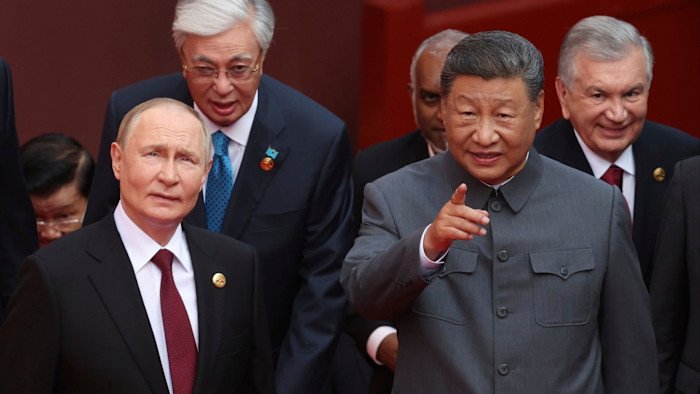
Unlock the White House Watch newsletter for free
Your guide to what Trump’s second term means for Washington, business and the world
The writer is director of the Carnegie Russia Eurasia Center in Berlin
“The one thing you never want to happen is you never want Russia and China uniting. I’m going to have to un-unite them,” Donald Trump bragged on the campaign trail. Fourteen months into his second presidency, Trump’s actions are having precisely the opposite effect. America’s latest war in the Middle East looks set to bring Beijing and Moscow’s asymmetrical interdependence to a whole new level.
While Vladimir Putin’s disastrous war in Ukraine has pushed Moscow deep into Beijing’s embrace — on Xi Jinping’s terms — the Sino-Russian relationship appeared to be plateauing in recent months. Bilateral trade peaked in 2024 at $245bn before falling 6.9 per cent to $228bn in 2025 as a result of a drop in the price of oil, which comprises the bulk of Russian exports, as well as weakening demand for Chinese goods among Russian households thanks to war-induced economic hardship.
Beijing seemed reluctant to further increase its reliance on Russian energy. In 2025, Moscow accounted for 17.9 per cent of Beijing’s oil imports and 27.8 per cent of natural gas. China enjoys the upper hand in the energy relationship — western sanctions translate into significant discounts. However, economic policymakers in Beijing have long advocated for the diversification of supplies to boost China’s energy security, despite the Kremlin’s pitches for a Power of Siberia 2 gas pipeline and additional cross-border oil pipes. So far, Xi has listened to this advice.
Trump’s war in the Middle East and the US naval blockade of Venezuela may change that calculus. In 2025, Venezuela shipped 80 per cent of its crude to China, which constituted up to 4 per cent of Beijing’s oil imports — but not anymore. Even if sales to Beijing resume, they will be strictly controlled by the US. Trump can turn off the tap at will. The war in the Gulf is an even greater problem. Iran supplied 13 per cent of Chinese oil imports, and Beijing sources an additional 42 per cent from other Gulf countries — with nearly all those barrels passing through the Strait of Hormuz, where shipping has in effect ground to a halt.
Damage to Gulf energy infrastructure is mounting, and oil prices are once again hovering around the $100 level. When the hostilities are over, it will take months to carry out repairs and restore normal energy flows. What’s more, given that the current conflict was preceded by a 12-day war back in the summer, Beijing now needs to brace for a scenario in which instability in the Middle East is the new normal.
China’s economy is still heavily dependent on imported hydrocarbons and will be for years to come, despite Beijing’s ongoing switch to renewables. Meanwhile, Chinese energy consumption is projected to jump, driven by the development of AI. In a world where physical supplies of energy are increasingly important, Russia looks like Beijing’s quickest and most obvious hedge. It should come as no surprise, therefore, that the new five-year economic development plan adopted by Beijing this week includes a new gas pipeline from Russia.
If Xi approves the project, it could be completed in under five years since its resource base is a cluster of well-developed gasfields that used to feed Europe. Additional branches of an overland oil pipeline can be completed even faster.
Meanwhile, the Kremlin has no choice but to redirect its energy flows eastward. It faces mounting risks to its westward-oriented energy export infrastructure, including Ukrainian strikes on oil ports and tankers, as well as the EU’s ongoing efforts to seize shadow fleet vessels.
Beijing can be sure that Russia will continue to sell below market prices. The Kremlin’s ability to leverage its growing market share in China will be curtailed by the fact that Moscow has no other big buyers next door.
As for the threat of US tariffs and sanctions, Beijing has the antidote: its grip on critical minerals, which Xi could bring into play just as he did last year when fighting Trump’s tariffs. There is a reason why Trump tariffed India for buying Russian oil but not China, despite it being a bigger buyer.
Trump’s chaotic policy choices are pushing Russia into an unprecedented degree of vassalage to China. Energy trade in renminbi coupled with western sanctions and China’s industrial dominance will leave the Kremlin with few options but to crawl even further into Beijing’s pocket. This cycle is vicious for Russia but virtuous for China. The key policy question is how exactly China will come to use its massive leverage vis-à-vis Russia and what that might mean for the rest of the world.