dailynewsnblog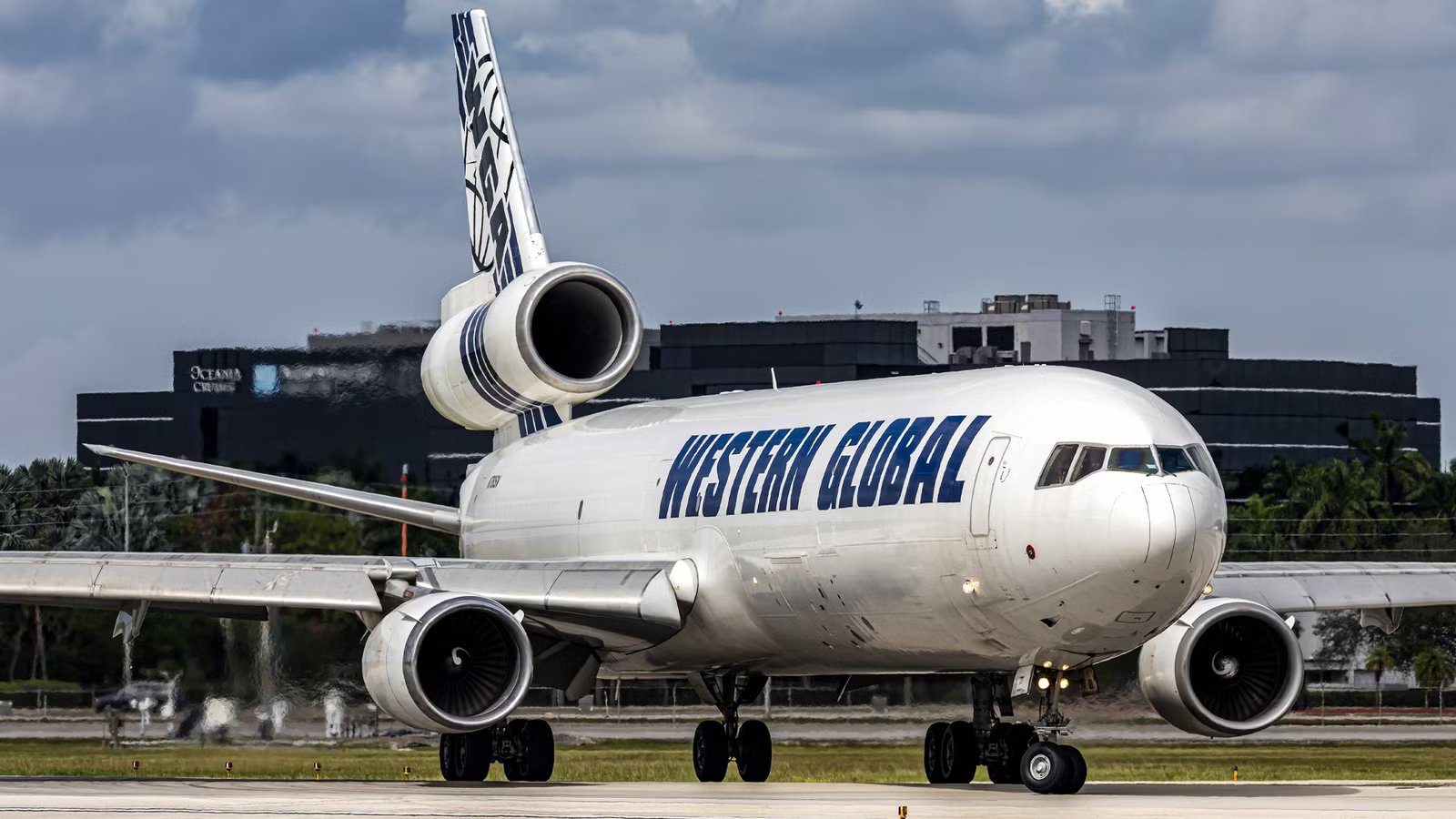
The McDonnell Douglas MD-11 was one of the last wide-body trijet airliners produced for commercial aviation. Developed by McDonnell Douglas as an evolution of the DC-10, the aircraft first entered service in 1990. It was designed to offer greater range, improved avionics, and lower operating costs compared with its predecessor. Although it initially flew with passenger airlines around the world, its long-term legacy would ultimately be tied to airfreight operations.
Cargo carriers valued the aircraft’s high payload capacity and long-range performance, making it ideal for global logistics networks. However, with the continued introduction of newer freighters such as the Boeing 777F and Boeing 767-300F, the MD-11 has steadily disappeared from service. Data compiled by ch-aviation shows that although several aircraft remain tied to airline fleets, the vast majority are now stored rather than actively flying cargo routes.
An Overview Of The Remaining MD-11 Freighter Fleet

The remaining fleet of McDonnell Douglas MD-11 freighters is small compared with its peak years in the early 2000s. During that period, the aircraft was widely used across the global air cargo industry, with dozens of airlines operating the type on long-haul freight routes. Major logistics companies and charter operators relied on the MD-11 because of its high payload capacity and intercontinental range. Over time, however, the number of operators declined.
This was because airlines began replacing older trijet aircraft with newer, more efficient twin-engine freighters. According to fleet records compiled by ch-aviation, roughly 86 MD-11 aircraft are still tied to operators in some capacity. However, the majority of these aircraft are no longer active in commercial service and instead appear in fleet inventories despite not currently flying.
Most of the remaining aircraft are listed as ‘stored,’ meaning they have been removed from operational service and parked for long-term preservation. The fleet consists entirely of freighter variants, primarily the MD-11F, which were either built as cargo aircraft or converted from former passenger models. Although these aircraft remain in airline records, their operational role has effectively ended as cargo carriers transition to newer aircraft with better fuel efficiency and lower operating costs.
The Last Remaining Operators

Only two cargo airlines remain associated with the McDonnell Douglas MD-11F: Fedex Express and Western Global Airlines. Both carriers relied heavily on the aircraft for long-distance cargo operations during the height of the MD-11’s use in global freight networks. As other operators gradually retired their fleets over the past decade, these two airlines became the final companies still connected to the type.
FedEx Express historically operated the largest MD-11 fleet in the world. The aircraft played a major role in the company’s international logistics network, transporting high volumes of cargo between major hubs in North America, Europe, and Asia. As newer and more efficient freighters entered the fleet, FedEx gradually began retiring or storing its MD-11s, reducing the number of aircraft actively used on international cargo routes.
Western Global Airlines, an American cargo airline based in Estero, Florida, also utilized MD-11 freighters for specialized freight missions. The aircraft were often used for ad-hoc cargo contracts and global charter operations, transporting oversized or time-sensitive shipments for governments, logistics companies, and humanitarian organizations. However, according to fleet data from ch-aviation, the aircraft currently associated with the airline are now listed as stored rather than active.

How Many McDonnell Douglas MD‑11s Were Built?
Though only a small number were built, the MD-11 remains one of the most iconic airplanes ever built.
Stored Aircraft Across The Global Fleet

Most of the remaining McDonnell Douglas MD-11 aircraft are now classified as stored. In the aviation industry, a stored aircraft has been removed from active service and parked for long-term preservation rather than daily operations. These aircraft are often placed at airports with dry climates or at dedicated aircraft storage facilities, where environmental conditions help reduce corrosion and deterioration. Even while stored, aircraft are usually maintained at a basic level.
This is so that critical systems are protected, and the airframe can potentially be returned to service if needed. Aircraft can remain in storage for several different reasons. Airlines may keep them as reserve capacity in case cargo demand rises unexpectedly, or while they evaluate whether returning the aircraft to service would be financially worthwhile. In other situations, aircraft are stored while waiting to be sold to another operator, converted for a different role, or dismantled for valuable spare parts.
They might also be permanently retired once maintenance costs and fuel consumption make them no longer economically viable compared with newer freighters. The MD-11 fleet now largely exists in this inactive state, as fleet records compiled by ch-aviation show that the overwhelming majority of the remaining aircraft carry a ‘stored’ status.
This indicates they are no longer participating in day-to-day cargo operations. As newer and more efficient freighters enter airline fleets, the remaining MD-11 airframes represent the final remnants of a once widespread cargo aircraft that has effectively disappeared from regular commercial service.
FedEx Express & The MD-11

For many years, FedEx Express was the dominant operator of the McDonnell Douglas MD-11. The company operated dozens of aircraft at the same time and relied on them to move large volumes of cargo between major international distribution hubs. The trijet’s range and payload capacity made it well-suited for intercontinental freight routes, allowing FedEx to connect North America with Europe, Asia, and the Middle East.
Fleet data compiled by ch-aviation lists more than 60 MD-11 freighters associated with FedEx Express. Examples include aircraft with registrations such as N521FE, N522FE, N523FE, and N528FE. Most of these aircraft are now between roughly 26 and 36 years old, reflecting the production period of the MD-11 during the early 1990s, and nearly all of them are now listed as stored, reflecting the gradual retirement of the aircraft from regular cargo service.
However, a small number, such as N574FE, N603FE, and N613FE, are recorded with a maintenance status rather than long-term storage. While this status means the aircraft are still being actively maintained, it does not necessarily indicate that they are currently operating scheduled cargo flights, as maintenance periods can sometimes precede storage, retirement, or limited future use within the fleet.

The Striking Differences Pilots Notice Between The McDonnell Douglas DC-10 & MD-11
A tale of two jets: the striking differences pilots notice between the McDonnell Douglas DC-10 and MD-11.
Western Global Airlines’ MD-11 Fleet

Western Global Airlines operated one of the final charter fleets of McDonnell Douglas MD-11 freighters in the global cargo market. The airline used these aircraft primarily for international charter operations rather than scheduled freight routes. These missions often included transporting large cargo loads for governments, humanitarian organizations, military logistics, and commercial freight contracts where long-range widebody capacity was required.
Fleet data compiled by ch-aviation lists 14 MD-11 freighters associated with the airline. Examples include aircraft registered as N411SN, N412SN, N415JN, N512JN, and N513SN. Many of these aircraft were originally delivered to passenger airlines during the 1990s before later being converted into dedicated freighters as part of the industry-wide shift from passenger to cargo use.
All the Western Global MD-11 aircraft listed in the dataset are currently classified as stored. This means they have been removed from active service and are parked rather than operating cargo flights. While the airline technically still holds the aircraft in its inventory, the storage status indicates that none of these aircraft are presently flying commercial cargo missions.
UPS Airlines’ MD-11 Retirements

Another major cargo operator that previously relied on the McDonnell Douglas MD-11 was  UPS Airlines. During the late 1990s and early 2000s, the aircraft formed an important part of the company’s long-haul cargo fleet, helping move large volumes of packages across its international network. With its long range and large payload capacity, the MD-11 was well-suited for high-demand routes linking major UPS hubs in North America with destinations in Europe and Asia.
At the time, the aircraft played a key role in expanding UPS’s ability to deliver overnight and time-sensitive shipments across continents. However, the fleet dataset now lists numerous UPS MD-11 freighters as retired, including N250UP, N251UP, N252UP, N253UP, and N254UP. These aircraft were gradually withdrawn from service over time as UPS began modernizing its fleet with newer cargo aircraft. In many cases, the retired MD-11s have been replaced by more efficient freighters.
With that being said, undoubtedly one of the driving factors behind the retirement of many ‘modern’ MD-11 Freighters is the recent accident involving a UPS McDonnell Douglas MD-11 on November 4, 2025. The jet crashed shortly after departing Louisville Muhammad Ali International Airport in Louisville, Kentucky, United States. The aircraft, an MD-11F registered as N259UP, had just taken off for Daniel K. Inouye International Airport in Honolulu when its left engine separated from the wing during the initial climb.
While the MD-11 once served as a backbone for several major cargo carriers, including FedEx Express, its role has steadily declined in recent years. Today, the aircraft remains an important part of aviation history, but its presence in active commercial cargo service is rapidly diminishing as airlines continue transitioning to modern freighter fleets.