dailynewsnblog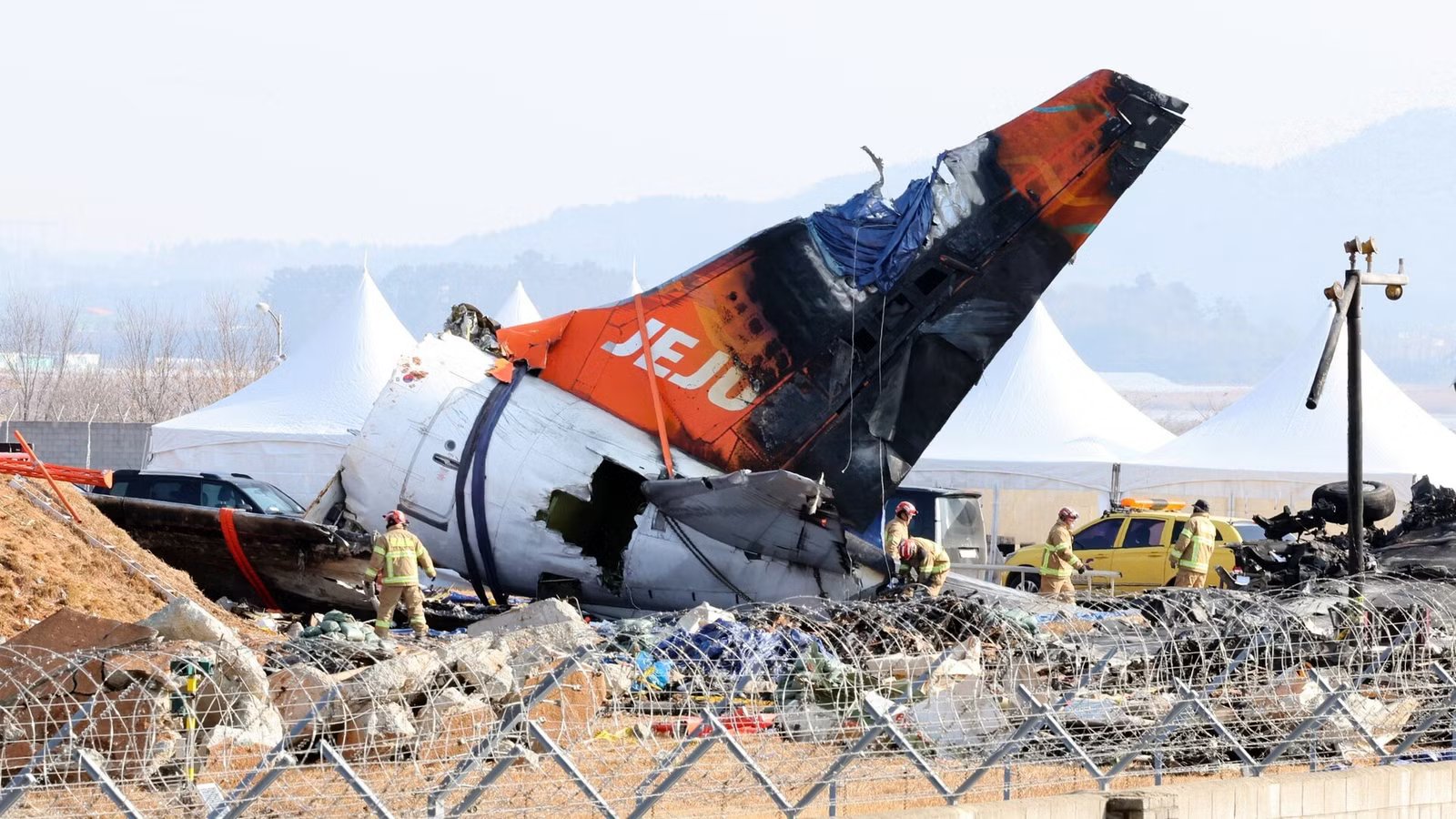
The crash of Jeju Air Flight 2216 at Muan International Airport on December 29, 2024, was initially understood as a disaster shaped by an onboard emergency, a belly landing, and a runway overrun. But the latest audit findings in South Korea suggest that the deadliest part of the sequence may have been waiting at the end of the runway: a concrete-supported localizer mound that the state auditor says was built that way to simply save on construction costs.
That changes the focus of the story. Instead of looking only at what forced the  Boeing 737-800 into an emergency landing, attention is now shifting to whether a survivable overrun became a catastrophe due to poor infrastructure design. As Simple Flying reported in January, a government-commissioned simulation indicated that the belly landing was survivable, and that the aircraft could have slid to a stop had the mound not been there.
It is now becoming clear that while the incident itself was caused by a bird-strike and the pilots subsequently shutting off the wrong engine, it was the non-compliant concrete structure that was the decisive factor in the deaths of 179 people.
The Mound That Changed Everything

Jeju Air Flight 2216 struck a flock of birds while attempting to land at Muan International Airport, and was forced to make a landing with its gear still retracted. It slid down the 2,500-meter-long runway and hit the concrete-reinforced mound containing the landing signal array at the end of the tarmac. The aircraft burst into a fireball upon impact, killing all but two flight attendants who were seated at the rear of the aircraft.
The audit’s most striking conclusion is that the mound at the end of the runway did not meet safety standards and was only built as a cost-saving measure. According to the report issued by the Board of Audit and Inspection (BAI), the terrain where the runway end safety area was constructed was sloping. Instead of flattening the area — which would have required significant earthworks and higher expenditure — officials chose to install the localizer on a concrete structure elevated above the runway.
The report said further:
“This reduced the required volume of earthwork, and so saved costs. The resulting height difference with the runway’s highest point was then addressed by building an embankment, which was later reinforced with concrete.
This finding turns the runway-end structure from a background detail into one of the most consequential elements of the entire accident. Localizer installations — the radio navigation systems that help an aircraft line up with the centerline of the runway during approach and landing — are not supposed to function like immovable crash barriers. Moreover, the issue was not the presence of navigation equipment itself, but the fact that it was supported by a substantial concrete embankment in an overrun area.
After the crash, South Korea said it would remove the concrete embankment at Muan and replace it with a safer structure, reinforcing how seriously the barrier was viewed by the authorities themselves. But the survivability question is what makes the finding even more serious.
Reuters reported that a structural engineering simulation concluded the crash could have been survivable without the concrete barrier, and that a breakable structure would likely have significantly reduced the severity of the accident. In other words, the emergency landing was catastrophic, but the fixed obstacle is what made it unsurvivable.
A Long Paper Trail Of Warnings

The audit also points to a timeline that is hard to ignore. It says the mound was approved in 2003 without a proper risk assessment, and that Korea Airports Corporation later requested a review in 2007 over concerns with its construction. Yet no meaningful changes were made to the structure to ensure greater safety, effectively dooming the Jeju Air aircraft nearly two decades later.
That is what gives the story its real weight. This was not an obscure hazard created shortly before the accident. It was legacy infrastructure with a long institutional history, one that appears to have moved through approvals, concerns, and later scrutiny without ever being fundamentally corrected.
A Timeline Of Events | |
|---|---|
Date | Event |
2003 | Transport ministry approved the mound/localizer arrangement without a risk assessment, so the design entered service without a full safety review |
2007 | Korea Airports Corporation raised concerns, and requested a review of the mound’s construction, but no changes were made. |
2019 | During the airport modernization, the mound was reinforced with concrete, ensuring the non-compliant design was not just preserved, but strengthened. |
December 2024 | Jeju Air Flight 2216 belly-landed, overran the runway, and struck the concrete-supported localizer structure, killing 179. |
January 2025 | South Korea officially recognizes that the barrier was a major safety problem, and says that it will remove the concrete embankment at Muan and address similar structures elsewhere. |
January 2026 | A government-commissioned simulation indicates the crash could have been survivable without the concrete structure. |
March 2026 | The state auditor says the mound had been built to save construction costs and found similar non-compliance at other airports. |
In aviation, disasters are rarely the result of one single failure. But the audit suggests this case may involve a particularly uncomfortable contributing factor: a design decision that was known, reviewable, and potentially remediable long before the accident happened. That shifts the debate from whether the crew could have avoided the overrun to whether the airport environment should have been more forgiving once the overrun occurred.

Report: Jeju Air Crash Was Survivable Without Concrete Runway Wall
As per reports, the concrete wall does not comply with safety standards and has been deemed unsafe for years.
An Issue At Multiple Korean Airports

One of the most damaging details in the audit is that the mound was reportedly reinforced in 2019 as part of an airport modernization project. That means the structure was not simply inherited from a distant past and forgotten. Instead, it remained active within the airport system and was strengthened during a period when safety and infrastructure resilience should have been under close review.
That creates a deeply uncomfortable contrast. Modernization projects are meant to reduce risk, not entrench it. Yet the audit suggests that public investment may have gone into making a hazardous runway-end structure more robust shortly before it became the object struck in South Korea’s deadliest domestic air disaster.
The audit also exposed that the runway-end safety problem was embedded across multiple South Korean airports, and not confined to a single site. Public reporting has identified 14 similar localizer structure concerns at seven other airports in Gwangju, Yeosu, Pohang Gyeongju, Gimhae, Sacheon, and Jeju. All failed to meet the necessary standards, and will require modifications to similar foundations.
That leaves the Jeju Air crash as not just a story about a tragic emergency landing, but about how a cheaper design choice, left in place for years, may have determined the final human cost when everything else had already gone wrong.

![New 20-Hour Flights: Qatar Airways Unveils This Ultra-Long Route [Full Schedule]](https://dailynewsnblog.com/wp-content/uploads/2026/04/qatar-airways-boeing-777.jpg)