dailynewsnblog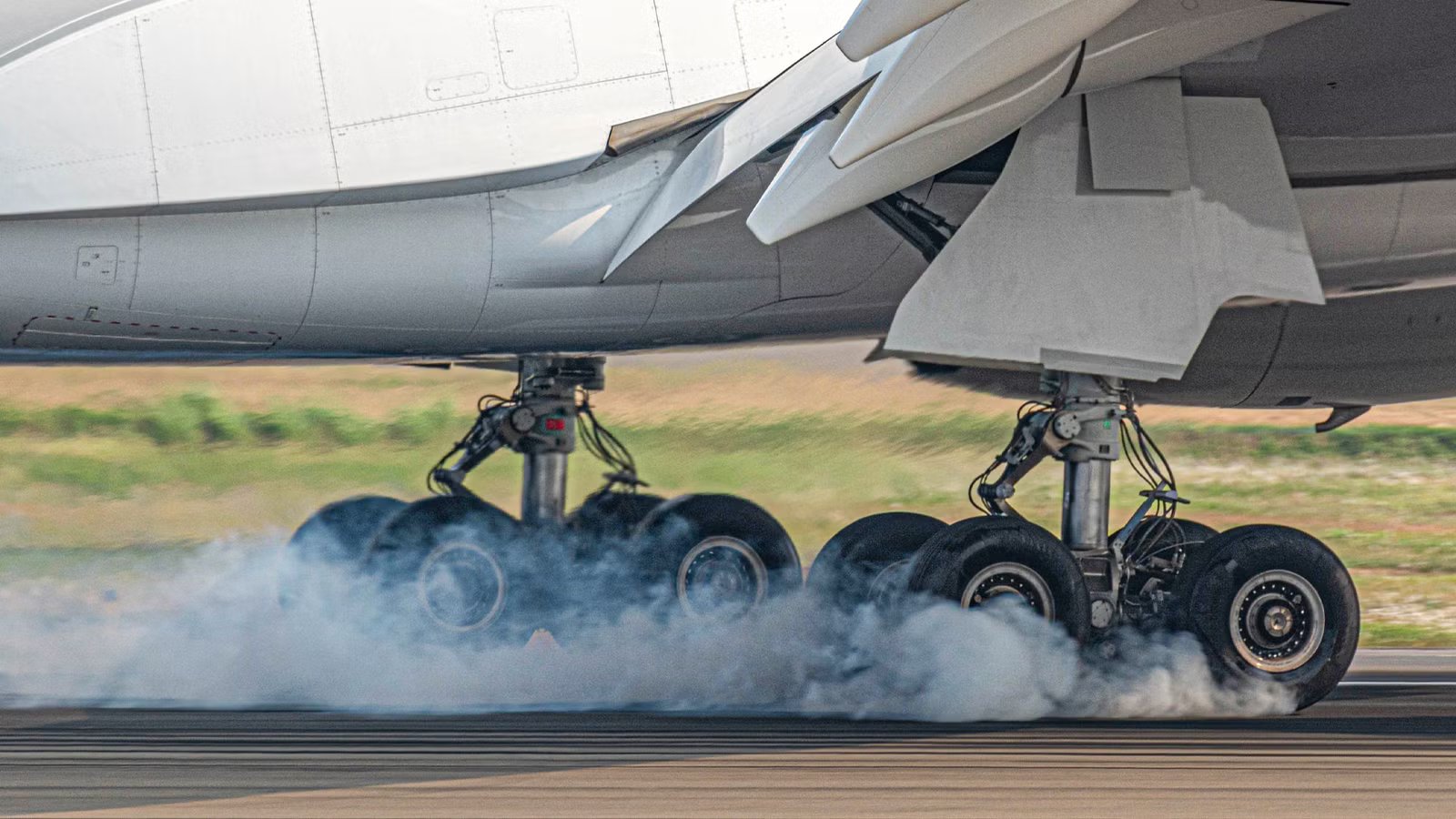
The Airbus A350-900 and the larger Airbus A350-1000 might look like identical twins at different growth spurts. However, for planespotters and aviation engineers, the real story of their design evolution is told beneath the wings. While both aircraft share the same sleek bandit mask cockpit and graceful carbon-fiber curves, their undercarriages are fundamentally different. The -900 relies on a standard four-wheel main landing gear bogie, whereas the stretched -1000 sits on a much more robust six-wheel configuration. This guide explores why that extra pair of tires serves as a mechanical necessity driven by weight, physics, and the delicate nature of airport infrastructure.
Understanding this hardware shift requires looking at the A350-1000 not as a simple stretch, but as a heavy-hitting evolution of the original platform. As Airbus sought to compete with the legendary Boeing 777-300ER, they had to significantly increase the aircraft’s payload and fuel capacity. From the engineering of the Safran-built struts to the way these wheels interact with the runway during a high-speed touchdown, the transition from four to six wheels is a masterclass in modern aerospace scaling.
Insight Into How Weight Is Distributed

The primary driver behind the A350-1000’s six-wheel bogie is a massive jump in maximum takeoff weight. While the standard A350-900 typically operates with a certified ceiling of around 283 tonnes, the -1000 variant pushes that figure to a staggering 322 tonnes. This 39-tonne difference is equivalent to carrying roughly eight additional fully grown elephants on every takeoff. To manage this extra mass without compromising safety or structural integrity, Airbus had to rethink how the aircraft’s weight is transferred into the airframe.
The -1000 is designed to carry more passengers and more fuel over similar, if not longer, distances than its smaller sibling. By adding a third axle to the main landing gear, Safran Landing Systems was able to ensure that the footprint of the aircraft remains manageable. Without those extra tires, the point-pressure on each wheel during a heavy landing would exceed the structural limits of the landing gear struts themselves, potentially leading to catastrophic failure under the stress of a heavy landing.
The A350-1000’s engines, the Rolls-Royce Trent XWB-97, produce significantly more thrust to get that extra weight off the ground than the -900. This higher thrust environment creates unique torque and vibration profiles during the takeoff roll. The six-wheel bogie provides a more stable platform for the aircraft as it accelerates, ensuring that the heavy tail section is properly supported during the critical rotation phase when the nose lifts off the runway.
Protecting What Lies Underneath

Flickr
The decision to move from a four-wheel to a six-wheel bogie is essential to help protect the ground beneath the aircraft. Every airport runway has a specific load-bearing capacity, often measured by the pavement classification number. If an aircraft’s weight is too concentrated on a small area, it can literally crack or dent the runway surface over time. By utilizing six wheels, the A350-1000 spreads its 322 tonnes across a larger surface area, ensuring its aircraft classification number remains within the limits of global long-haul hubs.
This distribution of pressure is a critical factor for airlines operating into older or secondary international airports that may not have the ultra-reinforced concrete found at major hubs like  London Heathrow Airport or
  Tokyo Haneda Airport. A four-wheel gear on an aircraft as heavy as the -1000 would result in a footprint pressure so high that the plane would be restricted from landing at dozens of major destinations. By adding that third axle, Airbus was able to lower the pressure per square inch, allowing the largest A350 variant to be just as versatile as its lighter predecessor.
The additional wheels also provide a massive boost in braking performance and heat dissipation. When a 300-tonne aircraft lands at 140 knots, the kinetic energy converted into heat by the brakes is astronomical. The -1000’s six-wheel gear allows for 12 individual carbon brake disks instead of the 8 found on the -900. This increased surface area means the aircraft can stop more efficiently, and the brakes cool down faster, which is vital for maintaining short turnaround times at busy gates.

Why The Airbus A380’s Main Landing Gear Needs 20 Tires
From mass to mechanics: why the A380 needs more wheels than a semi-truck.
Why Does The Gear Look Different?

The transition from the four-wheel bogie to the six-wheel system required a fundamental redesign of the aircraft’s lower compartments. To accommodate the larger Safran Landing Systems gear, Airbus engineers had to lengthen the landing gear bay by exactly one frame. This architectural change was necessary to ensure that the three-axle bogie could retract fully into the fuselage without encroaching on the cargo hold or critical fuel systems. This structural shift represents one of the most significant differences between the two airframes, despite the common DNA.
Beyond the physical size of the bay, the Safran-designed struts for the A350-1000 utilize advanced high-strength materials, including a higher percentage of titanium and specialized steel alloys. These materials are chosen specifically to handle the increased bending moments caused by the longer fuselage, meaning that during the rotation phase of takeoff, the main landing gear acts as a pivot point. Importantly, the -1000 is seven meters longer than the -900, and the leverage exerted on the gear is significantly higher. The six-wheel design provides a more stable foundation, reducing the shudder that can sometimes occur when a long-fuselage aircraft rotates at high speed.
Feature | A350-900 (Safran) | A350-1000 (Safran) |
Bogie Type | 2-Axle (four wheels) | 3-Axle (six wheels) |
Bay Length | Baseline | Baseline + 1 Frame |
Extension | Distinct Forward Tilt | Level / Flat Hang |
Braking Tech | Digital Brake-by-Wire | High-Capacity Brake-by-Wire |
One of the most fascinating aspects of this engineering feat is the tilt of the gear when extended in the air. Pilots and planespotters often notice that the A350-900’s gear hangs with a pronounced forward tilt, while the A350-1000’s gear remains almost perfectly level. This isn’t just for show, because the level hang of the six-wheel bogie is actually optimized for the -1000’s specific approach angle. By keeping the wheels level, Airbus ensures that all 12 tires make contact with the runway in a more synchronized sequence, providing smoother deceleration and reducing the initial thump of touchdown for passengers in the back.
Keeping Landings Safe

The shift to a six-wheel bogie alters the flare and touchdown characteristics of the A350-1000 compared to its smaller sibling. During the final seconds of flight, a pilot must manage the energy of over 230 tonnes as it transitions from the air to the asphalt. The 3-axle configuration provides a much larger cushion during this transition. Because the weight is distributed over 12 tires, the initial impact forces are dampened more effectively, which is particularly beneficial when operating on shorter or more restrictive runways where a precise aiming point is required.
From a pilot’s perspective, the six-wheel gear offers enhanced directional stability during the high-speed rollout, especially in challenging crosswind conditions. When the aircraft touches down, the sheer amount of rubber in contact with the runway provides a significant increase in mechanical grip. This grip, combined with the advanced brake-by-wire system, allows the A350-1000 to decelerate with remarkable smoothness. Interestingly, despite the massive size of the gear, Airbus has managed to maintain a common type rating, meaning pilots can transition between the -900 and -1000 with minimal additional training, despite the hardware differences under their feet.
The increased number of wheels also plays a vital role in thermal management. During a rejected takeoff or a heavy landing at a high-altitude airport, the brakes generate immense heat that can exceed 800°C. By spreading this thermal load across 12 carbon brake units, the A350-1000 reduces the risk of brake fade and shortens the mandatory cooling period before the aircraft can safely take off again. This efficiency is a quiet but powerful benefit for airlines, as it minimizes the time the aircraft spends sitting at the gate, directly impacting the profitability of long-haul routes.

Here’s How Much More The Airbus A350-1000 Costs Compared To The A350-900
The price difference between the two variants.
More Gear Means More Drag?

The evolution from the -900’s four-wheel gear to the -1000’s six-wheel powerhouse is a testament to the innovative design philosophy of the A350 family. Airbus had to figure out how to increase the aircraft’s physical footprint and weight-bearing capacity while maintaining the flight deck commonality that airlines crave. The answer was to develop a gear system that looks drastically different on the outside but responds almost identically to pilot inputs from the cockpit. This ensures that an airline can swap crews between the two variants without the need for extensive, costly retraining.
A common question among aviation enthusiasts is whether the extra hardware on the -1000 creates a significant drag penalty. While it is true that a six-wheel bogie is heavier and physically larger, the aerodynamic impact is mitigated by the highly optimized landing gear doors and the clean retraction sequence into the lengthened bay. In fact, the efficiency gains from the Rolls-Royce Trent XWB-97 engines more than offset the slight weight increase of the landing gear system. This balance of power and support is what allows the -1000 to remain one of the most fuel-efficient aircraft in the sky, rivaling the performance of the Boeing 777-300ER while offering a much quieter cabin experience.
The six-wheel gear also introduces a layer of operational redundancy that is particularly valuable for ultra-long-haul operators. With 12 tires on the main gear, the aircraft has a higher tolerance for a single-tire failure during the takeoff roll compared to an eight-tire system. If a tire were to blow at high speed, the remaining five tires on that side can more easily absorb the load of a 322-tonne aircraft. This increased margin of safety is a subtle but vital benefit for flights departing from hot-and-high airports or those operating at the very edge of the aircraft’s range limits.
Forming The Basis For The Next Generation

The evolution of the Airbus A350 undercarriage doesn’t end with the -1000. In fact, it serves as the blueprint for the next generation of heavy-lift efficiency. As the aviation industry shifts toward 2026 and beyond, the six-wheel bogie is becoming the foundation for the A350F, which is set to dominate the global cargo market. This variant will utilize a reinforced version of the Safran triple-axle gear to support a massive 111-tonne payload, proving that the move to more tires was a strategic long-term investment in the airframe’s modularity.
The future of these landing systems is also trending toward smart integration and sustainable materials. Engineers are currently testing fiber-optic sensors within the 3-axle struts to provide real-time data on structural stress and hard landing impacts, potentially eliminating the need for some manual inspections. Furthermore, the 12-wheel setup on the -1000 is a prime candidate for the introduction of electric green taxiing motors. By placing small motors in the hubs of the extra wheels, the aircraft could move from the gate to the runway without starting its massive engines, significantly cutting ground emissions and fuel burn.
Ultimately, the difference in tire count between the A350-900 and the A350-1000 is a masterclass in purposeful engineering. While the four-wheel gear of the -900 remains the norm for mid-sized long-haul efficiency, the six-wheel extension of the -1000 has allowed the A350 family to scale into the ultra-heavy category. As we look toward future variants and the potential for an even larger A350-2000, the lessons learned from this 12-tire configuration will be the key to keeping the world’s most advanced widebody fleet safely connected to the Earth, no matter how heavy the load.