dailynewsnblog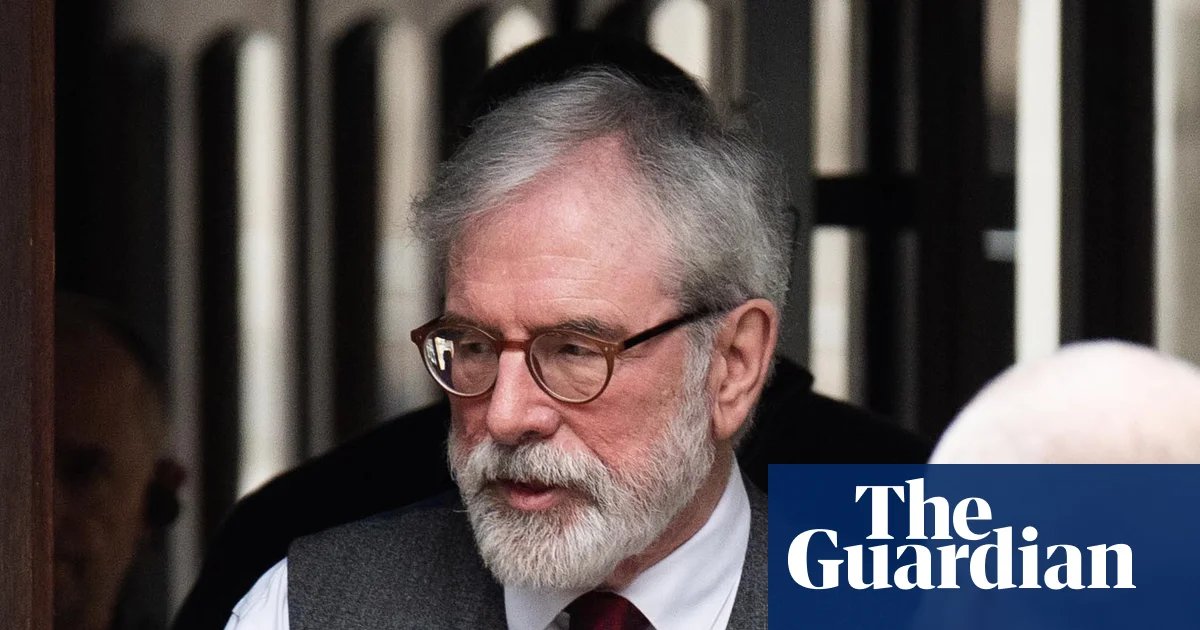
Gerry Adams is as culpable for IRA bombings on the UK mainland as the individuals who planted and detonated the devices, the high court has heard at the beginning of a civil trial.
The former Sinn Féin leader is being sued for symbolic “vindicatory” damages of £1 each by John Clark, Jonathan Ganesh and Barry Laycock, who were injured respectively in the 1973 Old Bailey bombing, and the London Docklands and Manchester bombings in 1996.
They allege that Adams, who is credited with helping to bring about the Northern Ireland peace process, “was an instrumental force in the organisation of the PIRA [provisional IRA] and building of the two-strand attack – ArmaLite and the ballot box. A foot in each camp.”
Opening the claimants’ case in London on Monday, Anne Studd KC, said in written submissions: “Their focus is to shine a light upon the involvement of the defendant in the PIRA in the course of that conflict and to prove on balance of probabilities that he [Adams] was so intrinsically involved in the PIRA organisation that he is as culpable for the assaults giving rise to these claims as the individuals who planted and detonated the bombs.”
She added: “There is no doubt that the defendant contributed to the peace in Northern Ireland, but the claimants say that on the evidence he also contributed to the war.”
Studd told the court that Adams admitted to his involvement with the IRA to a special branch officer after being arrested in 1972 and, in the same year, attended two meetings with government officials “as a member of PIRA and had authority to act on the organisation’s behalf”.
The claimants’ case is also relying on evidence from IRA volunteers including Dolours Price, one of nine individuals imprisoned in 1973 for the Old Bailey bombing, as well as Troubles-era intelligence officials.
Additionally, Studd claimed that, while detained under internment in the 1970s, Adams began writing a weekly column for the Republican News under the pen name Brownie, including a 1976 article that stated: “Rightly or wrongly, I’m an IRA volunteer.”
Adams, 77, who was in court, and is due to give evidence next week, has always denied being a member of the IRA.
In written submissions, his lawyer, Edward Craven KC, said the claimants had waited decades too long to bring the case, adding: “Even if the claim were not bound to fail on limitation grounds, the claim must inevitably fail on the merits. The defendant strenuously denies any involvement in the bombings.
“The claimants bear the burden of proving his factual and legal responsibility. In view of the gravity of the allegations (‘the most serious allegations imaginable’) this is a heavy burden, which could only be discharged through the presentation of cogent and compelling evidence. The evidence which the claimants intend to rely on at this trial comes nowhere close to this.”
Craven said had law enforcement authorities believed there was reasonable suspicion that Adams was involved, it was “extraordinary and inexplicable” that they never arrested him, while many republicans, including Price, harboured deep hostility towards the former Sinn Féin leader president because they were bitterly opposed to the peace process.
The court was being asked, said Craven, “to find a senior political figure liable for exceptionally serious wrongdoing committed between more than a quarter and more than half a century ago, on the basis of multiple and predominantly anonymous hearsay evidence, in the context of a deeply partisan conflict which has spawned countless personal and political grievances, schisms and animi, as well as a multitude of competing narratives about key events”.
He said that even if – as claimed but denied – Adams was a member of the IRA army council, “the mere fact of that membership would not in itself be sufficient to render him liable for bombings carried out”.
The trial continues.