dailynewsnblog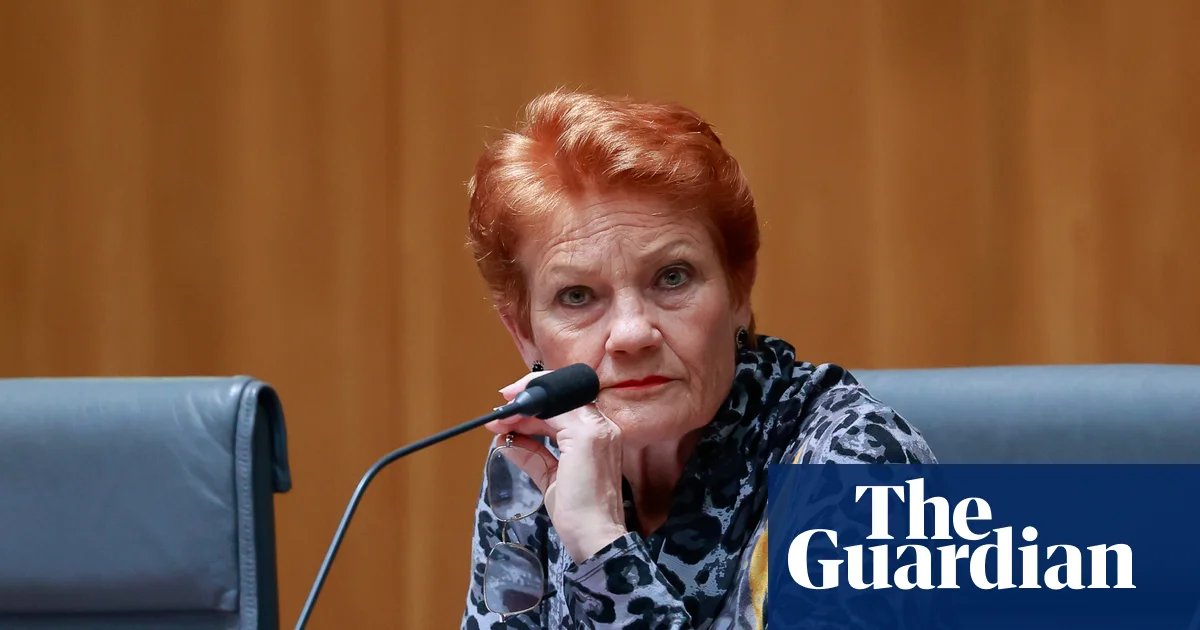
Pauline Hanson accessed a taxpayer-funded rebate scheme to install solar power on her Queensland home, despite calling for an end to public subsidies for renewable energy projects.
Information from the Clean Energy Regulator, released under freedom of information laws, shows the One Nation leader among three conservative federal MPs to access the small-scale renewable energy scheme (SRES), despite being a strident critic of government subsidies for net zero policies.
Nationals’ senator Matt Canavan and MP Kevin Hogan have also benefited from the scheme, which offers financial incentives to install systems like rooftop solar, solar batteries, solar water heaters or air-sourced heat pumps.
Independent MP Zali Steggall blasted the “breathtaking” hypocrisy of the conservative MPs for accessing the scheme while publicly undermining policies aimed at achieving net zero emissions.
Sign up: AU Breaking News email
A spokesperson for Hanson said Steggall “obviously hasn’t read One Nation’s energy policy”, released last December. In it, the party offered “in principle” support of the SRES.
“In other words, One Nation and Senator Hanson support rooftop solar as one of the few ways households can act to reduce their energy bills,” the spokesperson said.
“Of course, this wouldn’t be necessary if Labor and Steggall’s obsession with large-scale renewables wasn’t impoverishing Australian households with record high electricity bills.”
However, Hanson has previously also taken aim at the SRES, criticising the cheaper home batteries program that is run through the scheme.
“Only One Nation would stop these sneaky takeovers in the name of net zero, and simply make sure you get the cheapest electricity possible whenever you turn on the lights,” Hanson said in a press release last year.
A party spokesperson declined to clarify whether its support for the SRES extended to the home battery program, which Hanson has criticised.
To access the SRES incentive, those who install eligible systems claim “small-scale technology certificates” (STCs) that work as a subsidy to reduce the upfront cost of installation.
According to the regulator, most system owners assign the right to trade these STCs to an agent – usually the retailer – in exchange for a discount or delayed cash payment on their solar system.
In 2025, 99.6% of STCs went to an agent, rather than a system owner.
While the value of Hanson’s subsidy was unclear – as it varies dependent on size and location – the average 10kw solar system installed in Queensland in 2025 would be expected to generate a $2,760 rebate, based on the average STC price of $40.
The information, released by the Clean Energy Regulator to Steggall, showed that a small-scale certificate application was made for a residential property owned by Pauline Hanson in Queensland in April last year, with the application lodged in her name. It was approved.
Canavan had an STC application approved in 2020, while Hogan had one approved for a property in his name in 2019.
The moderate Liberal senator Andrew Bragg – who has been a supporter of action to address the climate crisis – has also benefited from the scheme, while another 13 conservative critics subject to the FoI were found not to have accessed the program.
In a 30-second clip posted to her party’s Facebook page last August titled “Debunking the anti renewables myth”, Hanson revealed that she had installed solar panels on her home.
“I am not anti-renewables. Actually I put panels on my roof at home this year, so I have put them on myself,” Hanson said.
“I am anti renewables and putting solar panels … hundreds of thousands, or millions [of them], on agricultural land.”
The interviewer then summarises: “So Pauline Hanson is for solar panels on roofs, for keeping coal-fired power stations open, and pro-nuclear.”
However, Hanson has been a fierce critic of government subsidies for renewables, calling for them to be wound up in a Senate speech last year.
“Billions of dollars of taxpayer subsidies for windfarms and solar panels over the past two decades have only resulted in massive increase in the cost of energy,” she said.
Canavan, one of the Nationals’ most strident critics of subsidies for renewables, last year told the Senate that Australians were being subject to a “green energy scam”.
“Time and time again, there seems to be this disconnect: we say that renewable energy is the cheapest form of power; yet the more renewable energy is installed, the higher everyone’s power prices go.”
Canavan defended using the subsidy saying he was “not against renewable electricity or electric vehicles”.
“But I do not think the government should be taking from the poor to pay rich people to have these things,” he said.
“I agree with Kerry Packer. I am going to minimise my contribution to governments as much as possible because they’re not spending it well enough to deserve donations. Zali wants higher taxes. Has she made some voluntary contributions?”
Hogan has also taken aim at net zero policies, saying the “reckless” ambition means “more blackouts and higher power bills.”
Defending his use of the SRES, Hogan said he had participated in “a very successful Coalition government policy” that had helped with the uptake of rooftop solar, but he expressed concerns about current subsidies for renewables.
“Taxpayer support should be targeted, transparent and deliver clear value for money. Not rely on large, open-ended subsidies,” he said.
Steggall, who has also benefited from the SRES, criticised the MPs who had attacked subsidies while at the same time benefiting from them.
“Despite the hollow right-wing rhetoric, the benefits of renewable energy are appreciated and enjoyed across the political spectrum,” Steggall said.
“The hypocrisy is breathtaking. If renewable energy is supposedly so harmful, why are these politicians lining up to benefit from it, and taking public subsidies in the process?”