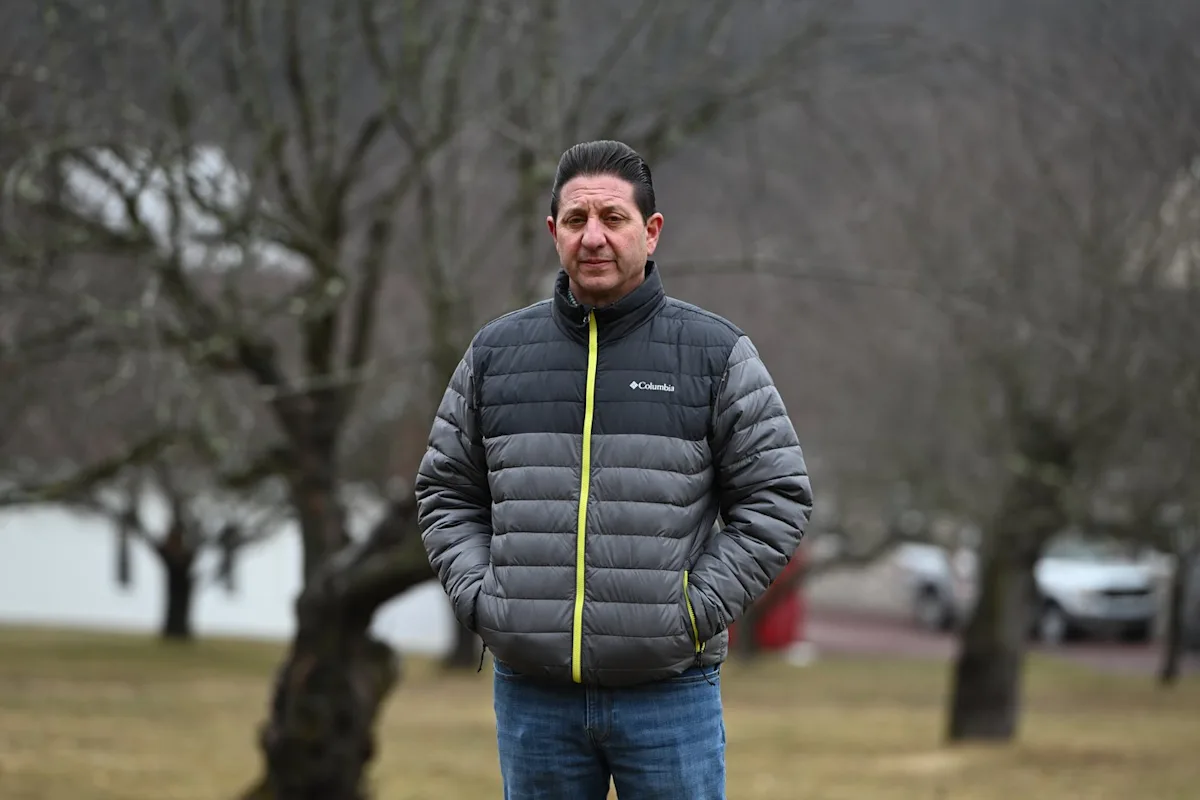
SUGARLOAF, Pa. (AP) — For John Zola, the 40 acres were like a paradise: apple orchards tucked into northern Pennsylvania’s rolling hills, a barn, meadows and more than enough land for four houses: one for himself and his wife and each of his three adult children.
It’s been “hell,” however, since a contractor hired by the local power utility knocked on Zola’s door in late 2024 and informed him that it planned to build a 500-kilovolt power line through his property.
The 240-foot metal towers would reach 10 times as high as the century-old apple trees they’d plow through and loom over the Zolas’ homes and the basketball court and swimming pool where his grandchildren play.
This line and others like it are being planned in accelerating numbers in the United States to deliver power, sometimes across hundreds of miles, to enormous data centers run by the world’s biggest tech companies.
Although advances in artificial intelligence are seen by President Donald Trump as critical to the nation’s economic and national security, their energy needs are threatening to overwhelm the power grid — and people like Zola are caught in the middle.
The local utility, PPL, said it did everything it could to balance the impact on people with its obligation to deliver electricity and protect grid reliability. But to Zola, all they care about is money.
“They don’t look at whose lives they are destroying, whose property they are destroying,” Zola said.
Big power lines, big data centers
These high-voltage power lines are the latest front line in the battle over tech firms’ massive operations.
Angry local opposition has sprouted against dozens of the behemoth data centers amid fears of rising electricity costs and irreparable damage to their communities.
Opponents of transmission projects are similarly motivated: they say the lines are intruding on the sanctity of private land and threatening long-lasting harm to sensitive public lands, farms, property values and pristine waterways — all for electricity that they don’t think benefits them.
Transmission projects have always faced challenges and yearslong permitting processes, and two decades of relatively flat power demand didn’t inject much urgency.
But analysts say the grid remains inefficient, aging and, with demand spiking, on the verge of causing widespread blackouts on the coldest or hottest days. Utilities contend that any new transmission line — even those driven primarily by large customers, like data centers or industrial sites — benefits everyone by adding capacity to the grid.
Some members of Congress want to exclude lines from state or certain environmental reviews, while some tech companies are trying to build their own power plants, or next to one, in part to avoid a quagmire.
These transmission projects aren’t local power lines on wooden poles. Rather, these are lines on steel towers five or six times as tall, carrying power in bulk across long distances.
Some — like the Sugarloaf project that could cross Zola’s property — require 200-foot-wide corridors.
Caught in the middle
Utility giants are forecasting that their spending growth will be driven primarily by transmission projects, with transmission spending projected to double to nearly $50 billion a year from 2019 to 2028.
But the expansion is eliciting opposition from landowners, conservationists, local officials, consumer advocates and even states.
In Texas’ Hill Country, the Hill Country Preservation Coalition sprang up against the construction of the southernmost of three 765-kilovolt lines — the highest voltage used in the United States — that Texas regulators commissioned to cross the state in east-west “superhighway” corridors.
The coalition’s founder, Jada Jo Smith, calls it a “Goliath” that will be nearly impossible to defeat. To at least minimize the damage, the coalition is pressing state regulators to adopt a different, slightly longer path that follows existing highway corridors.
“Why would you choose a route that would potentially harm our most iconic rivers that we have left in the state of Texas?” Smith said.
‘These are real dollars’
Pennsylvania’s state consumer advocate, Darryl Lawrence, is protesting a $1.7 billion proposed line spanning more than 200 miles from West Virginia across half Pennsylvania.
He questions whether cheaper alternatives are available, whether the data center demand it’s designed to serve will truly materialize and why grid operators want to import power into a state that, as a large power producer, normally exports it.
West Virginians are also fighting a pair of proposed transmission lines connecting coal-fired power plants there to northern Virginia, home to the so-called “data center alley.”
In the Midwest grid territory, a $22 billion transmission package is embroiled in a monthslong fight, as utility regulators in North Dakota, Montana, Arkansas, Mississippi and Louisiana urge federal regulators to block it.
“I think you may see more of those,” said Todd Snitchler, president and CEO of the Electric Power Supply Association, which represents independent power plant owners. “These are real dollars and consumers are paying a lot of attention.”
The Indiana-based Midcontinent Independent System Operator told federal regulators in a filing that the lines are necessary to address growing demand from manufacturing and data centers, and that the need for new power transmission “has never been greater.”
‘There’s no amount of money for me’
In eastern Pennsylvania, Amazon and other developers have so many data center projects in the works that PPL projected its peak electricity demand will more than triple by 2030.
PPL, which serves more than 1.5 million electric customers, argues that the 12-mile Sugarloaf project will minimize disruptions by reusing and expanding a power line corridor that once carried a since-removed residential line, rather than establishing a new corridor.
The utility has offered to pay property owners to access their land, but landowners worry that, if they don’t accept, PPL will go to court to use eminent domain to force a settlement.
The new line would run perhaps 100 feet from where Zola’s grandkids sleep at night. In recent days, Zola said holdout landowners got higher cash offers from PPL.
“My offer went from $17,000 to $85,000,” Zola said. “Just like that. And there’s no amount of money for me. And when you come here, you’ll understand why.”
___
Follow Marc Levy on X at: https://x.com/timelywriter
Marc Levy, The Associated Press


 dailynewsnblog