dailynewsnblog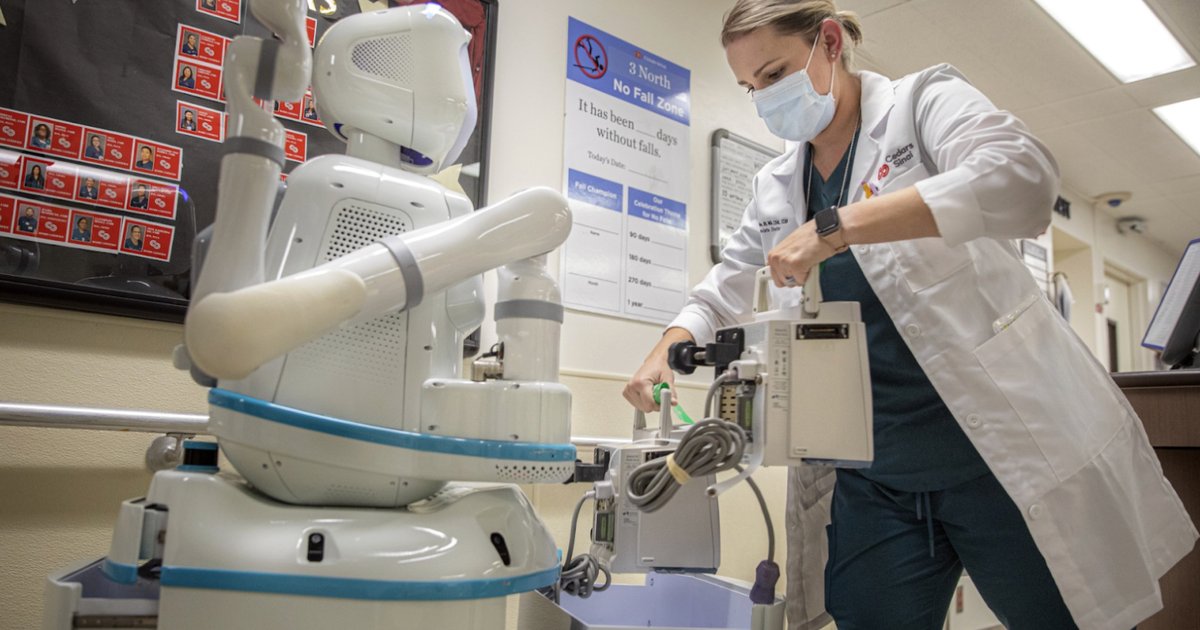
At Cedars-Sinai Medical Center in Los Angeles, the nurse assistant stopped by a patient’s room to pick up some lab samples while dropping off toiletries. Then, as the helper’s pixilated blue eyes flashed a heart sign to indicate the task had been completed, it summoned an elevator and quietly rolled off to the hospital’s supply room to carry on with its next mission.
Meet Moxi, a robot that is helping medical staff at Cedars-Sinai and roughly two dozen other hospitals around the U.S.
“I don’t have to go take my 10,000 steps down into the belly of the hospital to go find things and get it for my patient,” Melanie Barone, an associate director at Cedars-Sinai, told CBS News.
“Robots are no longer so sci-fi,” Barclays analyst Zornitsa Todorova said recently at the World Economic Forum in Davos, Switzerland.
Moxi saves hospital staff time and helps them focus on patient care, according to Diligent Robotics, the Austin, Texas-based maker of Moxi. The company told CBS News there are Moxis at 25 hospitals nationwide.
David Marshall, the chief nursing executive at Cedars-Sinai in Los Angeles, said the 900-bed hospital started using Moxi two years ago to help with backend work, such as moving linens and retrieving medication and patient belongings. Today, the medical facility uses three of the robots.
“We’ve seen positive, emotional responses that we see from patients, staff, visitors and children. … We had one patient that asked if Moxi could come back and tell her hello after her surgery.”
Cedars Sinai 
Casey Wilbert, vice president of Rochester Regional Health in Rochester, New York, was an early adopter of Moxi. The 528-bed hospital began using the robot in 2023 and today operates eight of the devices.
“One of the great things about the robots is you’re not paying overtime, …they don’t take sick days.” He told CBS News. “This is the beginning of how we integrate robotics into health care.”
Still, such technology has limits, Marshall of Cedars-Sinai emphasizes.
“Robots touch things and people touch people. They could never hold a patient’s hand or wipe their brow or help them brush their teeth,” he said.
Humanoid robots taking steps
If Moxi highlights how robots are already entering the workforce, the next step is the development of humanoid robots able to do a range of more complex tasks.
Jeff Cardenas, CEO of humanoid robot developer Apptronik, said taking on a more human form allows the technology to adapt to the kind of spaces people occupy at work and at home.
“They have the same footprint as a person does. They can use the same tools. You don’t have to change everything for the robot,” he said.
Todorova of Barclays — who projects the humanoid robotics segment growing from roughly $2 billion today to $40 billion over the next 10 years, and perhaps as high as $200 billion — expects the machines to help fill labor gaps in defense, agriculture, manufacturing and health care.
Indeed, Darrell West, a manufacturing expert from Brown University, thinks autonomous robots are likely to roll out much faster than many people expect.
“Similar to how industrialization changed the world a hundred years ago, all these digital tools are going to have the same large-scale impact now. And we just have to figure out how to handle that transition so that people don’t end up being left behind or getting completely depressed that this robot is doing part of their job,” he told CBS News.
The world’s richest person, Elon Musk, is pushing hard to speed the introduction of humanoid machines into the workplace and even people’s homes. His electric car maker, Tesla, is developing a humanoid robot, dubbed Optimus, that Musk expects to quickly become an important source of labor.
“By the end of this year, I think they will be doing more complex tasks, and probably by the end of next year, I think we’d be selling humanoid robots to the public,” he said at the World Economic Forum event in Davos last month. “That’s when we are confident it’ll have very high reliability — you can basically ask it to do anything you like.”
Surgical assistants
Apptroknik’s Cardenas wanted to develop humanoid robots after watching his grandparents age with dementia, and he sees their Apollo humanoid robot helping older individuals age more gracefully.
“And at the end of [my grandfather’s] life, he had a fall and lost his vision. And so had to rely on 24-hour caretakers. My dream was to build a robot, to build a tool that would help them do all the things that they didn’t — that they couldn’t — do anymore so that they could age more gracefully and with dignity.”
Michael Yip, an associate professor of electrical and computer engineering at UC San Diego, heads a lab that is developing surgical robots. “I think surgeon assistants are going to be there in 10 years,” he told CBS News, adding that “The capacity is there for them to perform autonomously in lower-stakes applications, like soft tissue cutting.”
Yip told CBS News that he expects humanoid robots to thrive in health care because it is a people-centered environment.
“In home care, where you have to navigate a home environment, and especially in hospitals where you have to navigate the hospital environment, a human form factor is actually kind of necessary.”