dailynewsnblog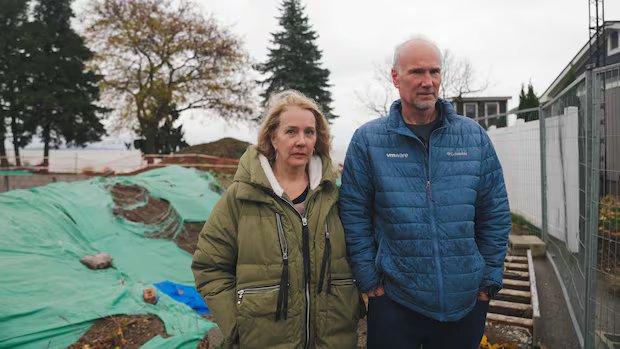
It was supposed to be a straightforward renovation, but a discovery on Christine and Dan Reio’s property in southern Ontario’s Niagara region could end up costing the couple hundreds of thousands of dollars they didn’t expect to pay.
The pair bought a bungalow overlooking Lake Erie in Wainfleet, Ont., during the pandemic with plans to expand the property.
“It really just felt like a great place to get away, a great place to cottage,” said Christine. “We’re also getting older and we’re trying to think about where are we going to retire.”
They got permission from the township to tear down the old home and begin their project. But it all came to an abrupt halt just a few days in when they got a phone call from the foreman.
“He said ‘We’ve got a little bit of a problem,'” said Christine. “He said, ‘We found human remains.'”
After an initial investigation by police to determine the bones were not part of a crime scene, the Reios say they were informed by a provincial official that they were ancestral Indigenous remains.
“They said he was a young man, probably in his early 20s,” said Christine.

A couple say they’re on the hook for hundreds of thousands dollars after Indigenous ancestral remains were found on their property in Wainfleet, Ont. For The National, CBC’s Idil Mussa investigates their story and uncovers murky rules about who’s responsible.
Tanya Hill-Montour, archaeology supervisor with Six Nations of the Grand River, was called to the scene. Her job is to ensure archaeological work is done with respect to Indigenous traditions. She believes the remains are at least 1,000 years old.
“We want to ensure that the best practices and protocols are respectfully happening,” she said.
The Six Nations of the Grand River includes the Mohawk, Seneca, Oneida, Cayuga, Onondaga and Tuscarora, known as the Haudenosaunee peoples, and their homeland spans the Finger Lakes region of New York state to the Grand River in southern Ontario, which includes the Wainfleet area.

$319,000 estimate
A 2002 provincial law — the Funeral, Burial and Cremation Services Act (FBCSA) — triggered what came next.
The couple was ordered by Ontario’s Registrar of Burials to launch a burial site investigation (BSI) to determine “the origin of the site.”
Ontario’s Ministry of Public and Business Service Delivery and Procurement (MPBSDP), which oversees the registrar, requires homeowners to hire a licensed archaeologist to determine the burial site’s history, borders and the best way to properly handle the remains.
The ministry says a BSI also determines if the property should be classified as a cemetery if more are found.

The Reios say one quote they received from an archaeology firm stated a crew of six would need to work for about 27 days to sift through about 100 square metres of dirt with three-millimetre mesh screens. The quote also included the participation of Indigenous communities to monitor the process.
The total: $319,000. The Reios were floored.
“This is an insane amount of money,” said Christine. “This is not within the scope of what’s reasonable.”
And that fee is only an estimate. According to the ministry, archaeologists are advised to dig a five-metre buffer to ensure all remains in the area are identified and recovered.
“If they find more, I mean, this could swell to $1 million,” said Dan.
‘Undue financial burden’
Under a provision in the FBCSA, homeowners can apply to the registrar for financial help if they can prove the mandatory dig would cause them an “undue financial burden.”
But the law does not include any criteria for how a homeowner would qualify.
The couple applied for financial help in October 2024, but haven’t heard back.
“I can’t even imagine the investment of man hours spent to give us no answer,” said Christine.
“I know that I personally have spent hundreds and hundreds of hours. Do they know that we don’t sleep at night? Do they know that we cry?”

Hill-Montour says the dollar value placed on the preservation of her ancestors is to blame for the registrar’s indecision.
“It’s a financial burden so costly that nobody wants to take accountability for it,” she said.
“I truly do not believe that homeowners should be completely responsible.”
At least 100 sites in area
Hill-Montour says the area of Wainfleet is ripe for more discoveries.
Niagara Region’s own mapping tool shows that almost the entire region has “archaeological potential” — denoting the likelihood of Indigenous ancestral remains and artifacts being buried there.

Hill-Montour questions why Wainfleet Township issued the Reios a building permit given the region’s history.
“Why would you put this person in this position to be where they are right now?”
The Township of Wainfleet declined an on-camera interview with CBC News. But in an email, its chief administrative officer Mallory Luey said municipalities don’t have access to precise archaeological or burial-site data and are “neither qualified nor authorized to speculate on what may exist beneath a particular property.”
“Determinations of this nature fall exclusively within provincial jurisdiction.”
But Hill-Montour says she believes Wainfleet officials do, in fact, know how archaeologically sensitive the land is.
“The awareness was there. I’ll just leave it as that,” she said.
In Ontario, licensed archaeologists must document sites in a provincial database. While the site is closed to the public, Ontario’s Ministry of Citizenship and Multiculturalism says it uses the information to “track the discovery and location of archaeological sites in the province” and to “inform the public record.” It’s unclear if municipalities have access to that database.
With the help of a licensed archaeologist, CBC News has learned that there are at least 100 sites of Indigenous remains or artifacts within a six-kilometre radius of the Reios’ property documented in the database.
“I just can’t even imagine what it feels like from the First Nations perspective to know that their ancestors are buried on this land and that Wainfleet’s like, ‘Go ahead and build,'” said Christine.
Scott Miller is a funeral director in the Ottawa area and a former board member of the Bereavement Authority of Ontario, a government-mandated body involved in administering parts of the FBCSA. Miller says the act is vaguely written, leaving the rules for financial aid eligibility open to debate.
“What is an undue hardship to you may not be an undue hardship to somebody else,” he said.
He says the hazy nature of the rules doesn’t bode well for the Reios’ application for help.
“I think the registrar, just my own personal opinion, is very hesitant to make a mistake on a case like this,” he said. “Therefore it’s one of these, ‘We’ll just bury our head in the sand and hope it goes away.’ And it won’t.”

As the federal and Ontario governments commit to accelerating development, both Miller and Hill-Montour say it’s vital to update the current law to make sure property owners don’t bury any artifacts or remains they dig up.
“What’s going to happen when the next person views this as a problem or a financial burden?” said Hill-Montour.
“They’re not going to want to do the right thing for reconciliation and truth.”
The Reios also want to see a rewrite of the law.
“I think it’s really a time to review the process … and decide if it’s still applicable in today’s world,” said Dan.
“Everything that we’re going through right now … is not efficient and it’s not timely. It’s just been dragging out what essentially should be a respectful burial.”
Application ‘still in progress’
The Ministry of Public and Business Service Delivery and Procurement did not answer a number of CBC News’s questions, but in a statement said the registrar needs “accurate and complete financial information from the landowner,” to assess applications and “may request further information.”
The Reios have gone back and forth with the registrar for months. They say they’ve submitted everything that’s been requested.
The ministry says 19 applications for financial relief for burial site investigations were received between 2023 and 2025, and six claims were approved during that time period. Approvals are recorded by the year they are granted, not the year applications are submitted. It’s unclear how long the process takes.
The ministry said the Reios’ application is still in progress. It did not give a timeline for an answer.
CBC News also reached out to the office of Ontario Premier Doug Ford to ask whether he would consider initiating an amendment to the current provincial law. It did not respond.
Now, all Christine and Dan can do is continue to wait.
“Everything in life has a pin in it,” said Christine. “We don’t make any decisions without thinking about this situation.”
Hill-Montour wants to see the ancestral remains protected and treated with dignity and says it’s high-time for action. “That’s the most important part right here, right now,” she said. “Somebody needs to take accountability.”