dailynewsnblog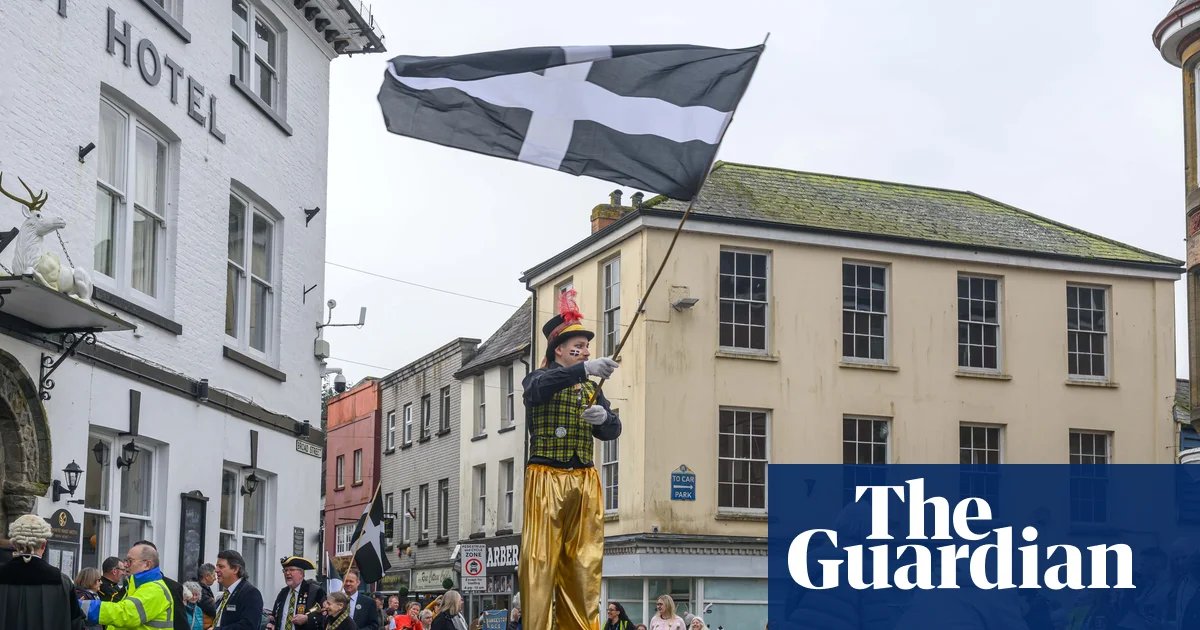
A crisp morning in Launceston, an ancient capital of Cornwall, and the town was humming as St Piran’s Day celebrations got into full swing.
Children paraded and danced, songs were sung, speeches made and the odd tear was shed as people gathered to celebrate all things Cornish.
The day has become a highlight of the spring in the far south-west of Britain, a chance to celebrate a patron saint but, perhaps more than that, to think about what it is to be Cornish in the 21st century.
“It’s a brilliant day,” said Launceston’s mayor, Nicola Gilbert, born and bred in Cornwall. “We’re very patriotic here, proud of who we are. We tend to get forgotten – we’re at the other end of the country. But we don’t forget who we are.”
The modern incarnation of St Piran’s Day is going from strength to strength and while 5 March is the actual date, the event sprawls into the weekend.
Celebrations such as the Launceston one were taking place in Bodmin, Truro and Falmouth and on Friday and Saturday, a new two-day festival marking cultural, academic and economic connections between Cornwall and Wales was being run in St Austell.
“I think there’s a resurgence in Cornish culture,” said Ross Wheeler, a stilt walker who took part in the Launceston parade. “It would be great if could turn it into a bank holiday.”
Cornish artist, musician and commentator Seamas Carey, said that when he was at school there were few St Piran’s Day activities. It is very different now.
“I think it’s about Cornwall getting to grips with its identity. Wales has St David’s Day, Scotland St Andrew’s Day. What’s interesting with St Piran’s Day is because it’s new and fresh, it’s like a blank canvas. People are doing whatever they want and calling it a St Piran’s Day activity. To be Cornish means to be other. I don’t mind if people forget I’m Cornish, but what I’m definitely not is English.”
In January, the Cornish language, Kernewek, was officially recognised under part III of the European charter for minority languages, which gives it greater protection and status.
The UK government has indicated that it will explore a bespoke devolution deal for Cornwall, possibly giving it more control over transport, housing and economic development.
Joanie Willett, co-director of the Institute of Cornish Studies at the University of Exeter, traced the modern rise of St Piran’s Day to the late 1990s.
This was the time of the 500th anniversary of the Cornish rebellion in which people from the south-west of Britain marched on London and also a period when Cornwall and the Isles of Scilly, among the poorest areas in the UK, were chasing funding from the EU.
“It created an environment that said Cornishness is really cool,” Willett said. “It really matters because of our heritage and it’s also really useful.”
But Willett is keen to make it clear that the day is fun and high-spirited rather than academic. “At our Institute of Cornish Studies, we are having our inaugural pasty toss.”
According to the Cornwall Heritage Trust, St Piran was the “merriest, hardest drinking, hardest living holy man Cornwall ever knew”.
The trust says he was a fifth century century Irish priest tied to a millstone and dropped in the sea after falling out with a king. Rather than sink, he floated over to Cornwall, where be preached Christianity.
The Rev Jess Lancaster, who took part in the Launceston parade, said there remained a deep Celtic tradition in modern Cornish Christianity. “There’s a calmness, a gentleness,” she said.
Two hundred and fifty miles away in the House of Commons, the Labour MP Perran Moon (his name comes from St Piran) for Camborne and Redruth was hosting an event with the trade and investment body Global Cornish.
He said: “When people think of Cornwall, they think of beaches and pasties and scones and cream and holidays. Actually, there’s so much more to Cornwall in terms of our culture, our language, our heritage.
“From an industrial perspective, we are kind of absolutely at the cutting edge of the government’s industrial strategy with wind, thermal and tidal energy, and we’ve got our critical minerals, tin, tungsten, lithium.
“Cornish culture and heritage has spread far and wide. There are St Piran’s events in Toronto, Mexico, Hong Kong, Australia. So this isn’t just a Cornish thing. It’s not even a British celebration. It’s an international celebration.”
In Redruth, the community was using St Piran’s Day to drum up support for their bid to become UK Town of Culture 2028 with the screening of a special film “The ‘Druth Is Out There”.
Will Coleman, who stars in the film, said that over the last decade there had been a “palpable wave” of positive energy around Cornish identity and language.
He said: “There has been a growing understanding of our distinctive past, as well as optimism about a distinctive and more prosperous future. So, for many years mis-cast as an ‘English county’, Cornwall is busy renegotiating its relationship within the British family, as one of its five nations.
“St Piran’s day is an opportunity to get out there and celebrate this newfound confidence in community, place and culture.
“I am aware that to an outside observer the flag-waving and parading might look suspiciously similar to the retreat into defensive nationalism currently fuelling division and hatred across Europe and the globe.”
But he said what was happening in Cornwall was a “different beast”. “From the inside, the resurgence of Cornish identity and language feels inclusive, empowering and celebratory – long may it continue to be so.”