dailynewsnblog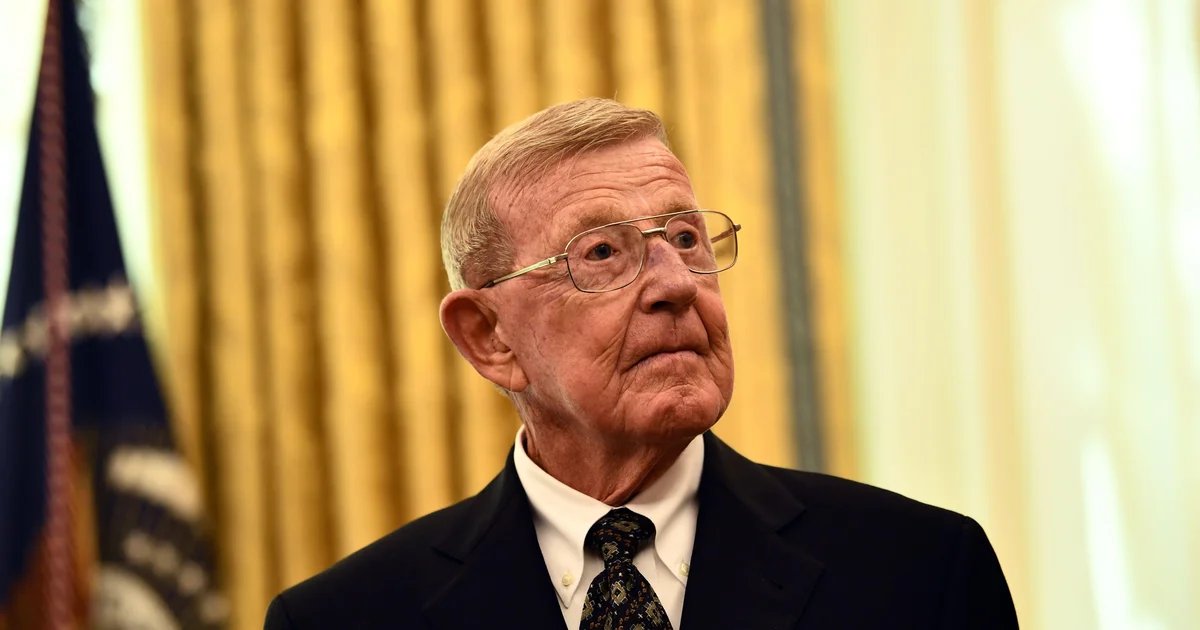
Lou Holtz, the former Notre Dame football head coach who led the team to a national title in 1988, has died, the school and his family announced Wednesday. He was 89.
Holtz died in Orlando surrounded by family, the family said.
“Holtz is remembered for his enduring values of faith, family, service, and an unwavering belief in the potential of others,” his family said in a statement. “His influence extended far beyond the football field through the Holtz Charitable Foundation and the many players, colleagues, and communities shaped by his leadership.”
Kevork Djansezian / AP 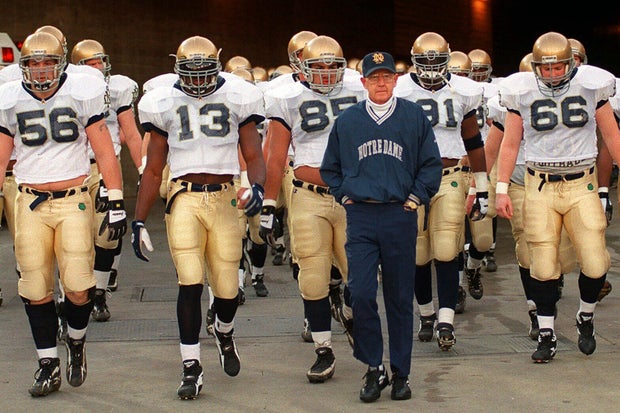
Holtz coached Notre Dame from 1986 to 1996, winning 100 games with the school, including a 23-game win streak and the school’s first back-to-back 12-win seasons, Notre Dame said. The Fighting Irish finished the ’88 season 12-0, capping it off with a win in the 1989 Fiesta Bowl and becoming the consensus national champion.
Holtz also had head coaching stints at William & Mary, Arkansas, Minnesota and South Carolina, along with one season helming the New York Jets in the NFL.
He won 249 games total in his college coaching career across 33 seasons.
“Notre Dame mourns the loss of Lou Holtz, a legendary football coach, a beloved member of the Notre Dame family and devoted husband, father and grandfather,” Notre Dame president the Rev. Robert A. Dowd said in a statement.
His son, Skip, who followed Holtz into coaching, said in a post on X that his father had passed away and was “resting peacefully at home.”
“He was successful, but more important he was Significant,” Skip Holtz wrote.
Before Holtz arrived in South Bend, Notre Dame was wallowing in mediocrity — a mere shell of the program built on a foundation of Knute Rockne, Ara Parseghian, the Golden Dome and Touchdown Jesus. Holtz turned things around quickly and had the Irish in the Cotton Bowl in Year 2 and winning the national title the season after that.
Holtz left South Bend after the 1996 season with a record of 100-30-2.
“Lou and I shared a very special relationship,” said current Notre Dame coach Marcus Freeman, who led the Irish back to the national title game in 2025 – a contest Holtz attended and spiced up with some trolling of the Ohio State program that beat the Irish that day. “Our relationship meant a lot to me as I admired the values he used to build the foundation of his coaching career: love, trust and commitment.”
Notre Dame was the highlight of a head-coaching career that began at William & Mary and North Carolina State and also included a one-year stop in the NFL.
Like so many who mastered the college game in his profession, he failed up there, resigning with one game left in a 3-10 campaign with the New York Jets in 1976 and proclaiming, “God did not put Lou Holtz on this earth to coach in the pros.”
That opened the door at Arkansas, which was one of the four schools he led into the AP Top 25. His teams made 18 appearances there; eight of those were in the top 10.
After Notre Dame, Holtz transitioned into the TV booth with CBS, promising he would never coach again.
“I said, ‘You could put it in granite.’ I’ve got the granite stone,” Holtz said. “It wasn’t very good granite.”
He took an open job at South Carolina, where he had once served as an assistant coach. Despite posting a career-worst 0-11 mark in his first season with the Gamecocks, Holtz went 17-7 over the next two seasons, beat then No. 9 Georgia in the second game of 2000 and also beat Ohio State twice in the Outback Bowl.
He left the sideline for good following the 2004 season and returned to the airwaves, working 11 more seasons with ESPN.
On the field, each program he led reached new heights in part because he never wavered from his core values of trust, a commitment to excellence and caring for others.
“I think you have to go in there with a vision of where you want to go and a plan of how you’re going to get there,” Holtz once said. “You have to hold people accountable, and you have to believe it can be done.”
The results were impressive, even if he sometimes used unconventional methods.
He once tackled quarterback Tony Rice following a failed play in practice and was widely critiqued in 1991 when he grabbed a player by the facemask, pulling him to the sideline and yelling at him the entire way after the player committed a personal foul. Holtz later apologized.
Holtz suspended his leading rusher, Tony Brooks, and leading receiver, Ricky Watters, in 1988 because they were 40 minutes late to a team meal the night before Notre Dame faced then No. 2 Southern California. The Irish still won 27-10.
At Arkansas, he once suspended three starting offensive players for disciplinary reasons before facing then No. 2 Oklahoma in the Orange Bowl. Arkansas, an 18-point underdog, still won 31-6.
As demanding as Holtz could be, though, he used his charm and eye for good players to recruit top talent. Notre Dame’s 1990 recruiting class included five future first-round NFL draft picks, and he found unique ways to motivate his team.
“The first thing I said at every practice was, ‘Boy, what a great day to work,'” Holtz recounted. “It could be raining. It could be whatever. I’d be, ‘Boy, am I glad to be here. No place I’d rather be than here.’ I used to say to them, ‘I travel all over the world speaking to every major corporation and they’d pay me money. I speak to you for free and you don’t have to take notes.'”
BRENDAN SMIALOWSKI/AFP via Getty Images 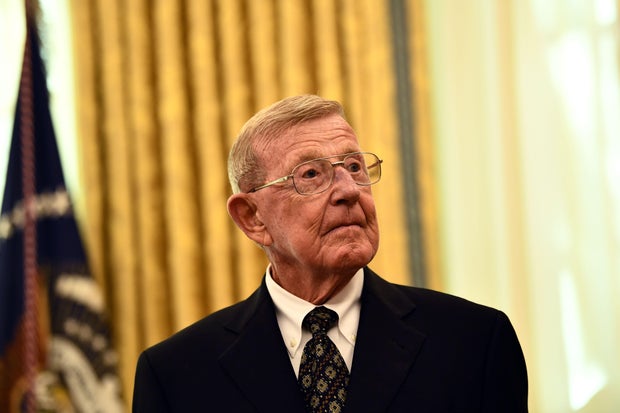
Louis Leo Holtz was born Jan. 6, 1937, in Follansbee, West Virginia, and aspired to be a high school football coach. His future wife broke off their engagement in 1960. That’s when Holtz, a 150-pound linebacker at Kent State, took a graduate-assistant job at Iowa. A year later, he married Beth Barcus, and they were together more than 50 years until her death in 2020.
She inspired him again in 1966 when, eight months pregnant with their third child, Holtz was jobless. Beth bought him a book about setting goals, and Holtz created a wish-list of what he wanted to do: attend a White House dinner, appear on “The Tonight Show” and see the Pope.
Holtz said there were 107 entries on the list: “She said, ‘Gee, that’s nice. Why don’t you add get a job.’ So we made it 108,” he said.
In 2008, Holtz was inducted into the College Football Hall of Fame and Notre Dame placed a statue of him outside its home stadium.
He said numerous times that his plan to be buried on that campus, as well. He figured it was only fitting because, as he said in 2015: “The alumni buried me here every Saturday.”
Holtz, a longtime Republican, spoke at the 2020 Republican National Convention to endorse President Trump. Mr. Trump awarded Holtz the Presidential Medal of Freedom, the country’s highest civilian honor, in December 2020.