dailynewsnblog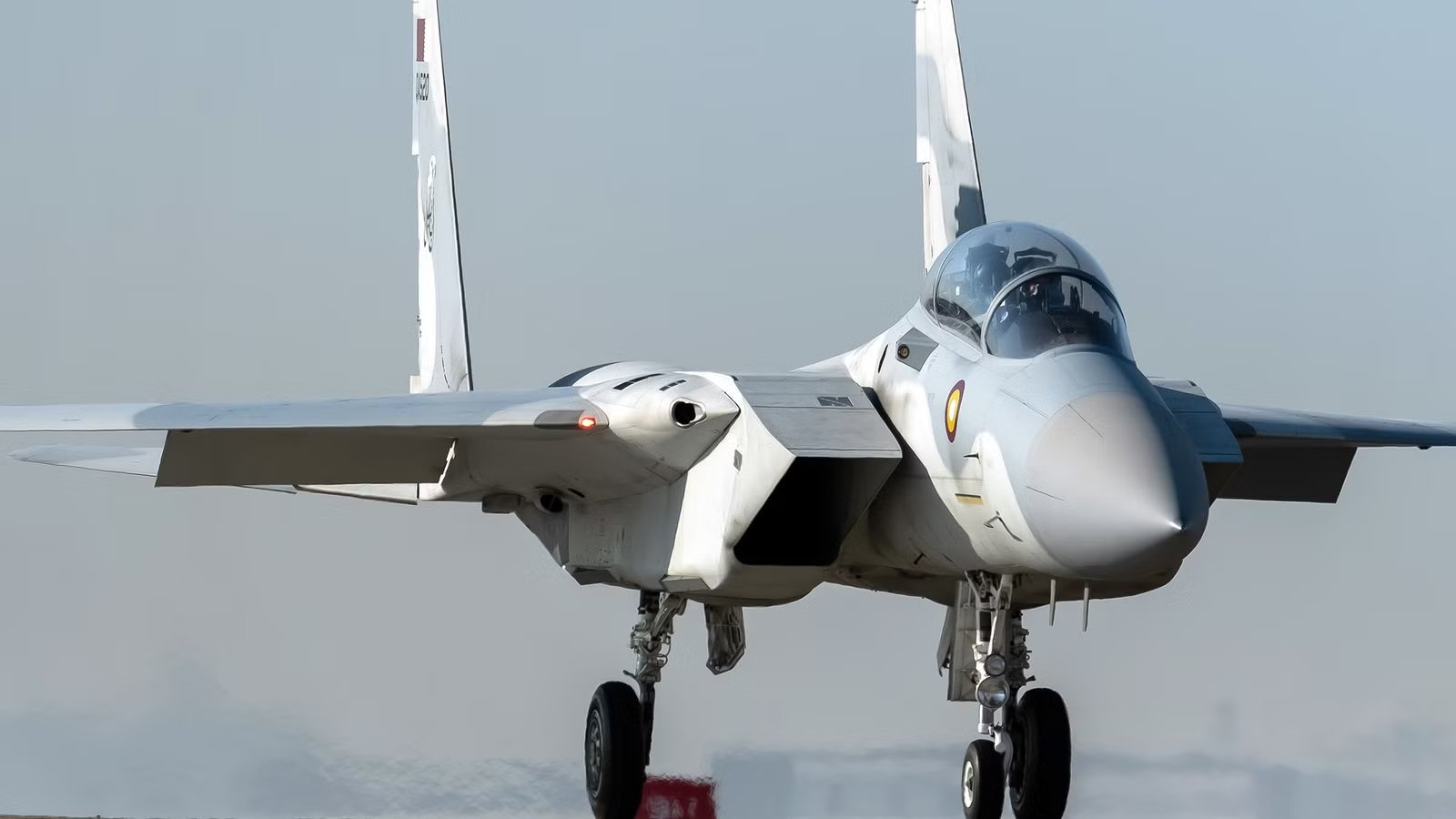
For more than four decades, the McDonnell Douglas F‑15C/D Eagle has been the USAF’s premier air superiority fighter. With an unmatched air‑to‑air combat record and a design built for speed, climb, and lethality, the Eagle has guarded American skies since the late 1970s. In early 2025, however, the active-duty USAF bid farewell to the last operational F-15C/D squadrons. The aircraft’s age, rising maintenance costs, and the introduction of newer platforms like the F-15EX Eagle II and the F-35 finally pushed the classic Eagle from the front line.
The recent deactivation of instructor pilot squadrons underscored this transition, drawing to a close nearly half a century of regular Air Force Eagle operations. Last year, the final active‑duty F‑15C/Ds left the flight line, marking the end of an era for the regular Air Force. However, the Eagle isn’t gone just yet, as, within the Air National Guard, a vital component of the USAF’s Total Force, some F-15C/Ds remain on alert.
Guard units in states like Massachusetts and Oregon continue to fly these veteran fighters, tasked with homeland defense missions such as aerospace control and intercepts. Here, the Eagle’s strengths, such as long range, raw speed, and reliability, still make it an effective tool for safeguarding American skies.
The Origins Of The F‑15C/D Eagle

The F-15 Eagle’s story began in the late 1960s, when the US Air Force was seeking solutions. The Vietnam War had laid bare the shortcomings of then-frontline aircraft like the F-4 Phantom II. Despite its versatility, the Phantom struggled in close-in dogfights against lighter, more agile MiGs. To make matters worse, the appearance of the Soviet MiG-25 ‘Foxbat,’ a high-altitude, Mach 3 interceptor, sent shockwaves through Western defense circles.
As such, the US needed a purpose-built air superiority fighter, one designed from the ground up to dominate the skies. The first operational version, the F-15A, entered service in 1976 and quickly demonstrated just how much of a leap forward it was. Only three years later, the improved F-15C/D models arrived. The single-seat F-15C introduced a larger fuel capacity, increased maximum takeoff weight, and more advanced avionics, making it better suited to long-range patrols and high-threat intercept missions.
The twin-seat F-15D, meanwhile, offered identical combat performance but with added flexibility, doubling as both an operational jet and a trainer. That two-seat capability proved invaluable, allowing instructors and weapons officers to prepare new pilots while still flying real-world missions.
Over its storied career, the F-15 Eagle has racked up more than 100 air-to-air victories without a single loss in aerial combat, although it was quite close to being shot down in at least one episode of the First Gulf War. Many of the F-15Cs and Ds still flying today rolled off the production line in the early 1980s, meaning these jets have been defending US skies for more than 40 years.
The Units Still Flying The Oldest F‑15C/D

After the retirement ceremony at Kadena Air Base , Japan, on January 24, 2025, the F‑15C/D left active‑duty service, but its story isn’t over yet.
Thanks to the Air National Guard, several units across the US still keep the Eagle flying, ensuring America’s skies remain protected.
The Guard’s mission has always combined homeland defense with a strong training pipeline, and the F-15C/D fits neatly into that role. Unlike front-line units tasked with overseas deployments, ANG wings often focus on air sovereignty missions, scrambling at a moment’s notice to intercept unidentified aircraft near US borders. These divisions are detailed in the table below.
Division | Role |
|---|---|
104th Fighter Wing (Barnes ANGB, Massachusetts) | Protecting the busy skies of the northeastern US, including the Washington D.C. and New York corridors. |
142nd Fighter Wing (Portland ANGB, Oregon) | Guarding the Pacific Northwest’s airspace, providing quick‑reaction intercept capability over Oregon, Washington, and approaches from the North Pacific. |
144th Fighter Wing (Fresno ANGB, California) | Covering the vast West Coast air defense sector, often responding to Russian bomber patrols off Alaska and California. |
159th Fighter Wing (Louisiana ANG) | Known as the ‘Bayou Militia,’ the 159th is based at NAS JRB New Orleans and flew F-15C/Ds for Gulf Coast air defense throughout 2025. |
173rd Fighter Wing (Kingsley Field, Oregon) | The last formal training unit for the Eagle, responsible for producing F-15C/D pilots, even as the type winds down. |
These Eagles are older than many of the pilots strapping into them each day. Some have been flying since Ronald Reagan was in office, yet they remain fully mission-capable thanks to careful maintenance, structural upgrades, and avionics refreshes. For the Guard units that operate them, the F-15C/D is a trusted workhorse, familiar, dependable, and still able to scramble at supersonic speeds to meet the mission.
How The F‑15C/D Has Stayed Relevant

Keeping a 40-plus-year-old fighter combat-ready is not an easy task. While the F-15C/D’s basic airframe was built for toughness, the Air National Guard has invested heavily in upgrades to ensure the Eagle could still do its job in a modern threat environment. In many ways, the type has been a bridge between the Cold War and the era of stealth, proving that with the right updates, even a fourth-generation fighter can remain lethal. Some of these upgrades are detailed in the table below.
Upgrade | Details |
|---|---|
Radar Upgrades | Many Eagles received the AN/APG-63(V)3 AESA radar, a system on par with what newer fighters carry. It dramatically improved detection ranges, resistance to jamming, and the ability to track multiple targets simultaneously. |
Avionics Modernization | Gone are the 1980s green monochrome displays. Modernized cockpits added digital multifunction displays, Link 16 datalink connectivity, and more capable mission computers, bringing pilots into the networked battlespace. |
Weapons Integration | The Eagle kept its teeth sharp with compatibility for the AIM-120D AMRAAM and AIM-9X Sidewinder, two of the most advanced air-to-air missiles in service today. Paired with the helmet-mounted cueing system, pilots could lock onto enemies just by looking at them. |
Structural Work | Perhaps less glamorous but equally vital, extensive wing and fuselage refurbishments have kept the fleet airworthy despite airframes racking up more than 8,000 flight hours each. For pilots, these changes transformed the F-15C/D into what some affectionately call a “Gen 4.5” fighter, not stealthy like the F-35, but still fast, powerful, and deadly in the right hands. |
Shari Williams, a former F-15C Eagle pilot, explained in an interview with Hush Kit that “the F-16 has decent AOA capability, but the fly-by-wire system is limited in speed of movement of the controls as it approaches its AOA limit.” She added that “the F-15 has no such limits. In my experience, I usually had more air-air experience than the vast majority of F-16 pilots, and usually had little trouble neutralising and then killing them in close.”
How The F‑15C/D Compares To Other Long‑Serving USAF Aircraft

Although the F-15C/D Eagle has now been phased out of active front-line service, it still holds a unique place as the oldest dedicated fighter type in the US Air Force’s Total Force structure. But when you zoom out and look at the entire inventory, you quickly realize the Eagle was not alone in carrying the weight of history. The USAF is home to several aircraft with service records spanning generations, jets that have endured so long they have outlasted entire wars, presidents, and even the companies that originally built them.
The most famous example is the B-52H Stratofortress, a bomber delivered in the early 1960s that is expected to fly until the 2050s. Alongside it, the KC-135R Stratotanker continues to provide the backbone of aerial refueling, with some tails dating back to 1957: they are literally older than the parents of many of the pilots they support.
Aircraft | Entered Service | Current Role | Status in 2025 |
|---|---|---|---|
B-52H Stratofortress | 1961 | Strategic bomber | Flying, modernized |
KC-135R Stratotanker | 1957 | Aerial refueling | Flying, multiple upgrades |
A-10C Thunderbolt II | 1976 | Close air support | Flying, still debated |
F-16C/D Fighting Falcon | 1984 | Multirole fighter | Flying, heavily upgraded |
F-15C/D Eagle | 1976 | Air superiority fighter | Retired/ANG phaseout |
On the tactical side, the A-10C Thunderbolt II has defied repeated retirement attempts thanks to its unmatched close-air-support role. At the same time, the F-16 Fighting Falcon has transitioned into the oldest active fighter in daily front-line service, bridging the gap between the Eagle’s retirement and the arrival of the F-35.
What ties all of these aircraft together is not just age, but adaptability. Each has been modified, re-engined, or re-wired multiple times to keep pace with modern threats. The F-15C/D’s story fits neatly into this pattern: a jet designed in the 1970s, updated across decades, and finally retired only when the Air Force began betting fully on stealth. The broader takeaway is clear: the Air Force doesn’t discard its legends lightly. If an airframe continues to bring value, it earns the right to stay in the sky.
Recent Operational Roles

Even in its final years, the F-15C/D Eagle was not a museum piece. Indeed, in 2025, the Air National Guard kept these jets on the front lines of homeland defense through the Aerospace Control Alert mission. This role, often invisible to the public, requires pilots and maintainers to be on standby 24/7, ready to scramble within minutes to intercept unknown or potentially hostile aircraft.
The Eagle’s blistering climb rate, powerful radar, and long endurance made it ideally suited for this job, where seconds can make the difference between a safe intercept and a potential security incident. Operationally, this meant that ANG F-15C/D units were the silent guardians of US skies. The table below details some of their typical tasks.
Mission Type | Example Scenario | Why the F-15C/D Was Well-Suited |
|---|---|---|
Aerospace Control Alert | Scrambling to intercept an unknown aircraft | High readiness & climb rate |
Air Intercept | Tu-95 bombers near Alaska | Long-range radar & endurance |
Civil Escort | Assisting comms-lost airliners | Reliability & authority |
Exercises | Large-scale training with allies | Combat-proven performance |
For many Guard units, these missions carried deep symbolic weight. Pilots flying the F-15C/D were often second-generation Eagle drivers, inheriting not just an airframe but a legacy. The fact that a fighter designed in the 1970s was still entrusted with defending US airspace in 2025 speaks volumes about its enduring capability. While the F-15EX is now stepping into this role, replacing the Eagle with fresh airframes, the C/Ds left behind a legacy of vigilance: jets that stood ready in the cold night, engines already spooled, waiting for a horn to sound.
The Future Of The Oldest Fighters

The Air National Guard’s F-15C/D Eagles are now embarking on their final chapter, and current United States Air Force plans reportedly call for their complete retirement this year, marking the end of more than four decades of continuous front-line service. Their successor, the F-15EX Eagle II, carries forward the same design philosophy but with a digital backbone, modern avionics, and an airframe expected to serve into the 2040s. This marks the end of an era when Cold War-era fighters remained America’s go-to air policing jets.
For aviation enthusiasts, this creates a fleeting moment of opportunity. Spotting a weathered 1980-built F-15C sitting on the ramp in the 2020s isn’t just planespotting: it’s seeing living history in motion. These jets are the last link between the USAF of the 1970s and today’s high-tech, stealth-driven airpower. Once they retire, the sound of twin Pratt & Whitney F100 engines in an ACA scramble will vanish from the American soundscape forever. The takeaway is clear: if you want to witness an F-15C/D at work, the clock is ticking.
Looking ahead, the F-15EX will assume the watch with more weapons, more range, and modern sensors, but it won’t carry the same nostalgia. For pilots who cut their teeth on the C/D models, the transition is bittersweet. For the Air National Guard, the coming years will be about writing new chapters with the EX. Still, for the F-15C/D, its legacy is already secure, an undefeated guardian that served longer than anyone expected.