dailynewsnblog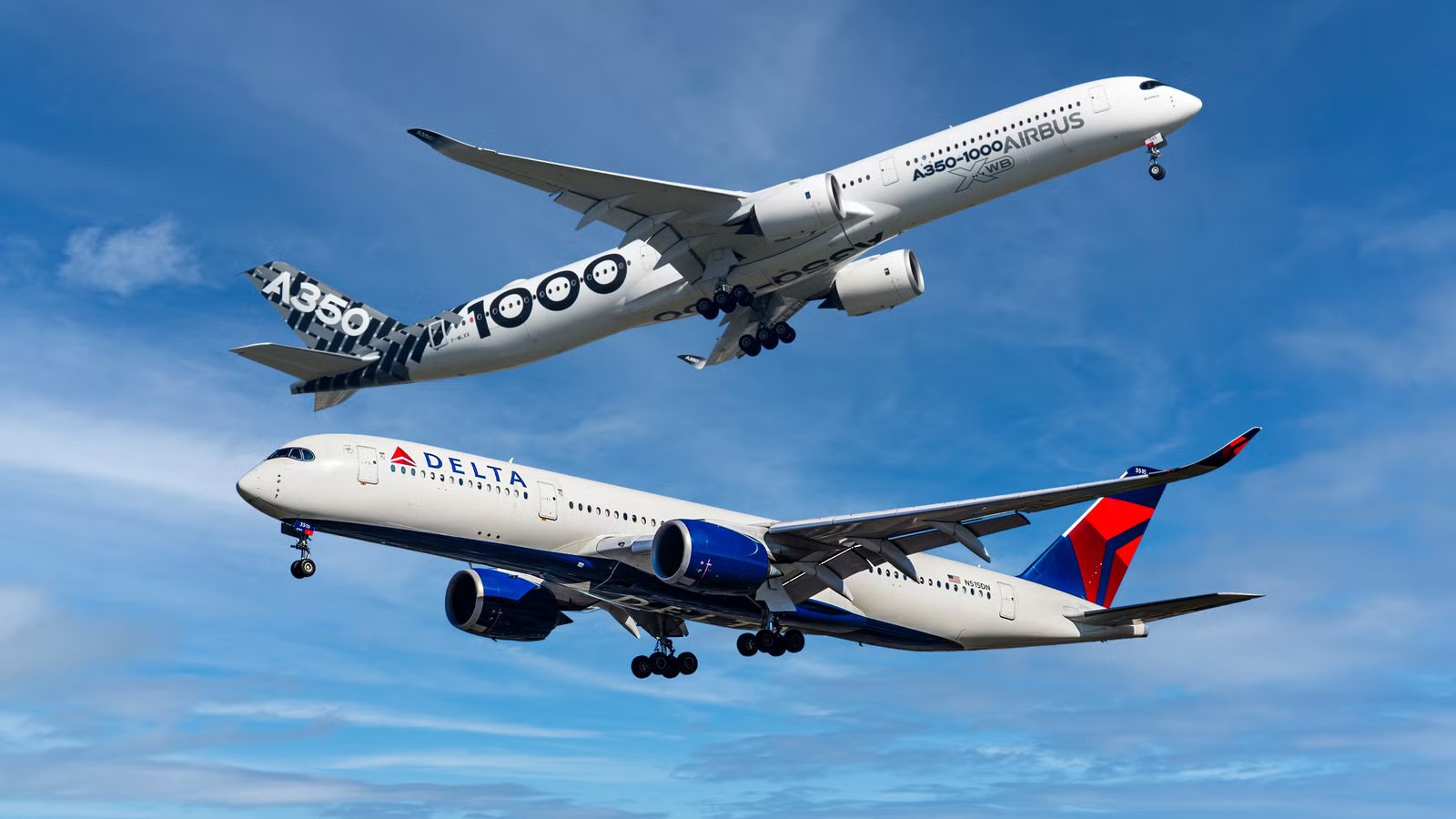
The Airbus A350-900 and the A350-1000 are the two core variants of Airbus’ next-generation long-haul family. Built around the same advanced composite wing, cockpit architecture, and overall design philosophy, the pair share a common type rating and high degree of operational similarity. To passengers and to many observers, the differences may appear limited to a slightly longer fuselage on the -1000. In reality, however, that stretch brings meaningful changes in weight, thrust, and overall performance characteristics.
One area where those differences become most visible is runway performance. While both aircraft are capable of operating from the vast majority of major international airports, the larger and heavier A350-1000 requires more runway at maximum takeoff weight than its smaller sibling. The gap is not dramatic, but in commercial aviation, even a few hundred meters can influence payload flexibility, route planning, and airport compatibility. Here’s a closer look at how their runway length requirements compare, and why the physics behind the numbers matter for airlines.
The Airbus A350 Family: Shared DNA, Different Missions

The Airbus A350-900 and the Airbus A350-1000 form the backbone of Airbus’ long-haul twin-engine portfolio. While they share the same type rating, cockpit commonality, wing design, and overall systems’ architecture, the two aircraft are optimized for slightly different roles within airline fleets. The -900 is the baseline model, while the -1000 is a stretched, higher-capacity evolution aimed at replacing larger twin-aisle jets.
From a structural standpoint, both aircraft are built primarily from carbon fiber-reinforced polymer composites, giving them excellent strength-to-weight ratios. They share the same advanced aerodynamics, including a highly efficient wing with curved sharklets that help reduce drag and improve fuel burn. Despite this common foundation, the -1000 incorporates structural reinforcements and modifications to support its higher operating weights.
These design differences, while subtle externally, directly influence runway performance. When comparing required takeoff distances, the relationship between airframe weight, thrust, lift, and drag become central to understanding why the larger variant needs slightly more pavement beneath its wheels.
Maximum Takeoff Weight: The Core Performance Driver

The most important factor influencing runway requirements is Maximum Takeoff Weight ( MTOW). The Airbus A350-900 typically operates with an MTOW in the 617,000–624,000 lbs (280,000–283,000 kg) range, depending on configuration and airline selection. The larger Airbus A350-1000 raises that figure significantly, reaching approximately 679,000–710,000 lbs (308,000–322,000 kg) in most configurations. That increase of up to and around 86,000 lbs (over 39,000 kg) represents a meaningful jump in mass, driven by additional passenger capacity, cargo capability, fuel for long-haul missions, and structural reinforcement required for the stretched fuselage.
From a performance standpoint, that extra weight has a direct impact on runway length. A heavier aircraft must generate more lift to become airborne, and generating more lift requires higher takeoff speeds. Higher speeds mean longer acceleration time, which translates into more runway used before rotation. Even though the -1000 is equipped with more powerful engines to help offset its additional mass, the physics of accelerating 700,000 lbs down a runway ensures it consistently requires more distance to safely depart at maximum weight than its lighter sibling.
While airlines may not always operate at full MTOW, long-haul sectors, particularly ultra-long-range flights, frequently push aircraft close to their certified limits. On such routes, the runway distance required approaches the maximum certified takeoff field length, making weight differences particularly relevant in operational planning.

Is The Airbus A350 Bigger Than The A340?
Airbus A350 vs A340: Which one is truly bigger? Discover how range, capacity & efficiency redefine “size” beyond fuselage length.
Engine Thrust And Performance Margins

Powering the Airbus A350-900 is the Rolls-Royce Trent XWB-84, rated at approximately 84,000 pounds of thrust per engine. The larger Airbus A350-1000 uses the more powerful Trent XWB-97, producing up to 97,000 pounds of thrust per engine, making it the highest-thrust engine ever fitted to an Airbus aircraft. The upgraded XWB-97 features strengthened internal components and performance refinements designed to support the -1000’s higher maximum takeoff weight and increased passenger capacity.
While the additional thrust helps the A350-1000 maintain strong acceleration and climb performance, it does not entirely cancel out the impact of the aircraft’s increased mass. The heavier airframe must still reach higher takeoff speeds to generate sufficient lift, meaning it spends longer accelerating down the runway. As a result, despite its more powerful engines, the -1000 consistently requires slightly more runway than the -900 when departing at maximum weight.
The enhanced engines also improve hot-and-high performance compared to what might otherwise be expected from such a large twin-engine jet. Even so, under standard sea-level conditions at MTOW, the larger A350 consistently posts a longer takeoff field length than its smaller sibling.
Takeoff Field Length: The Numbers Compared

Under International Standard Atmosphere (ISA) conditions at sea level, the Airbus A350-900 requires approximately 2,600 meters (8,530 feet) of runway at Maximum Takeoff Weight (MTOW). This relatively moderate requirement allows the aircraft to operate comfortably from nearly all major international airports, including hub airports in Europe, North America, and Asia, as well as some secondary long-haul gateways with extended runways. The A350-900’s efficient takeoff performance contributes to its versatility in long-haul operations, providing airlines with greater route flexibility and payload options.
The slightly larger A350-1000, under the same ISA sea-level conditions, typically requires around 2,800 meters (9,186 feet) of runway. While the difference of roughly 200 meters (650 feet) might seem minor at first glance, in practical aviation terms, it is significant. Even small increases in takeoff distance can influence payload planning, fuel loads, and departure decisions at airports with shorter runways or operational constraints, particularly when factoring in heavy cargo or extended-range flights.
Aircraft (Airbus) | MTOW Runway (ISA, Sea Level) | +10°C Temperature Increase | +1,000 ft Airport Elevation | 1% Runway Slope | Notes |
|---|---|---|---|---|---|
A350-900 | 2,600 m (8,530 ft) | +150 m (~490 ft) | +100 m (~330 ft) | +120 m (~390 ft) | Standard widebody long-haul; flexible for most major airports. |
A350-1000 | 2,800 m (9,186 ft) | +160 m (~525 ft) | +110 m (~360 ft) | +130 m (~425 ft) | A slightly longer runway is needed due to higher MTOW; it affects payload planning at constrained airports. |
It is crucial to remember that these numbers reflect idealized standard conditions. Real-world operations rarely align perfectly with ISA assumptions. Factors such as temperature deviations, runway slope, surface contamination (wet or icy conditions), headwind or tailwind components, and airport elevation can all increase the required takeoff distance. For example, higher temperatures reduce air density, which diminishes engine thrust and aerodynamic lift, potentially requiring hundreds of additional meters for a safe takeoff. Similarly, high-altitude airports demand longer runways due to thinner air.

Airbus A350-900 Vs A350-1000: Features Compared
Comparing and contrasting the modern widebody variants.
Environmental Factors: When The Gap Widens

Temperature has a major impact on runway requirements. On hot days, air density decreases, reducing both engine thrust and wing lift. For the A350-900 and A350-1000, this means a longer runway is needed to reach takeoff speed. The A350-1000, being heavier, is especially sensitive near Maximum Takeoff Weight (MTOW), sometimes requiring several hundred extra meters, which affects payload, fuel loads, and departure planning. Pilots and airlines monitor seasonal temperature trends at key airports to anticipate these adjustments, particularly on summer routes. Even small increases in required runway length can determine whether an aircraft can depart at full capacity or must reduce weight.
Elevation introduces a similar challenge. Airports at higher altitudes, so-called “hot and high” locations, have thinner air, further reducing lift and engine efficiency. Airlines may need to impose weight restrictions, reducing passenger, cargo, or fuel loads. While the A350-900 often operates with minor adjustments, the A350-1000’s higher MTOW makes it more affected. Many high-altitude airports also have shorter runways or surrounding terrain, making careful pre-flight calculations essential for safety and efficiency.
Runway surface conditions also matter. Wet, icy, or contaminated runways increase required takeoff and stopping distances, further influencing performance margins. Modern aircraft performance software allows airlines to optimize departure data precisely for these conditions, but the inherent weight difference between the two variants still results in slightly higher runway requirements for the A350-1000. Combined with temperature, elevation, and wind factors, these variables mean real-world takeoff distances often exceed standard ISA figures, requiring careful planning to maintain safety, optimize payload, and ensure operational flexibility, especially on long-haul routes.
Operational Impact: How Much Does It Really Matter?

In practical terms, most major intercontinental hubs offer runways exceeding 3,000 meters (9,800 feet). At such airports, both A350 variants operate comfortably without meaningful performance restrictions under normal conditions. For airlines based at large global gateways, the runway difference rarely limits route planning.
However, at secondary airports or destinations with runways closer to 2,700 meters, the distinction becomes more operationally relevant. The A350-900 may depart at higher payload levels, while the A350-1000 might require minor weight adjustments depending on temperature or route length.
Ultimately, the difference in runway requirement, roughly 200 meters, reflects the -1000’s higher capacity and greater revenue potential. Airlines selecting between the two typically base their decision on market demand and route economics rather than runway length alone. Still, in performance-critical scenarios, the lighter and smaller A350-900 retains a slight flexibility advantage, even as the A350-1000 delivers greater passenger and cargo capability.