dailynewsnblog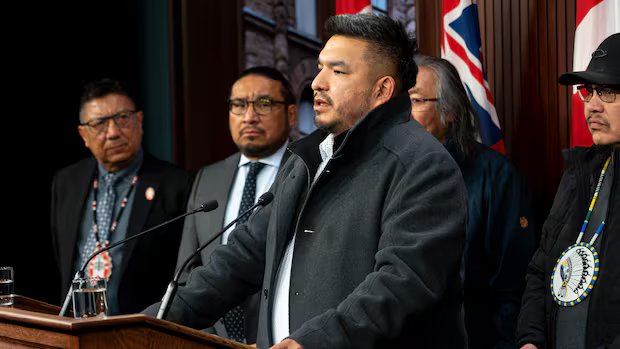

Listen to this article
Estimated 6 minutes
The audio version of this article is generated by AI-based technology. Mispronunciations can occur. We are working with our partners to continually review and improve the results.
Two Anisininew Nations in northwestern Ontario and northeastern Manitoba are speaking out against mining exploration in their traditional territories, which they say is happening without their consent.
Leaders from Sachigo Lake First Nation and Red Sucker Lake First Nation held a joint press conference at Queen’s Park on Tuesday about the Lingman Lake Gold Project, located between both communities. They were joined by Kiiwetinoong MPP Sol Mamakwa and Nishnawbe Aski Nation Grand Chief Alvin Fiddler.
The project is being led by Signature Resources Ltd., a Canadian-based advanced stage exploration company.
“We are being ignored at every level of these mining operations that are happening in our territory,” said Eugene Tait, a band councillor for Sachigo Lake First Nation.
He said his aunt used to hunt in the area but was unable to harvest there this season due to exploration activities underway.
“That’s a painful thing when that happens in your home where you can’t provide for yourself, you can’t put food on the table for yourself,” Tait said. “It hurts us when outside entities come in and try to tell us how they are gonna operate without our consent.”
According to both communities, Signature Resources Ltd. “has refused to negotiate a standard exploration agreement with our Nations.”
“We are deeply disappointed that neither Signature Resources nor the Government of Ontario has chosen to hear and accommodate our concerns,” the First Nations said in a statement Tuesday.
However, the company’s president, CEO and director Dan Denbow told CBC News it’s been trying to engage with the First Nations for years.
Our nations will exercise every lawful means at our disposal to protect our lands, our people and our rights. Our lands are governed by our laws.– Eugene Tait, band councillor for Sachigo Lake First Nation
“We recognize that we’re on their territorial lands. We want to work with them. We think it can be a great partnership. We think it can be mutually beneficial to all three partners,” Denbow said.
The company is keen to work alongside both First Nations to explore employment opportunities for their members, he said.
“We’ve just not been able to complete a formal agreement with them. We think it’s very important,” said Denbow. “Good communication and good partnership is very important.”

Ontario will spend millions to expand and fast-track construction of roads into the mineral-rich Ring of Fire, aiming to begin opening sections by 2030. CBC’s Shawn Jeffords breaks down the project and the new timeline.
The conflict comes amid the annual Prospectors and Developers Association of Canada (PDAC) conference in Toronto, which saw Ontario Premier Doug Ford announce an accelerated plan to build roads to the Ring of Fire mineral deposit in northwestern Ontario’s James Bay lowlands.
“Companies that operate without Indigenous consent operate at their own risk,” Tait said.
“Our nations will exercise every lawful means at our disposal to protect our lands, our people and our rights. Our lands are governed by our laws.”
CBC News reached out to the Ontario government for comment and received an emailed statement from a spokesperson of the Ministry of Energy and Mines Wednesday morning.
“The ministry will continue to engage in ongoing dialogue with Sachigo Lake First Nation, Red Sucker Lake First Nation, and all impacted communities. Ontario takes seriously its duty to consult and will continue working with First Nations partners as projects move forward to strengthen northern Ontario’s economy, create jobs, and improve quality of life in northern communities,” wrote issues management adviser Hanna Ali.
The ministry issued an early exploration permit to the company for the Lingman Lake project on May 17, 2024, Ali said, which involved engaging with both First Nations.
‘This is not about stopping development’
The First Nations expressed concerns about environmental risks from drilling and fuel spills, and have taken issue with the province’s classification of “low impact” exploration activities which may affect traplines, hunting and fishing grounds, travel routes and water systems.
They also say they’ve heard reports of “unsafe working conditions and disrespectful treatment of Indigenous workers employed by exploration contractors.”

Denbow said there have been no fuel spills reported, and that the company makes sure to clean up drill sites and keep the area around the exploration camp well-maintained.
Gold was first discovered in the Lingman Lake area in 1939, he said. Production failed to get off the ground during the Second World War, and since then, exploration activities have ebbed and flowed with the fluctuating price of gold.
“We’ve become more active in the last few years, trying to explore and expand on what was found nearly 80 years ago,” Denbow said.
This is not about stopping development. It is about stopping development that ignores Indigenous law and constitutional responsibility.– Chief Samuel Knott, Red Sucker Lake First Nation
The drilling work underway aims to take small, core samples which can help determine the amount of resources in the ground and their value, he said.
“We’re still in the early stage of exploration. It could be many years before we get into mining or something where we’d be looking at doing an impact benefit assessment with the local communities there,” said Denbow
Meanwhile, Red Sucker Lake’s Chief Samuel Knott says this is all happening without his First Nation’s approval — and he’s calling on the Ontario government to revoke the company’s exploration permits.
“If development is to occur within our territory, it must be based on consent, lawful engagement and respect. Until that occurs, these permits should not stand,” Knott said.
“This is not about stopping development. It is about stopping development that ignores Indigenous law and constitutional responsibility.”