dailynewsnblog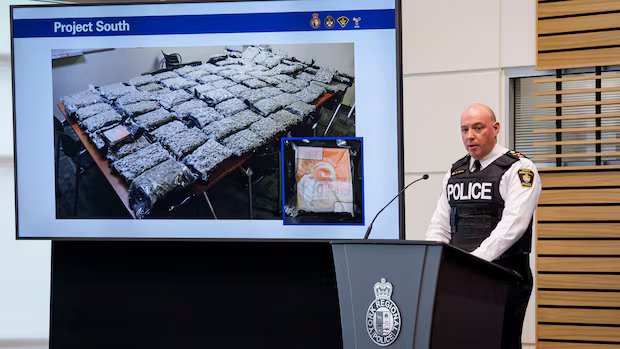

Listen to this article
Estimated 5 minutes
The audio version of this article is generated by AI-based technology. Mispronunciations can occur. We are working with our partners to continually review and improve the results.
Six Toronto police officers arrested and charged in a sweeping corruption probe by York Regional Police last month were scheduled to appear in court Tuesday — most for the first time — except the courtroom was largely empty, save for their lawyers and the Crown prosecutors.
Their absences aren’t actually against the law. But because this is a high-profile case and none of the officers scheduled to appear Tuesday are in custody, questions persist about when they’ll finally make a public appearance.
Here’s what you need to know:
Who was scheduled to appear in court?
Six Toronto police officers, one of whom is retired, and seven civilians had court appearances scheduled for Tuesday.
The officers scheduled to appear were:
- John Madeley Sr., 55, retired officer.
- Const. John Madeley Jr., 29, son of John Madeley Sr.
- Sgt. Robert Black, 42.
- Sgt. Carl Grellette, 49.
- Sgt. Saurabjit Bedi, 38.
- Const. Elias Mouawad, 24.
The officers’ charges range from conspiracy to obstruct justice to drug trafficking.

Seven Toronto police officers, one retired officer and 19 civilians are facing charges after an investigation into organized crime. Police say the investigation includes a conspiracy to commit murder, shootings, extortion, robbery, drug trafficking and firearms offences. UPDATE (Feb. 25, 2026): Some content has been blurred to remove potentially identifying information.
Why weren’t they in court?
None of the officers were in court Tuesday because they got their lawyers to file a designation of council for them.
That designation means they can skip out on a chunk of their court proceedings and have their lawyer — or sometimes another appointed counsel under them, like a paralegal — show up for them instead, as outlined in the Criminal Code. Anyone accused of a crime can file for a designation, according to the code.
They will eventually need to be present when a jury is being selected, if a witness takes the stand to provide oral evidence and when their sentence gets handed out, among other criteria laid out in the code.
A designation is not unusual and is “entirely normal,” said Alison Craig, a Toronto criminal defence lawyer.
“[In] the first few court appearances of any case, nothing of substance happens,” she said.
“Really it’s more of a convenience issue than anything for most people. But certainly I suspect in high-profile cases many accused persons just don’t want their face to be out there.”
Craig did mention that filing for a designation requires some level of organization and funding and not everyone could have those resources secured in time for their first court appearance, especially if they are relying on legal aid rather than a private lawyer.

None of the officers scheduled to appear are in custody
Out of all the officers charged in the investigation, only one is actually in custody. All the others were released on undertakings by police.
This means that when they got arrested and charged, they did not have to remain in custody and try to get bail. Instead, they were released by police with a requirement to obey certain conditions and attend court at a later date, according to the Ontario Court of Justice website.
Const. Timothy Barnhardt is the only officer in custody. He was denied bail and faces 17 charges, the most out of all the officers involved.
Barnhardt is co-accused on many of his charges with Brian Da Costa, 43. Da Costa, a civilian, is alleged to have connections with various criminal networks and is accused of leading a plan to run illegal cannabis dispensaries, according to his charges.
York police Deputy Chief Ryan Hogan previously called Barnhardt the “genesis” of the investigation. Police also allege Barnhardt released confidential information to criminals to help facilitate targeted shootings.
“I do have some questions about the fact that they were all released on an undertaking,” said Craig.
Although many of the charges for the officers aren’t the most serious, she said, they are part of a very “serious set of allegations that seem to have at least tones of organized crime or conspiracy behind them.”
“I think they were all very lucky and perhaps given some special treatment that the public would not ordinarily be given,” she said.
CBC News did ask York Regional Police why the decision was made to release all officers except Barnhardt on undertakings, but they declined to comment, citing the ongoing investigation.
When will the officers be seen in court?
“Realistically, the first time you’re likely to see these guys is either on the day of their guilty plea or on the day of their trial,” said Craig.
It could take months — if not years — to get to a trial, she said.
“Unless one of the officers has a burning desire to plead guilty in a fairly prompt fashion, which I suspect is not the case, the public is unlikely to see these guys until their trial.”