dailynewsnblog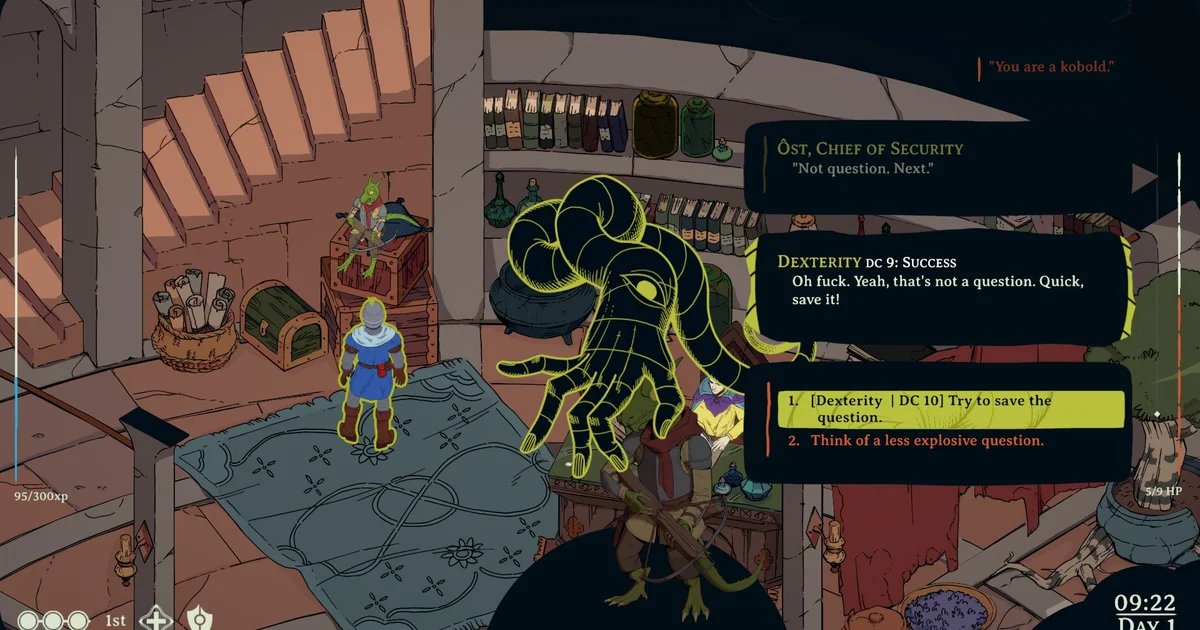
Among the first things I did in Esoteric Ebb was spectacularly injure myself by posing a question to a kobold guard that was actually a statement. To whit, “you are a kobold.” My Dexterity hollered at me to stave off embarrassment with a witty follow-up, but I failed the associated dice roll and almost bit my own tongue off.
“Use this to your advantage,” growled my Strength stat. “Intimidate him with your life’s liquid.” So I spat blood through my visor, all over the kobold’s feet. “He is baffled,” observed my Wisdom. “Your actions have truly made a mark upon his dark soul.” Later, the kobold and I agreed – again via dice roll – that neither of us like the taste of milk, which somehow unlocked a quest to become a milkman. Apparently, the money’s decent.
Watch on YouTube
If you’re thinking of Cuno or that awful tie or the lethally uncomfortable chair in Disco Elysium, that’s far from where the parallels end. Like ZA/UM’s heavily tabletop-inspired RPG, Esoteric Ebb casts you as a befuddled and erratic investigator with a brainful of arguing voices, representing different character stats. You begin the game in a similarly dreadful state – not just sorely hungover, but recently resurrected, laid out on a stone slab in a crypt that is also a monstrous apple storehouse.
Your bickering internal voices remind you that you’re a Cleric, sent to the “arcanepunk” city of Norvik to resolve the mystery of an exploding tea shop, five days before an election. It’s immediately apparent that your chief obstacle in this task will be… you. While perhaps a little less deteriorated than dear Harry Du Bois, the Cleric has a comparable capacity for idiocy, grandiosity and self-loathing. Much as Disco’s protagonist shuns his reflection, so one of your greatest, possibly insurmountable challenges is to remove your full-face helmet.
As one among many heirs to Disco’s throne, Esoteric Ebb has the advantage of being heavily championed by one of Disco’s main writers. “If you enjoyed Disco Elysium, do yourself a favor and try Esoteric Ebb,” Summer Eternal’s Argo Tuulik wrote on MechaHitler.com last week. “It’s *easily* the most exciting game Disco has inspired, one that transcends imitation and stands strong on its own. Haven’t been this impressed by a game since I played Pathologic 2.” He added: “Take notice, Disco-likes, *this* is how you spiritually succeed.”
My suspicion that Tuulik is using Esoteric Ebb as a stick to beat Zero Parades and Hopetown with aside, I’m encouraged to hear that the new game “transcends imitation”. The opening hour does feel a bit too close to Disco for comfort, at times. The wider world is another poetic thought experiment, a ring of liveable matter surrounding zones of mounting impossibility. The writing isn’t quite as soul-ravaged or flowery, but developer Christoffer Bodegård seems to be trying for the same moods and punchlines.
Much of the humour involves NPCs, not least your Kitsuragian goblin sidekick Snell, reacting to the fact that you’re a blundering clown with the fourth wall running right through his head. Opening conversations include a chat with your Strength stat about what a “quest” is. Esoteric Ebb also engulfs you in a very Elysiumish tug-of-war between radical lefties, morbid traditionalists and meddling overseas agents. Having survived my banter with the kobold, I proceeded to resolve a stand-off between some protesting dwarf workers and a menacing orc bureaucrat by convincing the latter that the former would abandon their rally if she herself stopped witnessing it.

Still, I get the sense that Esoteric Ebb is beating its own path. There’s the choice of something like a “high fantasy” setting, for one, which also means that you get to deploy spells in conversations and quests, after memorising them at shrines. I’m already enjoying the game’s dismantling of the Cleric archetype, here more of a glorified state goon than a man of faith.
It’s intriguing to pass an observation skill check and learn that characters have D&D alignments, like Neutral Evil – I wonder how that hoary morality system will complement the game’s jabs at contemporary politics, like the deadpan line about “exponential growth”? There’s also some complex and engrossing capital-L Lore, doled out succinctly by means of highlighted keywords. There’s a touch of Pratchett satire in, for example, the presence of an insurance business for magical resurrections below the age of 75, but the game takes its own setting seriously enough that you do too.
On the whole: game seems good! Maybe even great. And by happy fortune, it’s out today on Steam. If my first impressions leave you unconvinced, there’s still a demo as of writing.