dailynewsnblog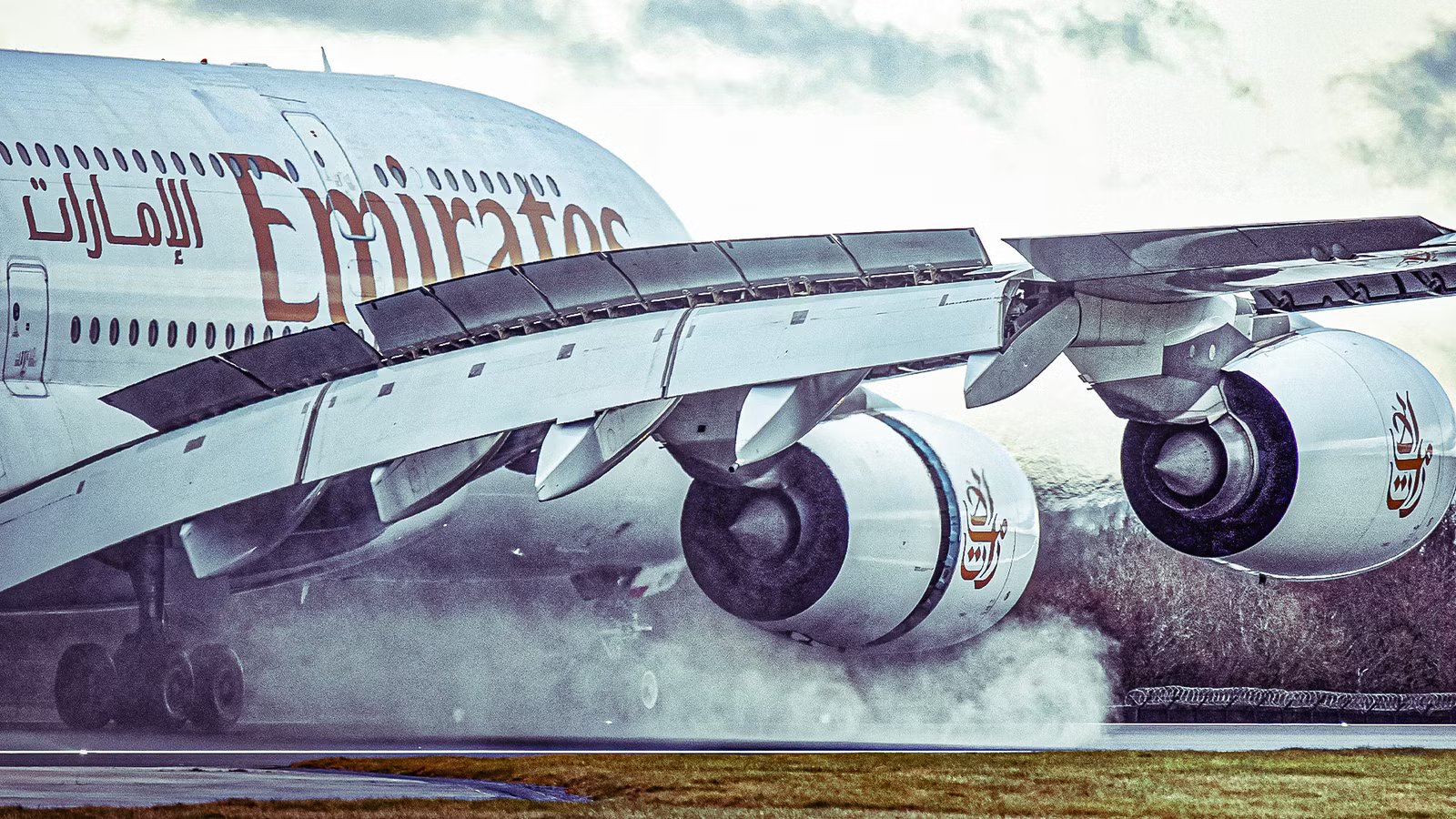
It is getting more common for widebody airliner programs to choose an exclusive engine option. This wasn’t always the case. Airbus gave its customers a choice with the Airbus A380 by offering the aircraft with either the Rolls-Royce Trent 900 or the Engine Alliance GP7200. This decision was made to force competition, which Engine Alliance hoped would lead to a stronger engine being developed. The A380 was also an extraordinarily expensive aircraft program. Using multiple engines diversified the risks.
Read on to learn more about the decision to offer two engine types aboard the A380. This article also covers the development and strengths of each engine and how Engine Alliance was able to achieve a slight victory.
Competition Guided Airbus’ Decision

Carriers are expected to have multiple engines to choose from when purchasing new aircraft. They would usually go all-in on one of the engine choices, allowing them to standardize their maintenance procedures and infrastructure.
The Airbus A380 was enormously expensive to develop as the largest commercial airliner ever built. Going with one engine option was simply too much risk, as powerplant problems could have derailed the entire program.
Although offering multiple engine options is now outdated, it did not contribute to the program’s failure. Instead, the market moved away from such enormous aircraft and the hub-and-spoke model they evangelized with the entrance of more efficient and ultra-long-range twin-jets.
The Rolls-Royce Trent 900

One of the two A380 engine options is Rolls-Royce’s Trent 900. The British manufacturer initially offered the engine for the Boeing 747-500/600X in July 1996. Yet, abandonment of this application forced Rolls-Royce to shift focus for the powerplant to the A3XX, which was under development and launched as the A380 in December 2000. It was the first engine selected for the A3XX program. The engine first ran three years later, and successfully flew in May 2004 on an Airbus A340 testbed.
This engine achieved early customers in the form of Singapore Airlines and Virgin Atlantic. Another critical, although unsurprising, customer was British Airways, which announced the selection of the Trent 900 to power 12 A380s in September 2007. That order made a significant contribution towards Rolls-Royce reaching a 52% share of the A380 engine market by February 2009.
The table below shows specifications for the Trent 900 according to the EASA:
Length | 215.7 in (5,478 mm) |
|---|---|
Fan diameter | 116 in (2,950 mm) |
Dry weight | 13,770 lbs (6,246 kg) |
Maximum thrust | 75,152 to 84,098 lbf (334.29 to 374.09 kN) |
Overall pressure ratio | 37-39 |
Bypass ratio | 8.5-8.7 |
Thrust-to-weight ratio | 5.46-6.11 |
Rolls-Royce claims that its Trent 900 engine offers customers the lowest lifetime fuel burn among A380 engines. The program is also notable for the continued improvements that the manufacturer has been able to make throughout the engine’s lifetime. It claims these developments have yielded 1.6% fuel burn improvements since entry into service. Another unique tribute of the Trent 900 among A380 engines is that it can be loaded into a 747 freighter without requiring disassembly. That drastically reduces the cost and time required for shipping.

Rolls-Royce Trent 900 Vs. Trent XWB: Which Engine Gets More Miles Per Gallon?
Of the two popular Rolls-Royce engines, there is a clear winner when it comes to seat miles per gallon (SMPG).
The Engine Alliance GP7200

While Rolls-Royce struck its own path with the Rolls-Royce Trent 900, the Engine Alliance GP7200 was born out of a collaboration between General Electric and Pratt & Whitney. The two firms developed their engine from the GE90 and the PW4000. This engine was also initially intended to power a canceled 747 variant. Ground testing for the engine began in April 2004, and it first flew that December, this time using a Boeing 747 testbed. It was first installed on an A380 for ground testing in August 2006 aboard the test aircraft A380-861 MSN 009. The same jet took to the skies for the first time eleven days later, taking a four-hour flight to and from Toulouse.
The collaboration on this jet extended beyond General Electric and Pratt & Whitney. MTU Aero Engines, a German company, had a 22.5% stake in the program. The firm built the high and low-pressure turbines and the turbine center frame. Safran was also responsible for building the low-pressure compressor.
The table below shows specifications for the GP7200, utilizing Engine Alliance data:
Thrust | 70,000 to 81,500 lb (311 to 363 kN) |
|---|---|
Fan diameter | 116 in (296 cm) |
Bypass ratio | 8.8 |
Pressure ratio | 36+ |
Noise emissions (stage 4) | 17 dB (0.8 dB lower than Trent 900) |
Engine Alliance makes a host of claims to assert that its engine is superior for the A380. This includes a payload-range advantage for passenger A380s worth $5.5 million a year, including $500,000 in fuel savings, and it is the most reliable engine with lower noise and air pollution emissions. Engine Alliance claims its engine option is 0.8 dB quieter and produces 1,900 metric tonnes of CO2 less each year. Performance isn’t the only metric by which carriers decide which engine option to go for. Engine Alliance also claims to have the world’s largest support network, helping its engines to remain operational for longer.
Emirates GP7200 Choice Helped Engine Alliance To Win

With the A380 now out of production, the winner in the battle of the engines is marginally Engine Alliance. Of a total of 251 A380s ordered, 130 were for GP7200-powered aircraft, over the 121 powered by the Trent 900. Central to this victory was the largest A380 customer, Emirates. The Middle Eastern carrier ordered 123 A380s, 90 with the GP7200, compared with 33 with the Trent 900.
A significant proportion of the  Emirates A380 order was made in July 2010 at the Farnborough Air Show. All 32 A380s made use of the GP7200 engine.
His Highness (H.H.) Sheikh Ahmed Bin Saeed Al-Maktoum, Chairman and Chief Executive, Emirates Airline and Group, told General Electric’s press team, “The performance of the GP7200 engines on our 11 in-service A380 aircraft has proven to be highly fuel efficient and extremely quiet, which is much lauded by our passengers. This made for a natural engine selection for our new order.” Engine Alliance President Mary Ellen Jones said, “We’re very proud of the GP7200’s performance in the Emirates fleet to date and delighted to be part of Emirates’ continued growth and success.”

Rolls-Royce Trent XWB Vs. General Electric GE9X? Which Engine Is More Powerful?
The GE9X is more powerful than the Trent XWB, although there is more than thrust that makes a good engine.
Why Modern Widebody Programs Lean Towards Exclusivity

Airbus A380 customers had two options to select from, but both Airbus and Boeing seem to now favor exclusivity for their widebody programs. The Airbus A350 is powered by the Rolls-Royce Trent XWB, a three-shaft high-bypass turbofan engine. Likewise, the Boeing 777X is powered exclusively by two General Electric GE9X.
The main reason for offering a single-engine option on modern widebody aircraft is the remarkable level of complexity. It now takes longer and substantially higher investments to develop leading widebody engines, with development costs running well into the billions. This cost is reflected in how expensive these powerplants are. List price for a single Trent XWB engine is an eye-watering $25 million, but enormous numbers of these engines need to be sold to offset development costs. Exclusivity deals are essential to convince engine manufacturers to take the risk of such a high investment.
Reducing engine competition can be unpopular among carriers, but aircraft and engine manufacturers alike defend this direction of travel. In 2013, Boeing selected the General Electric GE9X as the exclusive engine to power the Boeing 777X. Air Lease Corporation’s CEO, Steven Udvar-Hazy, was at the forefront of the complaints. However, even though its proposed engine was beaten, Pratt & Whitney told the Wall Street Journal, “Engines are no longer commodities…the optimization of the engine and the aircraft becomes more relevant.“
Where Can One Still See These Engines In Action?

The age of the superjumbo is now coming to an end. However, if you know where to look, you can still see Trent 900 and GP7200 engines roar into life. Simple Flying’s Victoria Agronsky used Cirium data to collate the busiest airports in the world for A380 flights in 2026. She found that Dubai International Airport (DXB) remains the busiest A380 airport in the world with 29,626 A380 flights in 2026. Other leading airports included London Heathrow, hosting 6,974 A380 flights in 2026. Singapore Changi Airport was close behind, with 5,684 A380 flights in 2026.
Dubai’s dominance of the A380 is hardly surprising. Ten carriers still fly the A380, including Korean Air, Lufthansa, Singapore, and Qantas. However, Emirates, with its Dubai hub, still has the majority of A380s in service. It still flies 116 examples of the jet, which it uses to facilitate a vast long-haul network across Europe, Asia, North America, and Australasia.
A380 traffic is now centered at the handful of hubs around the world that have sufficient infrastructure, demand, and airline strategy alignment to facilitate this beast. Such a pattern will surely only grow as the further expansion of ultra-long-haul widebody twin-jets makes point-to-point models increasingly dominant over the hub-and-spoke systems where the Airbus A380 thrives.

![Luxair’s Massive Expansion: 11 New Routes Launching In 2026 [Map]](https://dailynewsnblog.com/wp-content/uploads/2026/07/shutterstock_2493499699_cropped.jpg)