dailynewsnblog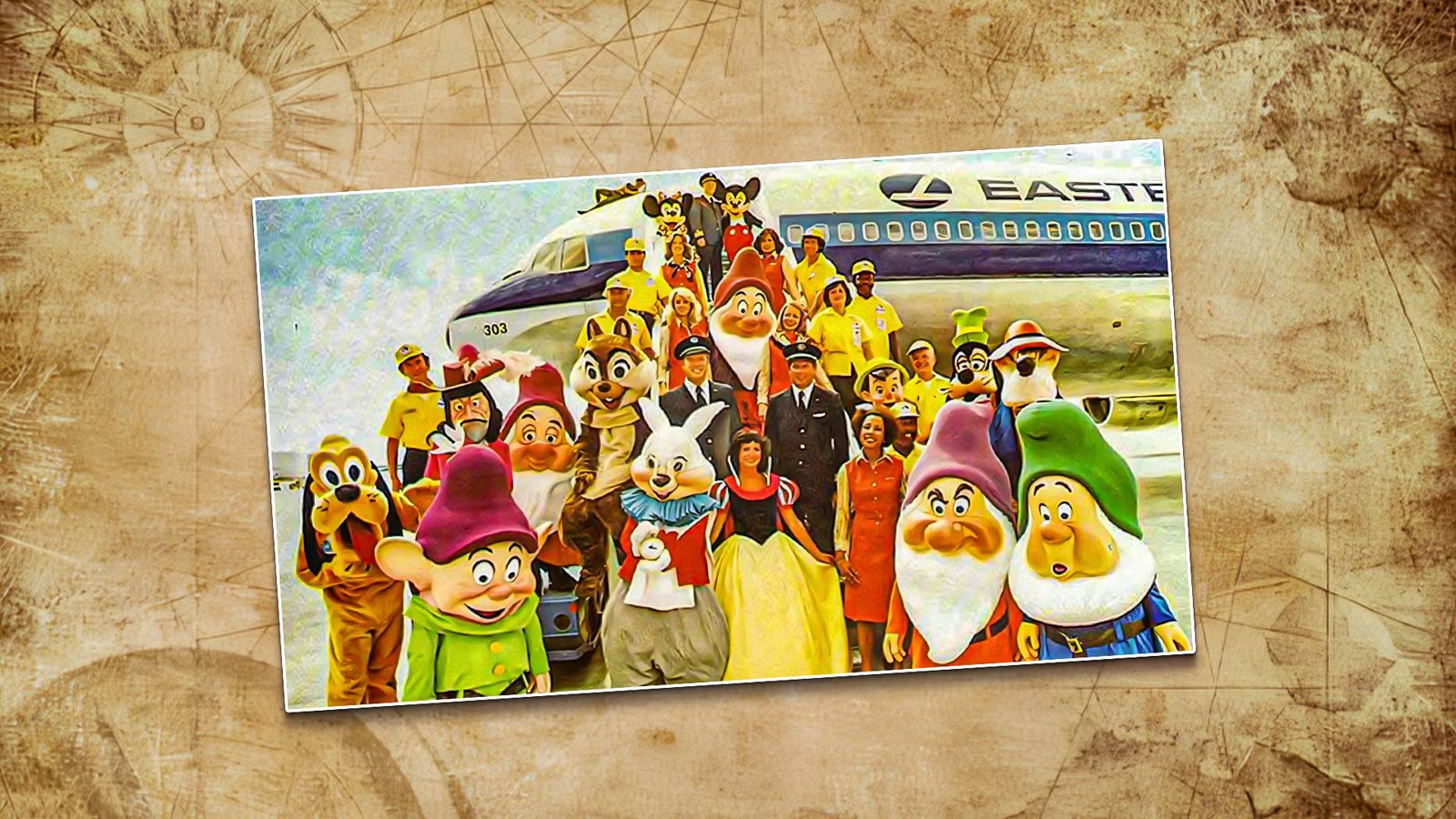
On January 18, 1991, Eastern Airlines collapsed and suspended all services. For over two decades, this American carrier had served as Disney’s official airline. The logic for the partnership was clear: Eastern Airlines also began serving Orlando in 1971, the same year Disney World Resort opened its doors.
In this article, we detail the carrier’s relationship with Disney, including its sponsorship of a specially built ride. We then look into the history and collapse of the carrier, and its 21st-century revival.
Official Airline From The Very Start

Walt Disney World Resort opened on October 1, 1971. From the very start of Disney World’s life, Eastern Airlines served as the official carrier, including during the buildup to the official opening. This official status was made clear in advertising for Disney World, including in travel agents, travel catalogs, and National Geographic.
Without the advent of price comparison websites and the other services we now rely on to book flights, the choice was clear for most Disney World guests. The situation created an effective monopoly.
It isn’t the only partnership that Disney has formed with an airline, but Eastern was the only airline to be granted the official title. Trans World Airlines supported a rebirth of New Tomorrowland’s Flight to the Moon, and United Airlines sponsored the ‘Enchanted Tiki Room’ in 1964.
An Airline With Its Very Own Ride

Owing to the success of the partnership, Eastern Airlines and Walt Disney World negotiated the carrier’s sponsorship of a ride. Set in Magic Kingdom, it was called If You Had Wings. It was a slow-moving ride for families, showcasing the destinations that could be visited by Eastern Airlines. Disney had previously gained sponsorship for pre-existing rides, but this was the first time it was creating a new ride at the behest of an airline. Disney was reported to have put a price on this service of $10 million, worth around $70 million today.
Guests to Disney World in those days will remember highlights, such as a bird that transforms into an airplane. The entire ride was soundtracked by an original song called ‘If You Had Wings’.
The ride remained open when the sponsorship deal expired, with Disney renaming the ride ‘If You Could Fly’ in June 1987. However, it was closed in January 1989 in a move thought to be permanent. It was then taken over by Delta Air Lines and named ‘Delta Dreamflight’. The ride remained the same, but the scenery changed. Delta’s sponsorship ended in 1996, and the ride became Take Flight, closing two years later. Now, the space is used for ‘Buzz Lightyear’s Space Ranger Spin’, which features many elements similar to the ‘If You Could Fly’ ride. However, the ride itself has changed, with rotating carriages.

Should The Walt Disney Company Launch Its Own Airline?
Disney would face challenges in launching its airline, but its unique brand could help set it apart.
The Collapse Of Eastern Airlines And The End Of A Tight Partnership

Eastern Airlines found enormous success as the official airline of Disney World, as it had achieved a near monopoly on flights to Orlando for this purpose. That made the partnership incredibly lucrative for the carrier in the 1970s and the first half of the 1980s. That changed as other airlines began to cotton on to the enormous amount of business to be had taking guests to Disney World. Eastern’s competition worked to market their flights to Orlando specifically and make booking far easier. These ‘no-frills’ carriers were precursors to today’s budget airlines, able to offer inferior basic services for substantially lower prices. Now guests had less reason to stick with Eastern Airlines.
With losses mounting and an approaching $9.5 million fine from the FAA for safety violations, Eastern was sold to Texas Air in 1986 and placed under the leadership of Frank Lorenzo. His tenure was wrecked by horrendous labor disputes due to his asking mechanics and ramp service employees to accept significant pay cuts. Lorenzo decided to lock out the company’s workers represented by the International Association of Machinists and Aerospace Workers (IAM) in March 1989. That was a sticking plaster. Pilots represented by the Air Line Pilots Association (ALPA) and flight attendants represented by the Transport Workers Union (TWU) organized a sympathy strike to destroy the carrier’s domestic services.
The same month, Eastern filed for bankruptcy. The measure allowed the airline to continue operating at a smaller scale, but it was the beginning of the end. Lorenzo lost his job in April 1990, and the company never fixed its cash flow issues. At midnight on January 19, 1991, the carrier stopped flying. The embedded Facebook post shows the letter sent to all remaining employees who lost their jobs in the shutdown.
Eastern Airlines’ Origin

The Eastern Airlines story begins long before its partnership with Disney. The carrier was formed in 1920, merging air travel companies like Florida Airways and Pitcairn Aviation. Initially owned by General Motors and operating a network that included destinations like New York, Washington, Chicago, and Miami, Eastern Airlines was bought by the First World War flying ace Eddie Rickenbacker in 1938.
Under Rickenbacker’s ownership, Eastern became enormously successful and never required state subsidies. However, his refusal to acquire expensive jets led to his replacement by Malcolm A. MacIntyre as CEO in 1959. Rickenbacker eventually retired entirely from the carrier in 1963. He was aged 73. The carrier was now under a new management team led by Floyd D. Hall and ready for the jet age. Its first jets were Douglas DC-8-21s, acquired in 1960. Specifications for this aircraft are listed below and are taken from Commercial Aircraft of the World data:
Capacity | 177 |
|---|---|
Wingspan | 142.4 ft (43.4 m) |
Length | 150.7 ft (45.9 m) |
Maximum takeoff weight | 276,000 lb (125.2 t) |
Range | 4,050 nmi (7,500 km) |
Engines | 4 x P&W JT4A |
The DC-8s took over Eastern’s longest flights, including from Chicago and New York to Miami. These were joined by Boeing 720s in 1962 and 727-100s in 1964. The carrier had collaborated with American and United Airlines to help develop the aircraft. Later, it became the first US airline to fly the Airbus A300 and was the launch customer for the Boeing 757.

The Last Plane In America With Piston‑Engine Propellers
Discover the Douglas DC-7, America’s last piston-engine airliner, and its legacy before jets took over the skies.
The Eastern Airlines Revival

Although Eastern Airlines’ glory days are now long in the past, a Phoenix airline has sprung up to carry on its legacy. Dynamic Airlines was originally founded in 2010. However, it changed its name in 2018 to become Eastern Airlines following a bankruptcy restructuring and a licensing agreement formed with Swift Air. Such an agreement makes sense, as Kenneth M. Woolley owned a 50% stake in Dynamic Airlines until its bankruptcy. He also co-owns Swift Air.
The carrier currently operates a fleet of 4 Boeing 767-300ER and 2 Boeing 777-200ER. Aircraft in its former fleet include other Boeing 767 and 777 variants, as well as the McDonnell Douglas MD-88. Since December 2023, the carrier has not operated any scheduled flights. Previous scheduled flights were from its Miami hub to destinations like Georgetown (Guyana), Montevideo (Uruguay), and Santo Domingo (Dominican Republic). It has interline agreements with Hahn Air.
Although carrying the Eastern Airlines name, the carrier does not match its predecessor’s commitment to facilitating family holidays. It is noteworthy for its contract with US Immigration and Customs Enforcement (ICE), under which it conducts deportation flights to South American nations like Brazil and Venezuela.
Will Disney Ever Have Its Own Airline?

In 2024, Simple Flying’s John Pullen set out to answer this question, asking if, considering the vast number of people traveling to a multitude of Disney-owned destinations, the company should launch a carrier. Disney already offers bundles helping guests with their logistical needs, including food, hotel accommodation, and park tickets. Expanding to a carrier would mean that guests spend an even higher proportion of their holiday money on Disney services, whereas the park currently loses travel revenue to airlines. The company could also streamline its customer experience by offering ‘all-inclusive’ packages.
Another factor that could make a Disney-owned airline feasible and successful is the enormous amount of data it has on its guests. Disney knows more than anyone else about where their customers are coming from, how frequently they visit the park, and how much they are prepared to spend while on vacation.
Moreover, the carrier has the undeniable potential to be incredibly popular. It has a vast amount of family-loved intellectual property and characters that it could use to create a wonderful themed experience. That would distinguish itself from the competition, also flying into Orlando, even if it can’t keep up with the cost-cutting skills of large budget carriers.
Ultimately, entering the aviation industry would be incredibly risky. Modern airlines face prohibitive start-up costs. A single Boeing 737 MAX, a jet likely flown by a hypothetical Disney airline, costs in excess of $100 million. However, if Disney is bold enough to take this risk, it could open up a fantastic new revenue stream.

![Luxair’s Massive Expansion: 11 New Routes Launching In 2026 [Map]](https://dailynewsnblog.com/wp-content/uploads/2026/07/shutterstock_2493499699_cropped.jpg)