dailynewsnblog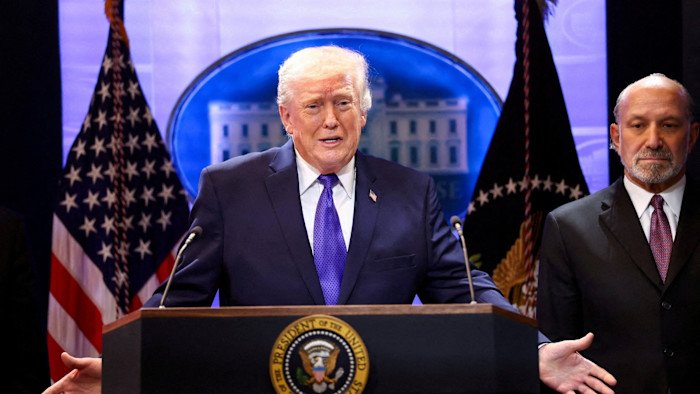
This article is an on-site version of our Trade Secrets newsletter. Premium subscribers can sign up here to get the newsletter delivered every Monday. Standard subscribers can upgrade to Premium here, or explore all FT newsletters
Welcome to Trade Secrets, where, not for the first time, matters of trade seem like slightly surreal distractions from the extraordinary actions the Trump administration is doing elsewhere, this time bombing Iran. In any case, back in our wheelhouse, the fiercely complex process of trying to claim refunds for the emergency IEEPA tariffs is now under way. I wrote about this in last week’s column, particularly the glorious fact that a bunch of these payments will go to Chinese companies but none direct to the American consumer, and talked about the issue with my excellent colleagues on the FT’s Unhedged podcast on Friday. In this week’s newsletter I go through the latest in that particular battle, including signs that the administration will — SURPRISE! — try to resist the payouts, and give a rundown of his other options. Charted Waters, where I look at the data behind world trade, is on the renminbi.
Get in touch. Email me at alan.beattie@ft.com
Getting your money back
It was never going to be easy, was it? I mean it was a clear Supreme Court ruling against the IEEPA tariffs with a solid 6-3 majority, and the administration even promised in a court hearing in December that it wouldn’t stand in the way of the tariffs being repaid even if they had gone through the final “liquidation” process.
And yet here we are with Trump sending out a Truth Social post on Friday musing about a “Rehearing or Readjudication [sic] of this case”. (Where would this be? Some super-Supreme Court of whose existence we were previously unaware, il Supremo di Tutti i Supremi?) Later that day the administration filed at federal court to delay even the discussion of the refunds for 90 days. If there’s a worse loser than Trump, I’d like to see them in action.

Treasury secretary Scott Bessent, who hasn’t quite turned out to be the voice for calm reason he was cracked up to be, said earlier in the week that the refund process wouldn’t even start for a month. He also criticised FedEx, which has filed a case for refunds and has talked about passing it back to consumers.
This kind of thing, as I’ve suggested before, is one of the reasons I think the Trump administration trying to drag feet on the refunds is a really bad idea. There’s clearly going to be a move by retailers and distributors to compensate their customers as a marketing exercise. I’ll share again here the website set up by the games company Cards Against Humanity, which should not be clicked on by those easily shocked by profanity, and it’s obviously not going to be the last.
Similarly I had an exchange last week with Alex Fine, the chief of Dame, a sex toy business (I have the BEST contacts, I tell you) which manufactures and imports its products from China and hence got clobbered by tariffs. She said the company had increased prices just last month and that the customers were well aware that the rise was caused by tariffs. “We are confirmed to return some of that to our customers,” Fine said. “It feels like the right thing to do and customers will respond to it.”
So if Trump keeps digging in on the refunds, he will be standing in the way of companies giving money away to people playing party games and using sex toys, possibly simultaneously. No one will benefit except a bunch of lawyers, most of whom are probably well off enough to pay tariffs on said entertainment products in any case.
Trump’s fallback options
IEEPA is dead; long live Section 122, the tariff authority supposedly aimed at resolving serious balance of payments problems, which Trump has alighted on as his stopgap until he has managed to get the Section 232 (national security) and Section 301 (unfair trade) tariffs up and going. In this section I’m mainly doing a bit of catch-up, pointing you to things that cleverer people than me have written about whether these tariffs are objectively justified (mainly no) and whether they can stand legal challenge (probably for long enough). There’s a great rundown of all of this in former Joe Biden administration official Peter Harrell’s paper here; see also a very critical take on the Section 122 in Foreign Policy magazine here, and academic and former policymaker Jennifer Hillman, who predicted the Scotus IEEPA decision, on Section 301 here.
First of all, the Section 122. The canonical economic critique has come from former IMF second-in-command Gita Gopinath, who points out that persistent trade deficits under a floating exchange rate are somewhat akin to high cholesterol whereas the Section 122 is designed for the equivalent of a heart attack, a balance of payments crisis under a fixed exchange rate system which drains official reserves. Extending the metaphor, using it now would be like employing a defibrillator when all you really need is some statins and 10,000 steps a day.

But is it unconstitutional? Much less obvious, because to rule against it requires the courts to go beyond the objective case of whether a balance of payments problem exists to rule on whether it can overturn a presidential determination that it does. In any case, given the length of time needed to exhaust the appeals process to the Supreme Court, the tariffs ought to be able to last the 150-day limit after which presidential authority to impose them expires.
As for the other two tariff authorities, Trump’s use of the Section 232 is also essentially bogus because it relies on emergencies he himself has decreed which usually don’t make much sense. In Trump’s first term he put a Section 232 on steel, supposedly to protect domestic supply for the US’s security and defence needs, only to have then defence secretary Jim Mattis telling him not to bother since the military had steel coming out of its ears. However, courts have usually been deferential to the president on national security, so although there are questions about the breadth of the measures he has been using Section 232 to impose, he’s more likely to get away with it.
The Section 301 tariffs are potentially vulnerable because they are supposed to be targeted at particular countries for particular alleged transgressions, not used as a flexible global catch-all tariff in the way the IEEPA ones were. As Harrell concludes, the outcome of any litigation against the Sections 122, 232 and 301 tariffs may very well turn on exactly how well they are designed and implemented to fit within the legal authority.
But ultimately, I find it hard to imagine a majority on the current Supreme Court being sufficiently reckless about its own standing and the calm of the financial markets to leave Trump with no substantial discretionary tariff powers at all. At the very least, I find it hard to imagine that the court is going to go on a striking-down spree that will leave him weaponless before November’s midterm elections. I have, however, been completely wrong before.
Charted waters
Against the threat that Trump could always turn his mind to currency war if the tariff version palls, the Chinese renminbi has strengthened in the first weeks of 2026, though with the authorities trying to ensure stability by intervening to slow its rise.

Trade links
Mark Carney has started a tour of the “middle powers” with a visit to India.
My FT colleague Martin Sandbu looks at the economics of war after four years of the conflict in Ukraine.
Shipping in the Gulf and Strait of Hormuz will be affected by insurers raising their premiums by as much as 50 per cent because of the US and Israel attacks on Iran.
EU member states are arguing over the extent of “Buy European” policies to direct more procurement to domestic economies.
Just to add farce to tragedy, Trump apparently thinks that the same authority that gives him the right to use IEEPA tariffs can also be used to take control of running the forthcoming midterm elections.
Trade Secrets is edited by Jonathan Moules
Recommended newsletters for you
The AI Shift — John Burn-Murdoch and Sarah O’Connor dive into how AI is transforming the world of work. Sign up here
FT Swamp Notes — Expert insight on the intersection of money and power in US politics. Sign up here