dailynewsnblog

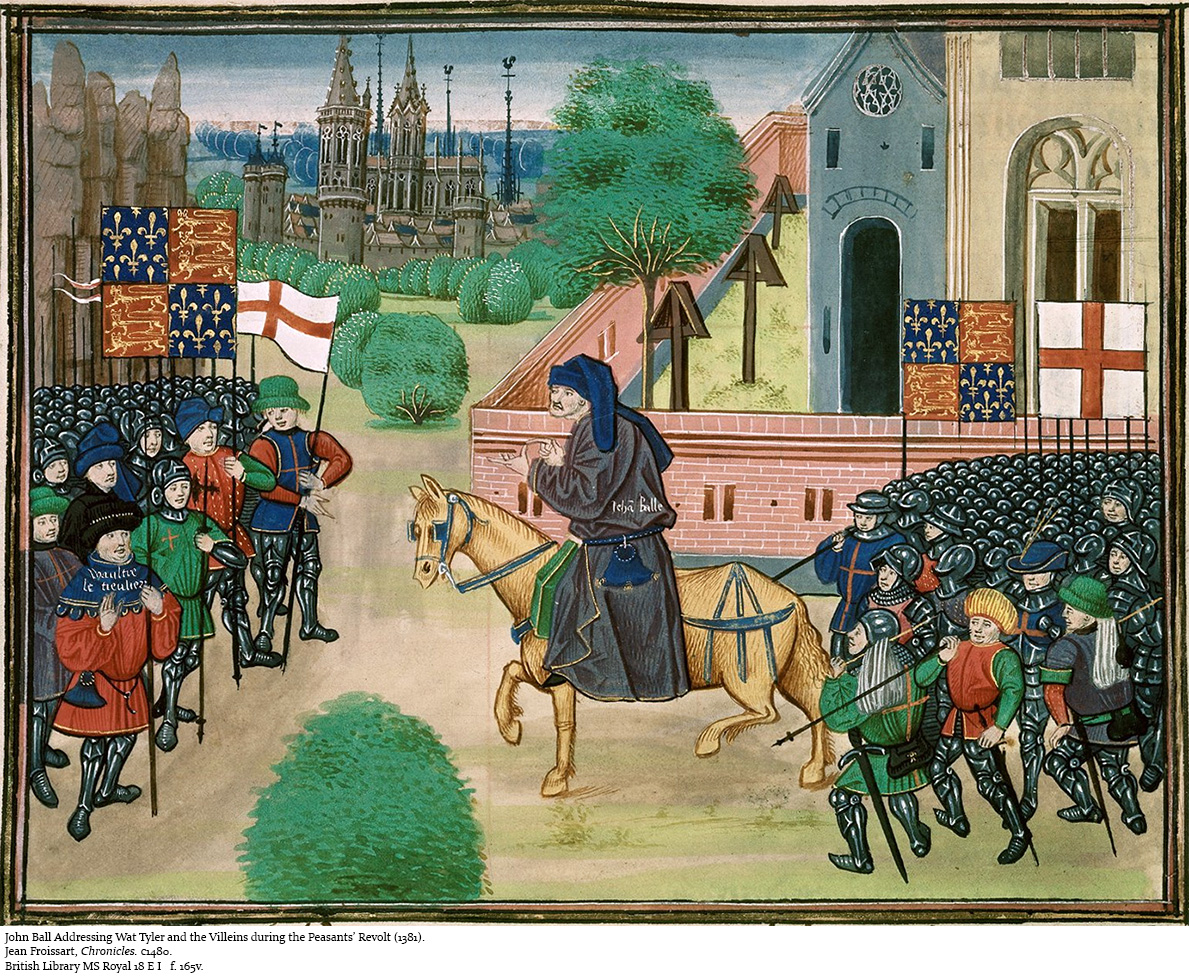 Thirteen eighty-one. Almost 650 years ago in the time of Chaucer, the English people did something unprecedented: they rose up against their oppressive king and nobles. It is known today as The Great Revolt. It should serve as a lesson for the American people today to take to heart. An uprising against the dictator and his fascist administration is overdue. Trump — who started a war with Venezuela and Iran, demanding “regime change” in both — should look to his own people who are demanding the same thing at home. Many of the issues that triggered the English uprising are happening in the USA today: inflation, high taxation (tariffs), corrupt officials, recovering from a pandemic, and unpopular wars.*
Although later historians and aristocrats would belittle and even denigrate the event and label it “the Peasants’ Revolt” or even “Wat Tyler’s Revolt” after one of its several leaders, this widespread uprising was earth-shattering for the rulers of England. Don’t be fooled by the later titles, the attempts to lessen its impact or its relevance to today.**
The Great Revolt is not alone in history. Over the centuries, the under-classes — peasants, workers, downtrodden, poor, serfs, indentured workers, slaves — have risen up hundreds of times against the ruling class in many nations worldwide. Nor was it the first: similar uprisings have been recorded since classical times, although this was the first such rebellion recorded in English history. Some of those uprisings resulted in victory for the under-classes, although, sadly for the peasants, not The Great Revolt. ***
It was sparked by the imposition of a poll tax in 1380 to raise money for the king’s ongoing, financially unsustainable war against France (the Hundred Years’ War), by taxing the peasants. Of course. That was the third imposition of oppressive taxation to pay for the increasingly expensive war in the past five years, and even more costly and widespread than the previous two. The war itself had been raging almost 50 years, and was deeply unpopular. On top of that, the war and the subsequent plague caused international trade to collapse. In 1381, one of the king’s tax collectors, the notoriously corrupt John Bampton, started a riot over his rough attempts to collect unpaid poll taxes from Essex. The riot spread and grew across southern England, led by a handful of men determined to end the widespread corruption of officials, and establish the people’s rights.
England, like the rest of Europe, had been slowly recovering from the devastation of the Black Death. It arrived in England in 1348 and stayed until the end of 1349, killing between 40 and 60 percent of the population. It returned in 1361-62, killing about 20 percent of the survivors and displacing many of the remaining population. The deaths of so many caused massive labour shortages particularly among farm workers, and left entire villages empty. Food shortages were common because fields and livestock were left untended. Inflation was rampant.
As normalcy returned, survivors demanded higher wages and better living conditions for their work, but the landowners resisted paying it (when they weren’t busy scooping up all the vacant shareholdings around them). The nobles and aristocracy then were like today’s billionaires who fight against unions, labour laws, and paying higher wages. To keep the irksome peasants down, King Edward III passed the Ordinance of Labourers, fixing wages at pre-plague levels and in 1351, Parliament then passed of the Statute of Labourers to reinforce the edict. You can imagine how popular those were. Laws could not stifle the workers’ demands: their wages and buying power rose over the following decades. In response, Parliament passed A Statute Concerning Diet and Apparel, a sumptuary law to “prevent them from consuming expensive goods formerly only affordable by the elite.”
Wikipedia notes, “The labour laws were enforced with ruthless determination over the following decades.” But landowners’ incomes fell, too, in part because they had little left to sell without the farm workers to harvest crops.
Again from Wikipedia:
…[the gentry] started to show an increased interest for offices like justice of the peace, sheriff and member of parliament. The gentry took advantage of their new positions and a more systematic corruption than before spread. A result of this was that the gentry as a group became highly disliked by commoners.
Low wages, inflation, taxes, war, a nation recovering from a devastating pandemic, declining international trade, corrupt officials, and a dictatorial ruler. Sound familiar? That’s the USA today. Consider, for example, the US federal minimum wage, always kept well below any ethical measure of poverty. Lawmakers keeping workers poor and unable to climb out of poverty, while enriching the aristocracy, is one of the things that sparked The Great Revolt. ****
Also keep in mind the similarity of the poll tax with Donald Trump’s erratic and oppressive tariffs. These are taxes on American citizens, despite his frequent lie that foreign countries pay them. The nonpartisan Tax Foundation estimated they meant the average American household paid $1,000 more in taxes in 2025 and will pay another $1,300 extra in 2026. The group called the tariffs “the largest US tax increase since 1993.” And you know how much people like paying taxes. Tariffs have affected a decline in both international trade and visitors to the USA (the latter compounded by the violent, xenophobic ICE Brownshirts and their reign of domestic terrorism against immigrants, people of colour, tourists, and even American citizens).
 Add to that the egregious costs of the dictator’s military attacks on (so far) Venezuela, Nigeria, Somalia, Syria, Yemen, Iraq, and now Iran. Included in that list are the two illegal wars (Trump has no authority to start a war; only Congress has). The USA is the largest spender on the military in the world by far and taxpayers foot the bill for it and his arbitrary and illegal use of it. Just like in 1381. ****
The analogy falls short, of course, when we look for leaders of any opposition. Yes, there are some vocal critics of the administration among the Democrats, yes there have been public protests against the regime. But no clear, outstanding, capable and charismatic leader has arisen to organize the unrest into something substantial and lasting. We have not seen the likes of Wat Tyler, John Ball, and Jack Straw emerge. Not even a John Pym among them. No one to lead a nationwide revolt against the despotic Trump and his corrupt, criminal cabal of administrators and cabinet members — yet.
Perhaps in the coming months, as Trump maneuvers to cancel the midterm elections through his usual web of lies, deceit, insults, threats, and illegal edicts, someone will be seen as the champion to rally the people against the regime and restore democracy to the beleaguered nation.*****
Notes:
* Trump quickly backed down on his “regime change” demand for Venezuela, instead appointing the regime’s next-in-command (its vice-president and Maduro loyalist) to the top role. Trump refused to appoint the popular opposition leader because she won the Nobel Peace Prize and, despite her giving him her medal, Trump is deeply misogynist and pathologically jealous. Meanwhile the US has been stealing Venezuela’s oil and selling it, mostly to European corporations. Trump deposited the initial $500 million from the sales in a U.S. (aka Trump) -controlled private account in Qatar where there is no accountability for its use or prevention of its transfer to Trump’s personal and family accounts. Venezuelan oil sales have now topped $1 billion and so far none of it has gone to the nation’s creditors or people.
The war against Iran has killed its ‘supreme leader’ (who was 86) but the nation recovered within 24 hours and put in place a council to oversee the country and its response to Israeli and American attacks. The council includes the president, the head of the judiciary, and a senior cleric from the Guardian Council. It will rule until the Assembly of Experts selects a new leader. Actual regime change — moving from a repressive theocracy to a democracy by unarmed citizens — is very unlikely. “It’s hard for people with no arms in their hands to bring down a very tightly controlled regime that has a lot of arms.”
Should armed resistance arise in the USA against Trump’s overt fascism, it will likely give him cause to invoke the Insurrection Act, martial law, and send in the military to quell resistance. American blood will be shed on American streets. And, of course, midterm elections will be cancelled.
 ** From Wikipedia: The term “Peasants’ Revolt” does not occur in medieval sources: contemporary chronicles did not give the events a specific title, and the term “peasant” did not appear in the English language until the 15th century. In the eighteenth and nineteenth centuries it was generally known as “the Insurrection of Wat Tyler.” Recommended reading: England Arise: The People, the King, and The Great Revolt of 1381, by Juliet Barker.
** Wikipedia lists dozens of “peasant revolts” from 206 BCE (inappropriately labeled as ‘BC’) in China to the Zapatista uprising of 1994. Four of these took place in England: 1381, 1450, 1451, and 1549. That long list does not even include the French Revolution, or the Russian Revolution, both of which were uprisings against the ruling class by the under-privileged, albeit assisted by some of their contemporary ‘middle-class’ members. Nor does it include the numerous slave revolts, such as that led by Spartacus against Rome.
*** The US federal minimum wage was $7.25 in 2009 and has not increased since. The US dollar buying power for consumers is about 70 percent of what it was in 2009, so the real value of the hourly minimum wage is about $5. In January, 2025, a bill was introduced to increase the minimum wage to $10.59 an hour as of Jan. 1, 2026, and to “raise the minimum wage annually by $4 from 2027 to 2030.” But the bill was “Referred to the House Committee on Education and Workforce” and disappeared. It has not passed, although some states have raised their own minimum wage levels. CBS reported: “On Jan. 1, 2026, the minimum wage is set to rise in 19 states and 49 cities and counties, for a total of 68 jurisdictions, according to a report from the National Employment Law Project (NELP), an advocacy organization for workers.” However, NELP wrote that (emphasis added), “..some states continue to resist raising wage standards, particularly across the South, where the majority of the nation’s Black workforce resides. In 2026, a total of 20 states will keep their minimum wages at the federal level of $7.25 per hour, and 8 other states with wage floors above the federal rate will not increase their minimum wages due to the absence of inflation indexing. These policy choices deepen regional inequities and leave millions of workers vulnerable to rising living costs.” Just like the edicts against workers in Tyler Wat’s day.
**** According to data cited by Al Jazeera from the Armed Conflict Location & Event Data Project (ACLED), the United States has carried out, or participated in, 622 overseas bombings using drones or aircraft since 20 January 2025 (but counted prior to his war with Iran), when Trump returned to office. In that period, US forces have attacked at least seven countries. He has also threatened military action against Greenland (and thus against Denmark), Panama, Cuba, Colombia, and Canada, as well as his military murdering civilians on boats in the Caribbean and Pacific and his Brownshirts executing American citizens on the street.
According to DefenseBudget.org, the US military budget now tops one trillion dollars:
In 2026, United States is estimated to have spent $1065.2 billion on military and defense, representing 3.5% of the country’s Gross Domestic Product (GDP). This budget covers the armed forces including army, navy, and air force expenditures. United States is the #1 highest military spender in the world by absolute spending.
Compared to the previous year (2025), defense spending increased by 4.8%, from $1016.8 billion to $1065.2 billion. This change in the military budget reflects growing defense priorities.
The USA spends more on its military budget than the next ten countries combined, and more than triple the next spender (China, at $349 billion).
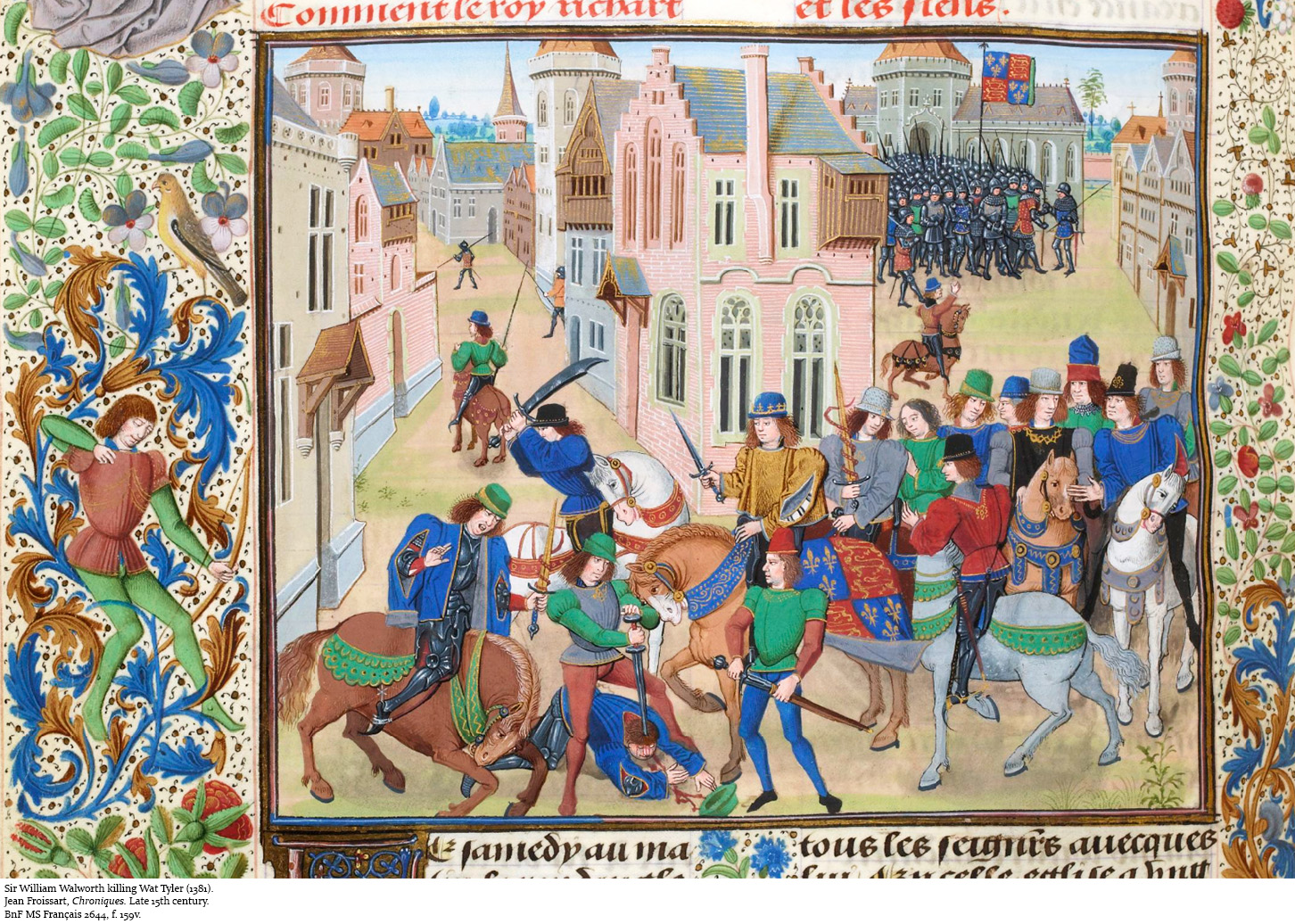 ***** The Great Revolt failed to achieve social change, in large part because Richard II lied when he agreed to the rebels’ demands. Tyler first met with the king at Greenwich to express the people’s demands, but the king was noncommittal. The rebels moved their army into London where it engaged in two weeks of looting and burning. The king, seeking to end the violence, agreed to meet Tyler again, this time at Smithfield in London.
At that meeting, Tyler demanded confiscation of all church lands, and “there should be no law but the ‘law of Winchester,’ and no outlawry; that no lord should henceforth exercise seigniory; that there should be only one bishop in England, and that the goods of holy church and the monastic foundations should, after suitable provision for the clergy and monks, be divided among the parishioners; and, lastly, that there should be no villenage in England, but all to be free and ‘of one condition.’ ”
Richard II promised he would do everything “consistent with the ‘regality of his crown,’” and urged Tyler and his followers to go home. Tyler remounted his horse to leave, but got into a fight with one of the King’s men, Sir John Newenton, over the latter’s disparaging remarks about him. The mayor of London, London, William Walworth, waded into the fracas and wounded Tyler in the neck and head. The badly wounded Tyler was taken by his followers to nearby St. Bartholomew’s Hospital. Later that day, the mayor had him dragged out and beheaded. Tyler’s head was paraded around London, then placed on London Bridge along with the head of Jack Straw, another recently executed rebel leader.
After Tyler’s death the government quickly ended the rebellion. Pockets of rebels were hunted down and wiped out. More than 145 rebel leaders were identified and hunted; those who were caught were executed and their property confiscated. In the week following, edicts and proclamations were produced “almost non-stop and messengers carried them to all corners of the kingdom.” They proclaimed the rebellion was over and “any promises made to the rebels earlier were withdrawn as they had been made ‘under duress’.”
King Richard then quashed any hopes that lingered of newfound freedoms for the rebels by saying of them, Villeins ye are still and villeins ye shall remain.
Words: 2,361