dailynewsnblog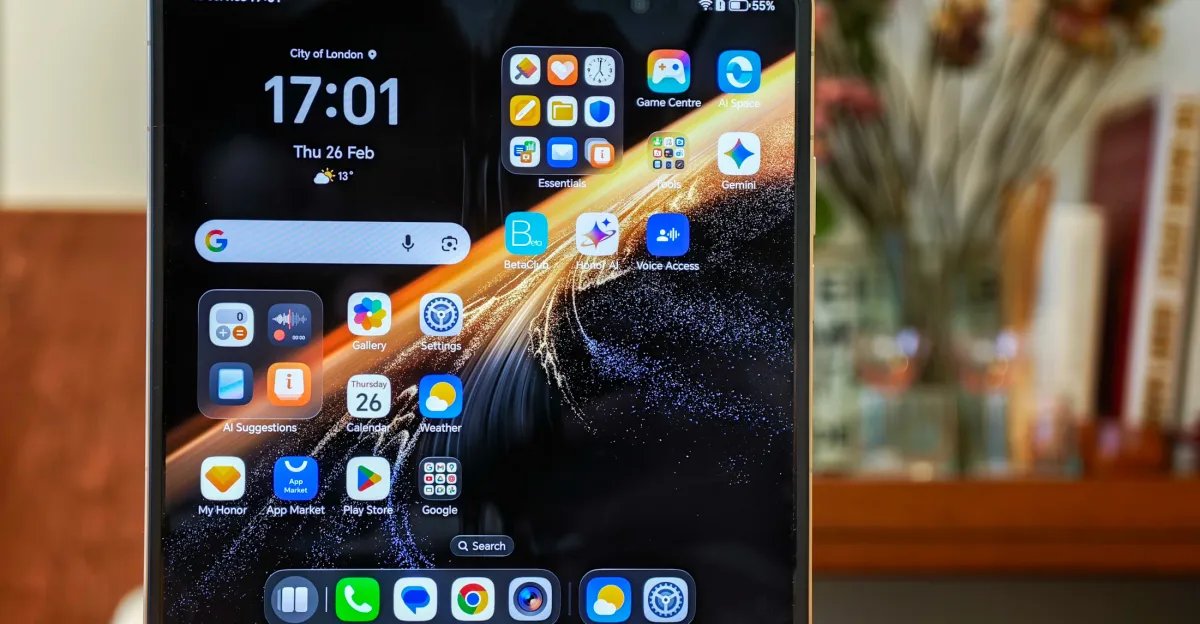
For the third year running, Honor has announced what it says is the world’s thinnest book-style folding phone. For the second year, it’s combined that with the biggest battery in any foldable too. This year, for its third and final trick, the company went ahead and made sure it was the first foldable with an IP69 rating too.
The Honor Magic V6 was announced at MWC in Barcelona today, though Honor has played a bit fast and loose with timing to guarantee those three records: the V6 won’t go on sale in China until some time later this month, and the international release is still months away, in the second half of the year, so Honor isn’t saying anything yet about pricing. Still, I’ve had a sample of the phone for a few weeks, so its big claims aren’t all hypothetical.
Last year Google proved its hardware chops with the Pixel 10 Pro Fold, the first foldable with an IP68 rating, meaning the maximum rating for dust protection and a near-top rating for water. Honor has one-upped Google with the Magic V6, which boasts both IP68 and IP69 ratings, meaning it’s rated for both immersion in water and exposure to high-pressure and high-temperature water jets. So now you can fold in both the bath and the shower, not to mention the inside of an industrial carwash.


The V6 measures 4mm thick when open, and 8.75mm when folded shut (well, the white version does — other colors are fractionally thicker). That’s the same as an iPhone 17 Pro Max, and thinner than previous foldables, but barely: it’s 0.15mm slimmer than Samsung’s Galaxy Z Fold 7, and only 0.05mm thinner than last year’s Magic V5, though Honor has slimmed its bulky camera module down a touch too. We’re deep into hair-splitting territory now, but it still remains delightful that a foldable can feel as thin as a standard slab smartphone.
More impressive is the battery. The Magic V6 has a huge 6,660mAh battery, up from 5,820mAh in the V5, and a full 50 percent larger than the Z Fold 7’s 4,400mAh. I haven’t spent enough time testing the phone to have a good sense of how long that battery lasts in practice, which I’ll save for a full review closer to when it actually goes on sale, but even with two screens I’d expect it to breeze through the day and then some. The big battery was my favorite part of the Magic V5, and now Honor has pushed it even further.
You might have guessed by now that Honor’s achieved the trick by using a silicon-carbon battery. This year it’s bumped the silicon content up from 15 to 25 percent, which has allowed it to make the battery even more energy-dense than before. The company claims to have developed a 32 percent silicon battery too, which will be exclusively available in the 1TB version of the V6 in China — Honor won’t yet say how big that battery will be, but it’ll apparently break the 7,000mAh line.


Other specs are typically high-end: a Qualcomm Snapdragon 8 Elite Gen 5, 16GB of RAM and 512GB of storage, stylus support on both screens, 80W wired charging, and wireless charging too — though not magnetic Qi2. The triple rear camera includes a 64-megapixel, 3x periscope that Honor claimed in a press briefing is “the best telephoto in a foldable.” I can’t give that a fair test yet since my sample phone is still on pre-release camera software, but I’d be surprised if it can beat the telephotos on Vivo’s recent foldables.
The Magic V6 has one more trick up its sleeve: Honor has leaned further into its efforts to build cross-compatibility with Apple devices. The Magic V6 will apparently be able to support the full software feature set of AirPods, even including Find My tracking (though, oddly, it will not support any other Find My devices). That’s in addition to the ability to sync notifications to an iPhone, send them to an Apple Watch, and share screens and files with iPhones or MacBooks. Honor didn’t confirm to me if it has plans to join Google in supporting AirDrop, but you have to imagine it’s in the works.
The V6 may not be quite as outlandish as Honor’s gimbal-equipped Robot Phone, also shown off at MWC. Each of its three records would feel quite minor in isolation, but hopefully they add up to a meaningful upgrade. We’ll find out for sure when the phone actually launches later this year.
Photography by Dominic Preston / The Verge