dailynewsnblog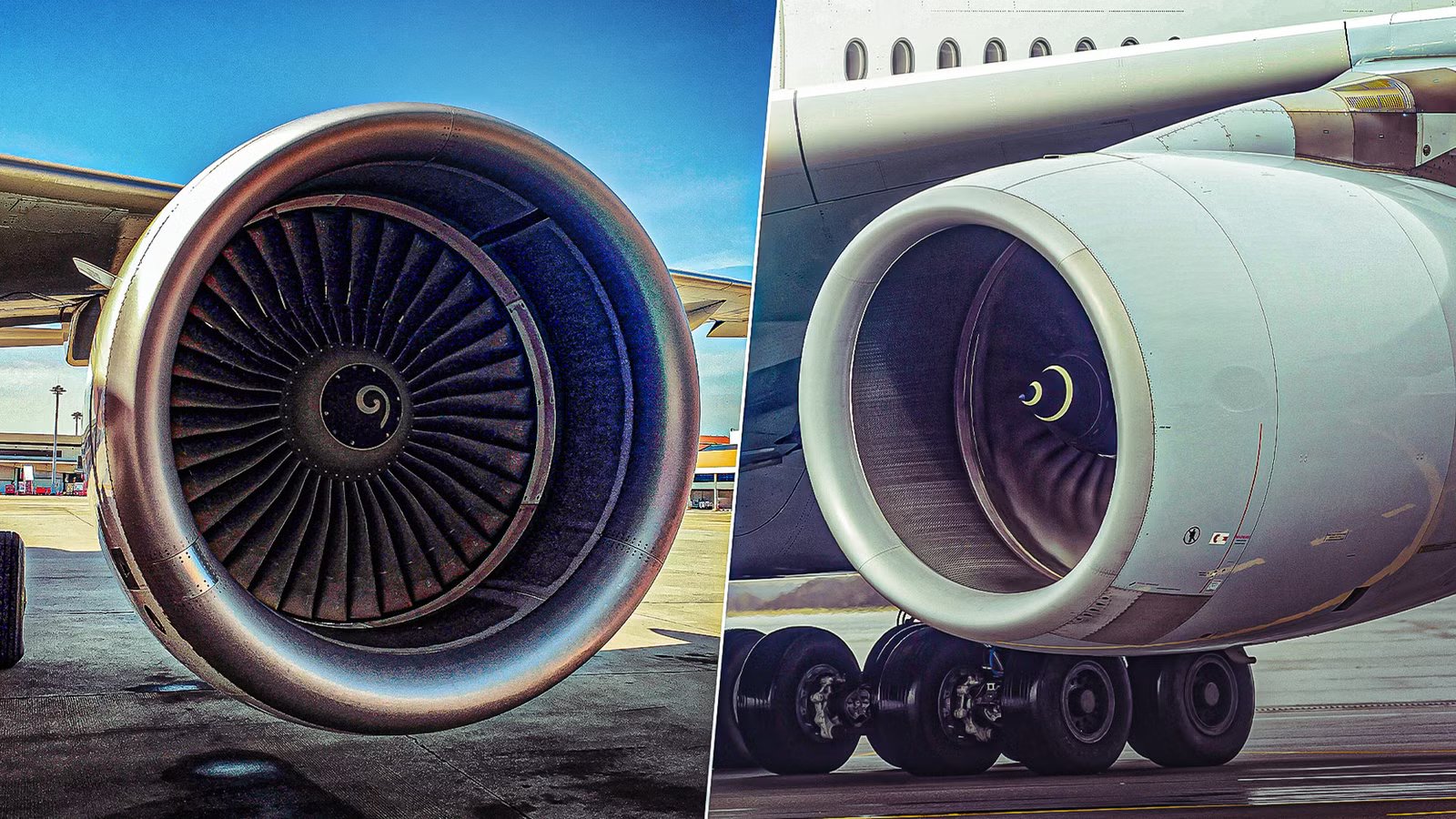
Stand next to an Airbus A380 on an airport ramp and the first thing that overwhelms you isn’t the height of the fuselage—it’s the engine. The circular inlet towers over a person, and up close, it feels less like an aircraft component and more like a standalone piece of industrial machinery. By comparison, an Airbus A320’s engine looks tidy and compact. It’s still a big turbofan, but next to the A380, the difference in presence is unmistakable. So how different are they, really? Once you get beyond the vague impression of “bigger,” the numbers make the gap feel even wider. Fan diameter, thrust, bypass ratio, and core architecture all point to the same conclusion: these engines sit in entirely different classes.
But this isn’t just a story of scale for scale’s sake. The starting point is physics. Aircraft have mass, and as mass increases, the lift requirement rises. More lift demands more speed, and reaching that speed requires more thrust. That simple chain is what ultimately drives both engine size and engine count. The A380’s Rolls-Royce Trent 900 and the A320’s CFM56 are two different answers to two very different physical requirements. Here’s how the comparison breaks down—step by step.
It All Starts With Physics

Aircraft design begins with first principles. Picture an airliner accelerating for takeoff: release the brakes, set thrust, and the aircraft starts to build speed. The force required to accelerate is proportional to mass. Increase the mass, and you need more force to achieve the same acceleration. In an aircraft, that force is thrust. But takeoff isn’t only about acceleration—it’s about flying. Lift must match weight for level flight. As weight increases, the lift requirement rises, and the aircraft must reach a higher speed (or rely on more wing area and high-lift devices) to generate that lift. During takeoff, the speed piece matters most: until the aircraft reaches the required airspeed, lift is short.
Category | Airbus A380 | Airbus A320 |
|---|---|---|
Entry Into Service | 2007 | 1988 |
Typical Seating | 500+ | 150–180 |
Maximum Takeoff Weight (MTOW) | ~575 tons | ~80 tons |
Engines | 4 | 2 |
That’s why higher weight cascades into higher thrust demand. Apply that logic to the A380 and A320, and the difference becomes obvious. The A380’s maximum takeoff weight is around 575 metric tons. The A320 sits in the 70–80-ton range. That’s close to a seven-to-one gap in mass, which means the total thrust requirement lives in a different universe. An A320 can do the job with two CFM56 engines, each producing roughly 27,000 pounds of thrust. The A380 uses four Trent 900s, and each can deliver up to about 84,000 pounds of thrust. Total installed thrust climbs past 280,000 pounds. The key point is this: the engines got bigger not primarily to go farther, but to lift something much heavier. Long range is the consequence; mass is the cause.
A Seven-Fold Difference In Mass

To understand why the A380 and A320 diverge so dramatically, you have to zoom out from the engine and look at the airframe’s mission. These two aircraft were designed around fundamentally different operating realities. The A380 was built to move 500+ passengers across oceans—an ultra-high-capacity platform aimed at routes where demand is concentrated, and airport slots are scarce. Think Dubai–Los Angeles or Singapore–London: long sectors where cruise efficiency matters, and where the economics hinge on moving a lot of people at once. The A320 is the opposite philosophy. It’s a 150–180-seat workhorse optimized for high-frequency, short-to-medium-haul flying—routes like Seoul–Tokyo or New York–Miami, where utilization, turnaround time, and operating cost per cycle shape the business case.

Superjumbo Service: Every Airbus A380 Route To The US In 2026
There are over 20 A380 routes to the US this year.
When the mass gap is that large, thrust demand naturally follows. The A320’s total installed thrust sits around 50,000 pounds. The A380’s four engines push it beyond 280,000 pounds. This isn’t a subtle difference—it’s a class change. It also helps explain why the A380 is a four-engine aircraft. When Airbus was finalizing the design in the late 1990s, the industry hadn’t yet standardized the combination of ultra-high thrust and long-range twin-engine operations the way it has today. As engine technology matured—think GE90 and later GE9X levels of capability—large twins came to dominate long-haul flying. The A320 never needed that debate. In the narrowbody market, economics win. More engines mean more weight and more maintenance costs, and you don’t get the same payoff you do on a 575-ton aircraft. For a single-aisle platform, two engines delivering “enough” thrust is the optimal answer.
Size Matters

Now put the engines side by side. The CFM56-5B’s fan diameter is about 68 inches. The Trent 900’s fan is roughly 116 inches. In diameter alone, that’s about a 1.7× difference—but diameter isn’t the full story. Inlet area scales with the square of the radius, which is why the A380 engine looks so disproportionate in person. On a pure geometry basis, the Trent 900’s inlet area comes out to roughly 2.8× the CFM56’s. Thrust mirrors that scale jump. The CFM56 sits at around 27,000 pounds of thrust. The Trent 900 reaches up to about 84,000 pounds. Even as a single-engine comparison, that’s more than triple. And, of course, the A380 has four of them.
Engine | Fan Diameter | Relative Inlet Area |
|---|---|---|
CFM56 | 68 inches | 1x |
Trent 900 | 116 inches | ~2.8x |
Architecture is another clear separator. The CFM56 is a two-spool turbofan designed around simplicity, reliability, and maintainability—exactly what you want in a global narrowbody workhorse. The Trent 900 uses Rolls-Royce’s three-spool layout, allowing different compressor stages to operate closer to their ideal speeds. That supports higher pressure ratios and strong efficiency, but it comes with added complexity—acceptable, even expected, on a flagship long-haul engine. Bypass ratio underscores the difference in design intent. The CFM56 sits around 5–6. The Trent 900 is in the 8.5–8.7 range. Higher bypass means more air is moved around the core at lower velocity, which is the path to better propulsive efficiency on long sectors. Weight also diverges sharply. The CFM56 is roughly 2.5 tons dry. The Trent 900 is more than 6 tons. At that point, you’re not just talking about an engine—you’re talking about a major structural and logistical element the entire aircraft has to be built around.

CFM56: Inside The Most Produced Commercial Jet Engine Ever Built
Over 32,000 of these jet engines have been produced.
Bigger Isn’t Just Stronger, It’s More Efficient

A bigger engine can look like it should burn more fuel. And at full power, it can. But efficiency isn’t about raw fuel flow—it’s about how effectively an engine converts fuel into thrust. Modern high-bypass turbofans are efficient because they move a large mass of air and accelerate it by a smaller amount. That approach generally produces the same thrust with less wasted kinetic energy in the exhaust—especially at cruise, where long-haul aircraft spend most of their time. That’s why the Trent 900’s high bypass ratio matters. The A380’s engine is designed to push a lot of air efficiently, and the payoff accumulates over hours at cruise altitude.
Category | Trent 900 (A380) | CFM56-5B (A320) |
|---|---|---|
Engine Type | High-bypass turbofan | High-bypass turbofan |
Spool Configuration | Three-spool | Two-spool |
Fan Diameter | ~116 inches (295 centimeters) | ~68 inches (173 centimeters) |
Maximum Thrust | ~84,000 lbs | ~27,000 lbs |
Bypass Ratio | ~8.5–8.7:1 | ~5–6:1 |
The tradeoffs are real, though. Big engines are heavy, structurally demanding, and complex. On a narrowbody, that can become over-engineering. The A320’s mission is short-to-medium-haul flying with high cycle counts, where dispatch reliability, cost, and maintenance simplicity matter as much as (or more than) peak cruise efficiency. So both engines can be “efficient,” but they’re optimized for different definitions of efficiency—different routes, different utilization patterns, and different economic models.
What That Size Means On The Ramp

The difference isn’t only academic. You see it immediately on the ground. The CFM56 is widely supported, standardized, and relatively accessible for line maintenance. The global narrowbody ecosystem is built around engines like that, and that shows up in tooling, logistics, and established maintenance practices. The Trent 900 operates in a different environment. With a dry weight of over 6 tons, removal and installation require heavy lifting equipment and specialized procedures. The A380’s engine isn’t just bigger—it imposes different requirements on ground operations and maintenance infrastructure.
Safety margins shift as well. Larger engines create larger ingestion zones, which raises the stakes for FOD control and ramp discipline. And engine size interacts with airframe geometry: narrowbodies typically use shorter landing gear, which limits ground clearance and constrains how large an engine you can physically mount without redesigning the entire aircraft. Putting a Trent-class engine under an A320 wing isn’t an engine swap—it’s a new airplane. In other words, engine size isn’t just a thrust number. It shapes the aircraft’s structure, airport compatibility, and day-to-day operational reality.
Engine Size As Strategy

Engine size is a technical outcome—and a strategic signal. The A380 is a product of the hub-concentration era: moving as many passengers as possible through major hubs where runway capacity and slots are scarce. In that model, very large aircraft and very large engines make sense. The Trent 900 exists to make that strategy work. The A320 supports the opposite: point-to-point growth and high frequency. Here, flexibility and operating costs dominate. The CFM56’s reliability, maintainability, and scale made it a perfect match for that world.
The market’s direction has been clear. A380 production ended, while the A320 family continues to grow. The center of gravity shifted away from ultra-high-capacity four-engine flagships and toward flexible, efficient single-aisles and long-range twins. So the visual contrast on the ramp is more than an aesthetic moment. The Trent 900 and the CFM56 reflect two different eras, two different network philosophies, and two different answers to the same underlying question: what’s the most efficient way to move people through the sky? Once you see that, the “engine size” comparison stops being a novelty—and becomes a lens for understanding how the industry evolved.