dailynewsnblog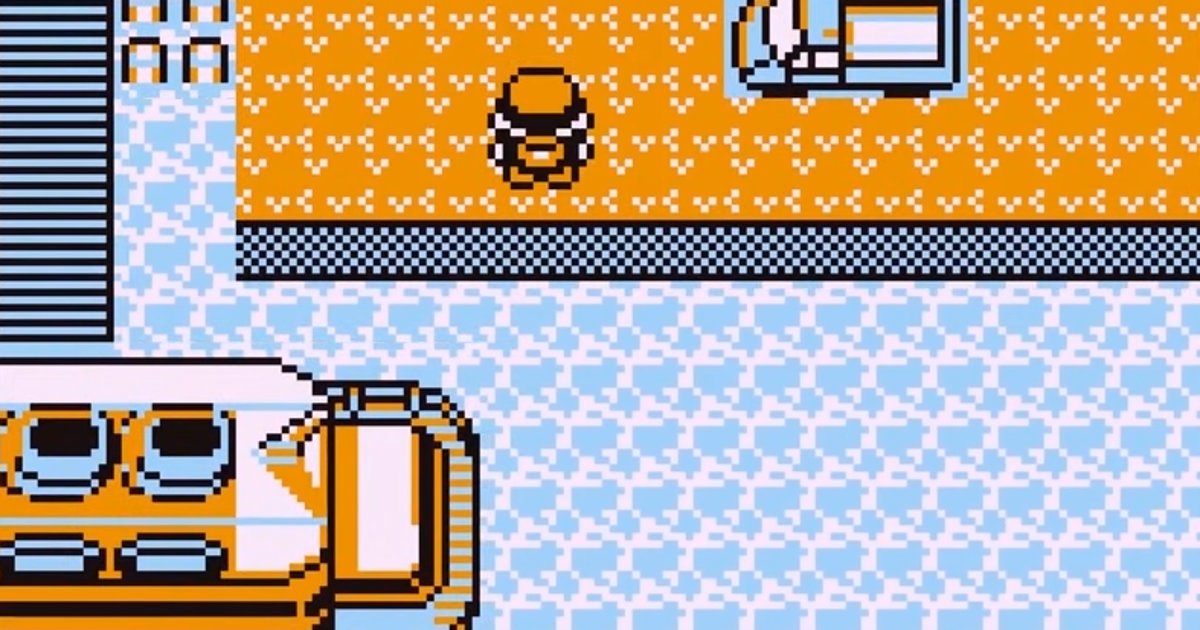
A special, long-form extract from ON Games Volume 2, which we’re featuring as part of our celebration of Pokémon’s 30th anniversary.
You’ve probably heard about the Mew that was hiding under a truck.
A secret, 151st Pokémon planted in Pokémon Red, Blue and Green, finding it required a brief, yet impetuous journey outside of regular bounds. Head south from Vermilion City, then surf just to the east of the short jetty which usually leads to a cruise ship, the SS Anne, soon bound for another undefined voyage around the world. There, beyond the ship, lies a small, apparently innocent patch of land. To reach that little bank, you’d need to blag your way past a ticket inspector – through glitch or other crafty workaround – and borrow a friend’s Pokémon; one that can use Surf before it’s properly allowed. Make the short hop across the harbour waters then and on the bank, parked conveniently just out of view from any legitimately reachable part of the world, you’ll find a single, abandoned truck. The only model of a truck, curiously, that’s been placed anywhere in the game. And under that mysterious truck, if you push it to one side with a Pokémon that knows the move Strength, you’ll find a Poké Ball. And inside that Poké Ball will be Mew.
There was, of course, no Mew hiding under that truck. But like so many great stories, the hard facts mean little next to a tale well told. Mew’s absence did little to stop the truck story from billowing outwards, engulfing the school yards of Japan, then North America and the rest of the world, eventually becoming the most widely spread playground legend of the modern age. If you were a kid in the 90s, your feet firmly planted at the epicentre of Pokémania, you knew about the Mew and that truck.
Like millions of other people now reckoning with their early-to-mid 30s – this story is more universal than it’ll ever be personal – a vastly outsized chunk of my childhood was defined by this one rumour. Armed with my dad’s original Game Boy (on which he had hitherto stoically chipped away at Tetris, and only Tetris), my copies of both Red and Blue, a Link Cable, and nary a friend with whom to actually trade, reader, I was obsessed. I tried everything to reach that cursed patch of land.
Unfortunately for seven-year-old Chris, I wasn’t much of a whizz at discovering glitches – and crucially, nobody in my particular playground actually knew the ticket inspector workaround. “Trying everything,” in my case, mostly boiled down to repeatedly talking to the same, stubborn NPC, bumping into the same few fencing tiles blocking the path, or just wistfully looking out towards the same passing rolls of the sea beyond, where my truck remained unmoved, my Mew forever undiscovered.
Instead, the mystery itself had to be sufficient. And it was, just as it was for those millions of other seven-year-olds at the time. Mew, even in its absence, was the beginning of a lifelong personal connection, one made to a series of games that always felt, for reasons I could never quite pin down, like it was somehow bigger, more real, than whatever it was showing in the few dozen 8bit pixels on screen.
“Sometimes the unsettled, unsolved mystery is more captivating than the one with an answer.”
Here’s the good bit, though: as time went on and my obsession evolved, from living the mystery to something closer to knowing it, I learned there was no Mew under the truck – but there was a secret, 151st Pokémon hiding somewhere in the game. And it was indeed Mew. The mythical, undiscovered Pokémon otherwise referenced only in whispers and scribbles, dotted across secret laboratories and tattered research notebooks in the games’ more sinister corners. The Pokémon that many had assumed must, surely, exist somewhere, if only by virtue of there being a real and very much catchable Mewtwo. It’s just that rather than some intentional, hidden Easter egg buried by developer Game Freak, a treasure just waiting to be unearthed on that little patch of land, the real Mew wasn’t meant to be found at all. Its discovery, and the subsequent rumours that turned Pokémon’s initially middling Japanese sales into a global mega-phenomenon, all happened entirely by accident.
Or at least that’s how most remember it. Mew’s story is one of gaming’s great fables, a blend of mystery and mythology, pure happenstance and genuine, ingenious intent. It’s the perfect example, I always felt, of this series at its very best. Ephemeral and strange, a game played on-screen and off, along a map’s edge, your feet astride real and virtual worlds, overlooking the unknown.
It’s also the perfect example of something I’ve come to feel, as I’ve grown up – or some might argue as the games themselves have been purposefully aged down – to be missing from the series’ modern entries. The great, multi-level dungeons of old, which once led to mythical and legendary Pokémon of their own, have been flattened in place of linear paths. Arcane mechanics have in time turned mundane, their hidden intricacies all solved, or simplified, or explained. A handful of impish young developers have, inevitably, evolved their way into a corporation that spans the world, with brand values and bottom lines, and which now handles the largest entertainment franchise of all time. I thought I’d go in search of the true origins to these old myths and mysteries here, maybe reminisce a little, pay homage to a series’ distant, gilded past. But much the same as Mew’s story, in doing so I realised the old myths are really just the half of it.

The original story of Mew, and Pokémon’s subsequent viral explosion, goes something like this:
With just a short time to go before Pokémon Red and Green’s initial Japanese launch, and their code locked after a desperate final round of debugging, Shigeki Morimoto, a programmer known for, among other things, a slightly mischievous spirit, took it upon himself to make one final, unauthorised addition. Removing the debugger freed up 300 bytes of space on the cartridge, he’d realised – just enough space for one more, very small, 151st Pokémon.
He decided it should be Mew – Game Freak had already referred to it in the game by name, if only in hushed and mysterious tones, but never intended to actually include it, so it made for a nice bit of fun for the team – then quickly whipped up a simple design and snuck it in, much to Nintendo’s apparent ire on its discovery later on (that debugging phase, it was later revealed, was then Nintendo’s most expensive of all time). Inevitably, introducing new code right after the debugging was finished also introduced, you guessed it, a new bug: a glitch that allowed players to find and capture a Mew that was never meant to be found.
That glitch actually happens in an entirely different part of the games, under circumstances far less enticing than the tall tales of mysterious trucks and dodging guards. But soon enough the rumours swirled, and an era’s great snowball began to roll. “The monthly sales we’d had up to then began to be equalled by weekly sales,” said Pokémon Company president Tsunekazu Ishihara in the years after, “before increasing to become three, then four times larger”. Eventually, the games topped Japanese sales charts – but not until over a year after their initial release.
The real story is a little more complicated. The runaway success caused by the inclusion of Mew was partially an accident – but it also wasn’t really an accident at all. The decision to include Mew wasn’t just Morimoto’s, for instance. It was actually the decision of the whole Game Freak team, led in particular by Ken Sugimori, the series’ legendary artist and designer, and Satoshi Tajiri, its fabled and now highly reclusive co-creator.
As a pair of teenagers in the mid 80s, Sugimori and Tajiri were arcade gaming fanatics, their obsession taking hold with one arcade game in particular, over which they originally met and bonded: Xevious. A game which achieved a kind of viral success of its own in the arcade scene, thanks to a strikingly familiar set of circumstances. A series of urban legends spread by fans about secret appearances of strange sprites, complex methods for finding Easter eggs, and characters and places that may or may not have been real. The credit for that nugget of development history, and indeed countless others, must go to a man called Kyle Tarpley, known to the internet as Dr Lava, and the loose network of fellow researchers, dataminers, translators and archivists with whom he works.
“My job is very, very tedious,” he tells me, as we begin to lay out his methods. “I don’t think there are very many people at all, especially YouTubers, who are willing to do that amount of tedium.”
What Tarpley is referring to here, with what I soon discover is a kind of signature curmudgeonly charm, is the lengthy process of finding, cataloguing, translating, refining, and editing together of material he goes through for his videos, which began as contributions to a channel of his own, Dr Lava’s Lost Pokémon, before he landed a full-time gig as a writer-researcher for a larger team. “I don’t even know why my boss pays me to do this,” he half jokes. “It’d be a lot more beneficial to crank shit out. Fortunately, he’s willing to pay me to do it the slow way.”
“There’s so many books and magazine interviews and everything else. There’s just thousands and thousands of pages, still untranslated, only in Japanese…”
An American living in China with his family, Tarpley skirts the border between dry wit and ever-so-slight cynicism in that lovably Gen X way, talking with a subtle, but unmistakable, Arkansan drawl. It’s the voice and tone of a man who might have spent his life on something admirably futile – tracking down escaped alligators, maybe, or playing sheriff to a small town with one persistent drunk. Instead, his talk of smoking guns and great hunts here refers to old development anecdotes and snippets of normally throwaway conversational detail, as he pores over thousands of pages of Japanese magazine and book interviews in search of untold secrets about Pokémon.
His method is, on paper, simple enough – albeit far from quick or easy. Through connections in Japan, or research of his own, he’ll find out about some conversation had somewhere by some designer on one of the early Pokémon games. He tracks down the original source material – say, an untranslated Japanese book on illustrative design, featuring a chat with Ken Sugimori (and plenty of other gems, such as Kingdom Hearts director Tetsuya Nomura) – then scans it, page by page. He runs those pages through DeepL, a more accurate machine translator than Google, then works his way through them looking for leads, cataloguing the extracts into files divided up by game. Once he finds a good one, he then sends that section off to be professionally translated, before searching through his many thousands of files for any similar references and working it all together into a narrative – if one ever emerges – to then finally convert into a video script.
Tarpley’s tried this in the past for a few series – Mario, Zelda – but Pokémon, he says, is different. Where those other games might garner a few thousand views, an equivalent video on Pokémon would do an order of magnitude more, scaling into the hundreds of thousands and beyond. He puts it down to the series’ longevity and the unprecedented amount of money it’s made in part, but also the fans themselves. “There’s something I just can’t put my finger on that gives it that special sauce,” he tells me. That brings in a particular kind of obsessive. And a particular kind of person – early 30s, tinged with nostalgia, we know the sort – that can’t quite leave their childhood behind.
“For people in my line of work,” he explains, “it’s the perfect franchise”. There’s a huge fan base, yes, but “they care about even the smallest stuff”. Together with a “virtually a bottomless well” of unused material to mine, Dr Lava’s videos are sheer magnetism to a viewer like me – obsessive, millennial, ever so slightly stuck in the past. “There’s so many books and magazine interviews and everything else. There’s just thousands and thousands of pages, still untranslated, only in Japanese.” The result is pure alchemy. You could translate barely a handful of pages, he says, “and just have gold, gold, gold, gold”.
One of those particularly bountiful sources – “so much gold” – comes in the form of a book by Tajiri himself, called A Catcher in Pac-Land, effectively a memoir of his teenage years spent across the many arcades of 80s Japan. It’s home to a gem of an anecdote, which Tarpley kindly relays.
A young Tajiri, obsessed with the urban myth-fuelled shoot ’em up Xevious, began to spread some rumours of his own about hidden secrets in the game – until that game’s creator, Masanobu Endō, a legend amongst Tajiri and his friends, turned up at the local arcade himself to debunk them. Tajiri was lambasted by his peers. “In one fell swoop, I went from being a missionary to being a con man,” he wrote. “I was criticised and stoned. When I went to an arcade, even people who had been my friends pointed fingers at me.” That’s until Endō returned, as though magnanimously descending from on high, to declare Tajiri a good kid at heart, after which his fellow Xevious fanatics ultimately allowed him to return.
Later on, in a roundtable interview with Sugimori and Endō himself that Tarpley again directs me towards (one that’s also quite possibly Tajiri’s last known public appearance, in 2016) Tajiri admitted he might’ve been embellishing just a little. He and Endō were actually quite regularly in touch, for starters, while Endō recalls he really enjoyed encouraging the weird rumours as well. For him this was all part of a plan; he’d intentionally cultivated a sense of mystery with Xevious, believing it to be far more fun that way, and also a clever means of spreading the word.
Crucially, that interview is another source that emphasises Tajiri and Sugimori’s overt desire to do the same – to recreate the playground mythology of Xevious, and its viral success, with a secret-filled game of their own. “I think it was important that Endō-san left the mystery vague. That’s why, even when people ask me various questions about Pokémon, I try not to answer too clearly,” said Sugimori. “The fact that you can enjoy it more deeply by leaving it vague is something I learned from my experience with Xevious, and hold dear.”
Tajiri, with admittedly a little question-loading from the interviewer, put it even more directly: “Without Xevious, there would be no Pokémon!”
Tarpley and his network of researchers and historians – unabashed fanatics themselves – pieced this together, along with extracts from other interviews and memoirs, to paint something closer to a true picture of Mew’s story. The Game Freak team, including the impish Morimoto, had actually thought they might release Mew someday, it turns out, and so having the special Pokémon in the code made for a nice option in the future if they ever decided how. In the end it came via a competition giveaway, post-truck rumour, in CoroCoro magazine. More than 78,000 people entered in Japan for a chance at just 20 authentic, numbered Mews, each delivered via Link Cable by Morimoto himself. I learn this, and try not to unravel at the thought of how many of those 20 priceless cartridges may have since been lost to time.
Likewise, that strange truck also has an origin story of its own. One cult datamining collective known as Helix Chamber discovered a lost city in some old prototype files, just south-east of Vermillion City – exactly where the truck could be found. What can be seen, in that half-built town? Two buildings. A Pokémon Center. And a single truck. It was simply left in the game by accident. Or perhaps because its very location – inaccessible, out of sight – meant the developers thought they could afford to just leave it there, safe in the assumption nobody would see it anyway.
For close-watching Pokémon fans, the irony isn’t lost: with Xevious, a leftover asset was the cause of one of its most infamous rumours – about a secret, Vietnam-era F-4 Phantom fighter jet the player could apparently summon in the otherwise entirely futuristic sci-fi shooter. Now, a game inspired by that same sense of mystery and viral myth had taken off into the stratosphere with a playground rumour of its own – all accidentally spawned by another rogue object in the code. It may have all come together by pure chance, but the circumstances around it – the scrawled notes about this mysterious, mythical Pokémon, the lifelong beliefs of Tajiri and Sugimori that some questions are best left unanswered – are proof enough to Tarpley: it was a happy accident, to borrow a phrase. One intentionally cultivated and allowed to grow.
“In the age of the Internet, is it even possible? Not like it was.”
I wonder aloud about whether these kinds of mysteries are even possible any more. If Pokémon could ever re-capture the magic, if its mythology can continue to grow, when datamining in particular – somewhat poetically, the practice that makes so much of this kind of archeology possible – has become so prevalent, the fanbase so rabid and well-attuned, that it’s just impossible to bury any secrets in a Pokémon game today. Or, in other words, if Tarpley’s “near infinite” well of material will one day prove finite. He pauses for a long time.
“I guess, no.” He offers his reasons. For one, with the newest games, the modern churn of everyday news means there’s an incentive to bleed each contemporary interview dry. “Every little snippet that comes out is going to be on the front page of Nintendo Life or Eurogamer.” The other is a bit of a half-truth: “There aren’t really magazines any more.” Or, he clarifies, at least not the same volume of magazines that operate in the traditional way: “There’s just not thousands of pages of untranslated material, that no one else has, that I can bring to life.” Dataminers, meanwhile, have become faster and more prolific – full game data, right down to the finest points of Pokémon locations, spawn rates, and damage stats that could only be uncovered with access to the game’s code now appear on hugely popular sites such as Serebii or Bulbapedia within hours of a new game’s release.
All that’s compounded by another problem: a Game Freak that has, as the series grew into a behemoth – its die-hard fans into a more demanding horde, and its developers more wary of controversy – simply become more buttoned-up and withdrawn. That’s something I can attest to: between 2016 and 2019, I had three interviews with series boss Junichi Masuda at Eurogamer. There have been no more since. The result, as Tarpley puts it: “There’s just not a pile of gold waiting to be dug up.”
The classic games and the many pages of untold history surrounding them will continue to be a gold mine, no doubt. But for Tarpley and his questing peers, that’s largely the sum of it. Pokémon’s period of myth and mystery has come to its natural end. “In the age of the internet, is it even possible?” he asks himself. “Not like it was.”
A man who goes only by his online moniker disagrees. Tahk0 (‘taco’) is a familiar face to any internet-enabled Pokéfan, a west-coast American in his early-to-mid 30s, he regularly sports a varsity jacket and a signature floppy, Fall Out Boy fringe that feels straight from the emo-skater era of the mid 2000s. He’s a professional pixel artist by trade (inspired by 8bit Pokémon) though like his real name he keeps the games he’s worked on strictly confidential. He’s known for a particular obsession with Pikachu.
I look at him, in front of a tastefully lit version of the classic content creator Kallax wall, filled with yolk-hued Pokémon memorabilia, and I see the nearly 50 million millennials who grew up playing Pokémon Red, Blue, Green, and Yellow in 1996 and beyond. And I see myself. On the surface, he is exactly the kind of person Tarpley is referring to when he talks about the 90s kids who refused to leave this one part of their childhood behind. But beneath the surface, he’s a man leading a quiet revolution.
“I do agree that, yeah, that era is over,” he says, of the time when Game Freak could hide a secret Pokémon in the game’s code. “But through researching that, you realise how that stuff got – I wouldn’t say ruined,” he catches himself, “because I feel like this is just a natural progression of human society”. For Tahk0, datamining, 24-hour coverage, and the instant global spread of information that the internet provides have instead simply forced Pokémon’s developers to adapt. “‘Ruining it’ puts this negative spin on it,” he says. “It was always going to happen. That’s just where society was headed – you can’t put the genie back in the bottle, so why complain about it?”
Much the same as with Dr Lava, I set up a conversation with Tahk0 because of a YouTube video. The difference this time is that Tahk0 is not a YouTuber, nor really a ‘content creator’ or anything of the sort. The video that drew me to him is called ‘There’s more story in Pokémon Legends: Arceus than you realize,’ and only he made it, in his words, “because – I don’t know why – people only listen to you if it’s in video form”. And he has some things he’d really like Pokémon fans to hear.
“The essence of Pokémon is outside of Pokémon… that’s why Pokémon is successful… it’s that it’s bigger than the game. From the beginning, it’s bigger than the game.”
Beneath the typical lore-hunter surface, Tahk0’s video is really a plea to think about games differently. “Let’s meet games halfway,” he says at one point, before pointing viewers towards a side project, a private group he calls the Lore Library.
(A pause here for a confession: I think lore, particularly game lore, is sort of bobbins. A lot of proper nouns got together, and so the universe was born, etc. This lore, thankfully, isn’t like that lore – if anything ‘lore’ is a bit of a misnomer.)
Tahk0’s Lore Library, he explains, is actually more like a book club. Every Sunday, he gathers its few dozen members to simultaneously watch either a game playthrough, a film, or an episode of TV, the group regularly pausing to take notes, capture screenshots or make observations, before everyone then discusses what they’ve watched. And rather than offering authoritative, outright declarations, they talk about how they’ve interpreted it, or what they think it might mean. “What is the emotion that I’m supposed to feel right now?” As Tahk0 puts it: “What are they trying to convey?” Everyone is actively encouraged to start on the ground floor.
“The fun part is they want to learn, and are open to not knowing things,” Tahk0 says of its members. “I feel like that’s a really important aspect – to be comfortable not being the expert.” Altogether, it strikes me as an uncommonly literary way of thinking about games – this is really a close reading group, a weekly English literature seminar. And it’s of particular importance, Tahk0 argues, for truly understanding Pokémon.
The Pokémon Legends: Arceus video begins with a simple analogy: the Pokémon games, in particular the most recent ones, have their overt stories about saving the world – standard Pokémon story fare – but also a kind of secondary layer of storytelling. Moments, he says, that are more like a collection of “puzzle pieces” than they are typical overt game narratives. In it, he links together clues from incredibly minute details – unexplained objects in the corner of a room you might never visit; specific Pokédex entries and the tone in which they’re written, even inferred NPC accents based purely on a few lines of unvoiced dialogue, and how that links them to a specific place at a specific time – all left, intentionally he insists, by Game Freak for players to seek out and to put together themselves.
This, it should be emphasised, is not a commonly held belief amongst Pokémon fans. After tweeting his thoughts about Pokémon having always had this kind of implied storytelling, right back to the Game Boy days, Tahk0 describes receiving an almighty social media dunking. “I had developers and well-known influencers – all people I thought were cool! – making fun of me. And I’m like, ‘I swear I’m not making this up!'”
For Tahk0, the mistake Pokémon fans are making is to think of games either too dismissively, or too functionally. In ‘Marvel Cinematic Universe, hard-coded, everything’s connected’ terms. “Maybe a good example I’ve seen,” he offers: every once in a while, a social media algorithm will surface a Spongebob Squarepants superfan onto his timeline. “They’re like: ‘These are the superpowers of Spongebob that he is able to do. He’s able to rip his arms off and then grow another one, and if you power-scaled him versus other characters…'” Tahk0 laughs. “I’m like: ‘Well, I don’t think that’s the point. I think it was a joke!'”
The point of all Tahk0’s work, meanwhile, is to get people to “not be so literal about Pokémon,” and in doing so get a little closer to what he sees as the real meaning of the series itself. “The only people willing to talk about Pokémon are the people that would take it the most literally – but it’s more: what is this doing to me, in my life? That is the point of Pokémon.” It’s a strange way to put it, I think, but as we talk more I begin to understand. The best explanation, in fact, comes back to his answer to my opening question.
I set out my stall: Pokémon’s success, I reckon, owes more to its many in-game myths and real-world urban legends than most people realise. But before I can get to the real crux of it – the worry that this age of mythmaking might be over – Tahk0 goes one further. “I think they’re completely inseparable,” he says. “I think they’re the same thing.”
“The essence of Pokémon is outside of Pokémon, right?” I do my best to go along, half following. “That’s what I mean by saying it’s inseparable. It’s that, whether it’s a playground rumour or actually part of the game, you’re always having that discussion in a group setting, in a way. Whether it’s directly, or even if you’re reading about it in a magazine and not talking out loud. I really think that’s probably why Pokémon is successful, if I had to guess – it’s that it’s bigger than the game. From the beginning, it’s bigger than the game.”
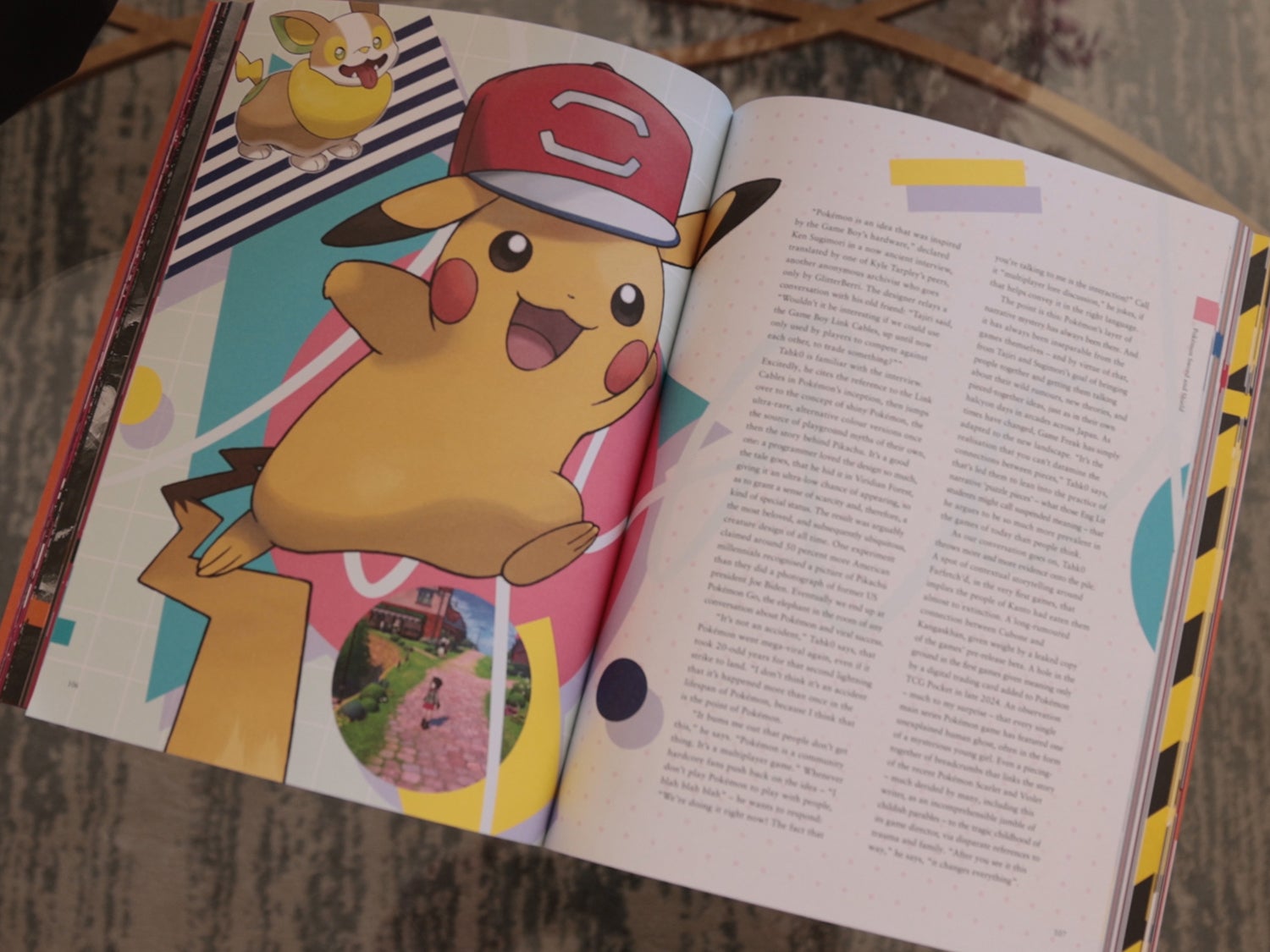
“Pokémon is an idea that was inspired by the Game Boy’s hardware,” declared Ken Sugimori in a now ancient interview, translated by one of Kyle Tarpley’s peers, another anonymous archivist who goes only by GlitterBerri. The designer relays a conversation with his old friend: “Tajiri said, “Wouldn’t it be interesting if we could use the Game Boy Link Cables, up until now only used by players to compete against each other, to trade something?””
Tahk0 is familiar with the interview. Excitedly, he cites the reference to the Link Cables in Pokémon’s inception, then jumps over to the concept of shiny Pokémon, the ultra-rare, alternative colour versions once the source of playground myths of their own, then the story behind Pikachu. It’s a good one: a programmer loved the design so much, the tale goes, that he hid it in Viridian Forest, giving it an ultra-low chance of appearing, so as to grant a sense of scarcity and, therefore, a kind of special status. The result was arguably the most beloved, and subsequently ubiquitous, creature design of all time. One experiment claimed around 50 percent more American millennials recognised a picture of Pikachu than they did a photograph of former US president Joe Biden. Eventually we end up at Pokémon Go, the elephant in the room of any conversation about Pokémon and viral success.
“It’s not an accident,” Tahk0 says, that Pokémon went mega-viral again, even if it took 20-odd years for that second lightning strike to land. “I don’t think it’s an accident that it’s happened more than once in the lifespan of Pokémon, because I think that is the point of Pokémon.
“It bums me out that people don’t get this,” he says. “Pokémon is a community thing. It’s a multiplayer game.” Whenever hardcore fans push back on the idea – “I don’t play Pokémon to play with people, blah blah blah” – he wants to respond: “We’re doing it right now! The fact that you’re talking to me is the interaction!” Call it “multiplayer lore discussion,” he jokes, if that helps convey it in the right language.
“Pokémania is the closest thing to a fictional thing being real I’ve probably ever experienced. Where everybody everywhere is enjoying this thing together, at the exact same time, for a long time… that feeling is probably the thing I’ve been chasing forever…”
The point is this: Pokémon’s layer of narrative mystery has always been there. And it has always been inseparable from the games themselves – and by virtue of that, from Tajiri and Sugimori’s goal of bringing people together and getting them talking about their wild rumours, new theories, and pieced-together ideas, just as in their own halcyon days in arcades across Japan. As times have changed, Game Freak has simply adapted to the new landscape. “It’s the realisation that you can’t datamine the connections between pieces,” Tahk0 says, that’s led them to lean into the practice of narrative ‘puzzle pieces’ – what those Eng Lit students might call suspended meaning – that he argues to be so much more prevalent in the games of today than people think.
As our conversation goes on, Tahk0 throws more and more evidence onto the pile. A spot of contextual storytelling around Farfetch’d, in the very first games, that implies the people of Kanto had eaten them almost to extinction. A long-rumoured connection between Cubone and Kangaskhan, given weight by a leaked copy of the games’ pre-release beta. A hole in the ground in the first games given meaning only by a digital trading card added to Pokémon TCG Pocket in late 2024. An observation – much to my surprise – that every single main series Pokémon game has featured one unexplained human ghost, often in the form of a mysterious young girl. Even a piecing-together of breadcrumbs that links the story of the recent Pokémon Scarlet and Violet – much derided by many, including this writer, as an incomprehensible jumble of childish parables – to the tragic childhood of its game director, via disparate references to trauma and family. “After you see it this way,” he says, “it changes everything”.
I remain curious as to why Takh0 puts so much energy into this, publishing too infrequently to make any real profit, and all in his spare time. “Real life gets a little bit more interesting if you see it through the lens of what people are interested in,” he tells me. “Pokémon is just the Trojan horse. Really, the thing I’ve always been interested in is fictional things being real.” I wonder what he means, and he returns to the original, myth-fuelled craze of the 90s.
“Pokémania is like, the closest thing to a fictional thing being real I think I’ve probably ever experienced. Where everybody everywhere is enjoying this thing together, at the exact same time, for a long time,” he says. “That feeling is probably the thing I’ve been chasing forever… I think I’m just chasing that high.”
I know that feeling. That old millennial chestnut is returning again, the Peter Pan syndrome that drives this perpetual thirst for new Pokémon information, new links to an ever more distant past, that makes it possible for the likes of Tarpley and his team to dedicate such vast amounts of time to the historical cause. But Tahk0 describes it as a little more than that – or at least something a little different.
“I think there was an acceptance,” he says. “I remember mourning the loss of my childhood when I was 20.” But that part, he says, “is gone – I’m not actually trying to recreate my childhood, because I left that behind me. It’s more: Oh, now I’m free to understand it.”
“There’s basically a pile of documents in someone’s basement, that they can’t seem to find. But I know it’s real… this guy’s name is on it. And I found the guy. And it is really a huge, huge story…”
Returning one last time to the playground legend of Mew, I ask Tarpley if he ever got to the bottom of its original source. That one’s proved difficult, he explains. He and his peers have tracked other rumours right back to their origins before: they traced one somewhat uncomfortable claim that Satoshi Tajiri is autistic – which made it all the way to articles by the Independent and the BBC – right back to a Japanese middle school student in the late 90s, who simply wrote an essay at school suggesting as much. But Mew’s is almost too popular to fully pin down. “I don’t think I found any sort of smoking gun,” Tarpley says, “like it originated from some child who wrote into Famitsu’s April 1996 issue, or something like that”. The answer of who patient zero was will be “unfindable,” he suspects – any number of people could claim they started it, or even be gaslit into thinking they heard it from someone else. “It’s lost to time.”
He takes a beat to think about it some more, then goes on. “Like Sugimori was talking about, sometimes the unsettled, unsolved mystery is more captivating than the one with an answer. So I suppose to wrap that up in a bow, it’s a nice way of saying: ‘Y’know, I don’t know’.”
Tahk0’s Lore Library continues its shared watch parties – as we speak in the days immediately after David Lynch’s death, he tells me they’re currently most of the way through Twin Peaks: The Return. It couldn’t be more appropriate, a work by a man obsessed with abstractions, and the way his medium can wordlessly express them. I tell Tahk0, who lives in fear of spoilers, he’s in for a ride.
Tarpley’s search continues, meanwhile, as he hunts for more new answers to old, undiscovered questions. “There’s one story I’ve been working on for years,” he tells me, almost reluctant to reference it aloud. One true, smoking gun. “There’s basically a pile of documents, essentially, in someone’s basement, that they can’t seem to find. But I know it’s real,” he goes on, a glimmer of undiscovered treasure in his eye.
“Possibly they’ve lost it – but I know that they had it at some point. And I think they still have it, because it’s mentioned in some Japanese publications from the 90s. And this guy’s name is on it. And I found the guy. And it is really a huge, huge story. But I just cannot get those documents.”
Together, I realise Tahk0 and Tarpley form two parts of what makes Pokémon whole. Two interpretations of this series’ endless mythology. Two kinds of people in search of puzzle pieces, clues, untapped veins of gold, piecing together what they can within two types of mystery that might forever remain unsolved. And two people who have encouraged me, in different ways, to abandon any millennial shame and go in search of this series’ myths all over again. Pokémon’s creators would be proud.
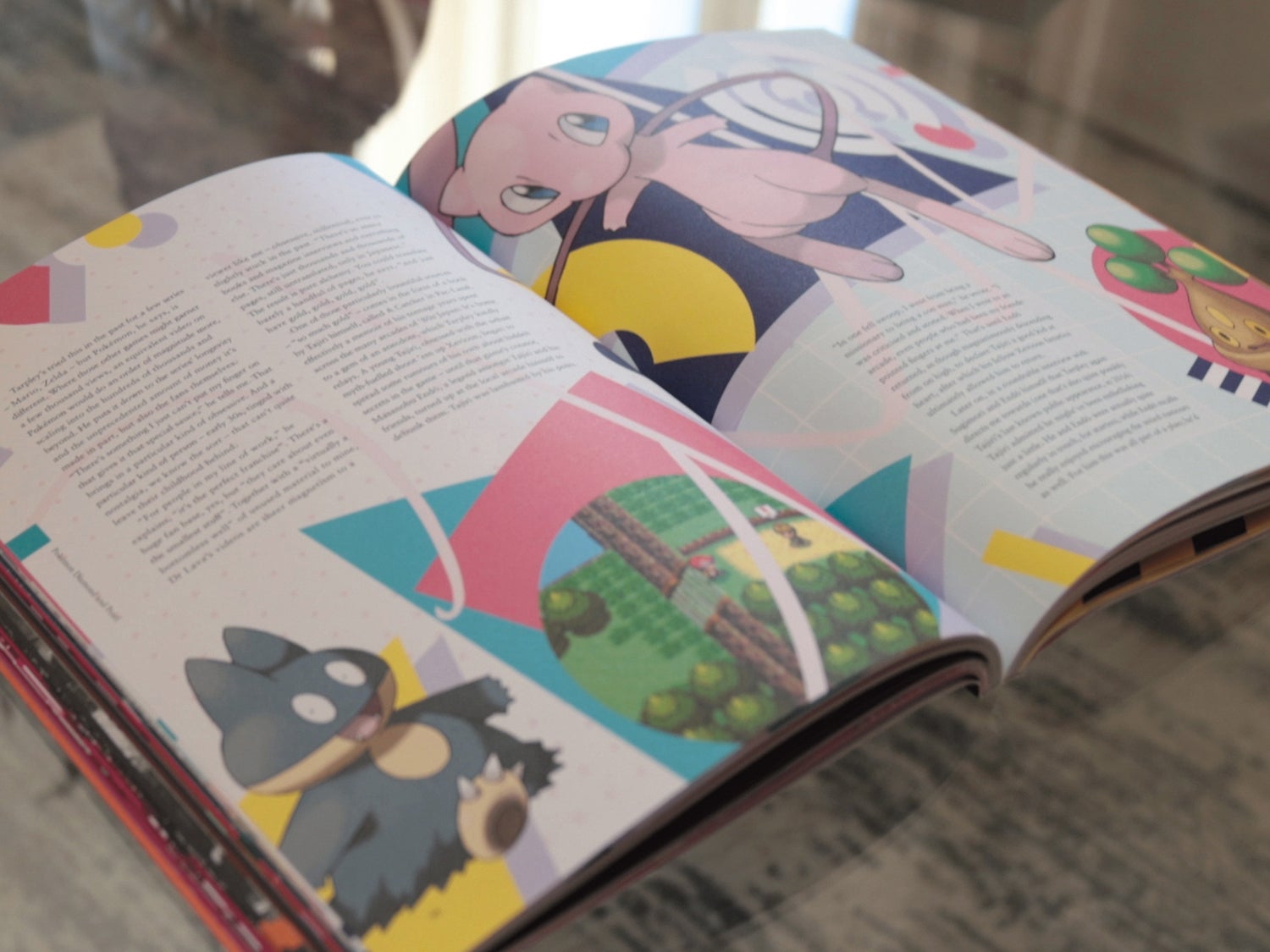
This article is an extract from ON Games Volume 2, from Hybrid Publications, which we’re featuring as part of our celebration of Pokémon’s 30th anniversary.
A series of coffee table journals which feature numerous authors who have also appeared on Eurogamer – including Christian Donlan, Keza MacDonald, Jeremy Peel, Caelyn Ellis and more – you can find it directly from Hybrid Publications here.