dailynewsnblog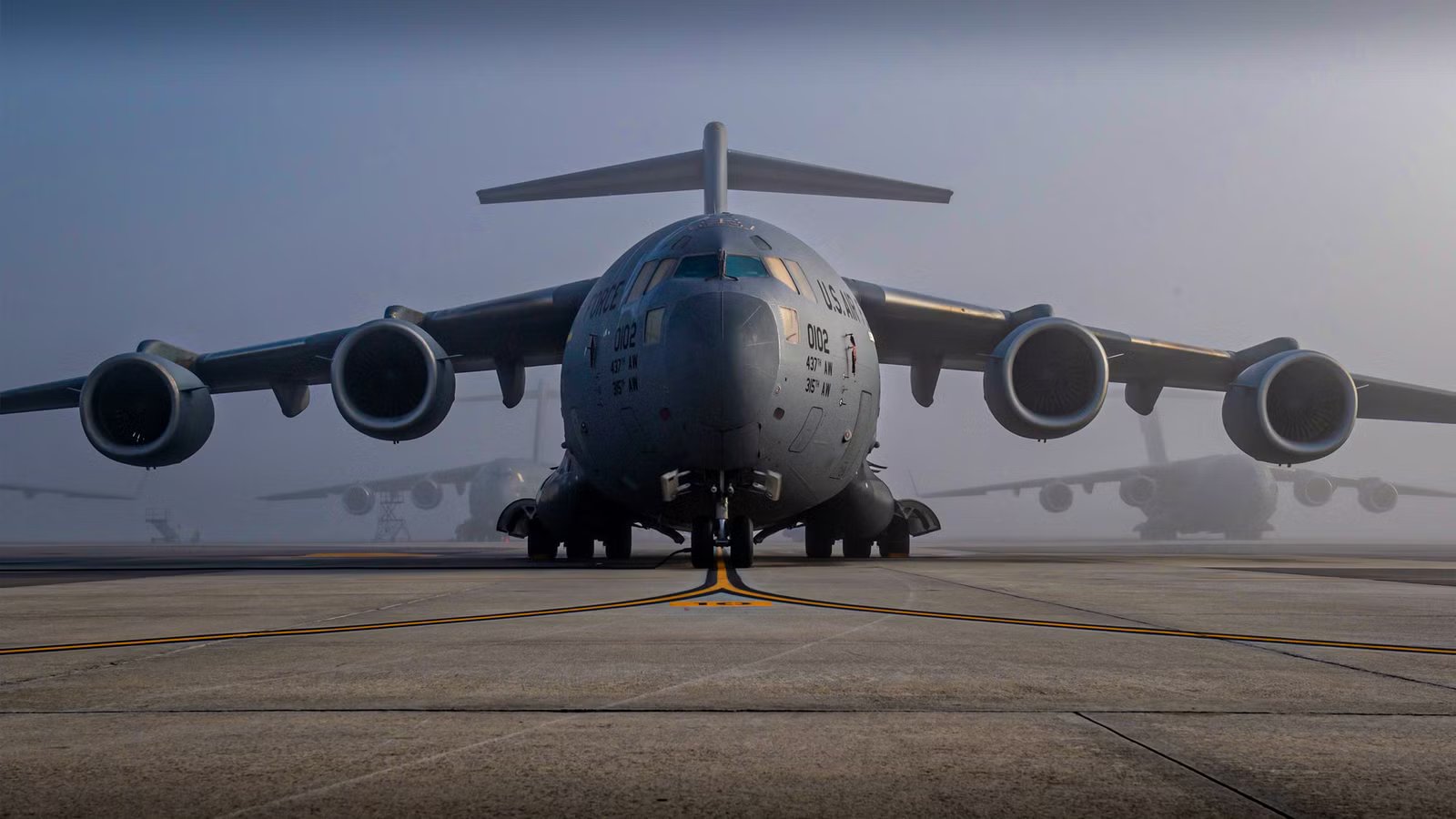
Aviation is a field full of precision and symmetry, dictated mainly by aerodynamics. Most aircraft are deliberately designed to be symmetric along their centreline: equal wings, balanced weight, and mirrored fuselage features. But occasionally, designers have chosen, or ended up with, asymmetry: unequal parts, offset components, mismatched sponsons or pods. This article explores notable examples of asymmetric aircraft designs, with a special focus on the C-17 Globemaster III’s asymmetry as recently spotlighted online, and looks back at historical and modern experimental designs, production aircraft, civil examples, and finally, the physics behind why asymmetry can sometimes make sense.
In our article, we will examine a variety of asymmetric aircraft: from WWII experimental models to modern prototypes, from military success stories to designs that never took flight, and what lessons physics teaches us about when asymmetry is effective.
The C-17 Globemaster III And Its Belly Asymmetry

In September 2025, The War Zone (TWZ) published an article pointing out an unusual asymmetry on the Boeing C-17 Globemaster III. The asymmetry is in the under-fuselage sponsons (fairings) that house the main landing gear: the right-hand sponson is longer forward (due to housing auxiliary components) than the left. Casual observers often don’t notice it because of the size of the aircraft and how it sits on the ground, but from certain angles it becomes obvious, and once you see it, it can’t be unseen anymore! The article discussed why this asymmetry exists and precisely what is inside the sponsons that causes the mismatch.
TWZ explains that on the C-17, the auxiliary power unit (APU) is installed in the forward part of the right sponson. The APU is needed for systems such as electricity, hydraulics, environmental control/air conditioning, and de-icing/anti-icing, regardless of the main engines. The right sponson also houses a ram air turbine (RAT) extension, which can deploy in case of primary power failure to provide hydraulic power to critical flight controls. Because of all that, the right sponson’s shape and length differ from the left.
That article also noted that the difference in length is significant enough that, under certain lighting and viewing angles, especially from below and off to the side, it is clearly visible. Despite this, the aircraft is structurally designed to compensate: weight distribution, structural reinforcement, and aerodynamic trimming are all in place to ensure stable flight. The asymmetry does not appreciably degrade performance or handling, thanks to careful design and the aircraft’s large size and heavy redundancy. Observers on social media helped bring the sponson difference into wider notice.
History Of Asymmetric Aircraft From WWII: Blohm & Voss Designs

Asymmetry in aviation is not a new idea. In the 1930s and during World War II, designers experimented with unconventional layouts to address issues of visibility, weapon mounting, or engine placement. The German firm Blohm & Voss, became particularly famous for pursuing such concepts. The Blohm & Voss BV 141, for instance, offset its engine nacelle to port and carried a glazed observation gondola to starboard, later even introducing an asymmetric tailplane to improve the gunner’s field of fire. Despite its unconventional look, flight tests showed good stability and performance, though the Luftwaffe favored the more conventional Focke-Wulf Fw 189 for reconnaissance.
Other Blohm & Voss projects pushed asymmetry further. The jet-powered P.178 placed its single Jumo 004B turbojet under the wing on the starboard side, creating thrust asymmetry, while the P.194, P.204, and BV 237 explored mixed propulsion or unusual offset engine layouts. Although these aircraft never progressed beyond prototype or paper stage, they demonstrate the extent to which German engineers explored asymmetry to balance new technology with operational demands. These experiments also highlighted key challenges, including managing yaw control, trimming, and aerodynamic drag, while ensuring structural balance and adequate performance.
The Pioneers of Asymmetry
Aircraft | Era | Role | Nature of Asymmetry | Reason / Purpose |
Blohm & Voss BV 141 | WWII (late 1930s-early ’40s) | Reconnaissance / observation | Observer gondola offset, engine & fuselage boom on opposite side | Better visibility, field of view, compensate drag vs torque |
Blohm & Voss P.178 | WWII | Dive bomber / fighter-bomber project | Jet engine under one wing (starboard), asymmetric thrust potential | Mixed power, better attack profile |
Blohm & Voss P.194 / P.204 / BV 237 | WWII | Ground attack / tactical bomber | Mixed propulsion or offset pods or wings / nacelles | Trying to get power / role trade-offs |

But not all wartime asymmetry was confined to Blohm & Voss projects. The Heinkel He 111 featured a “stepless cockpit” with glazing offset to give the pilot better forward visibility while the navigator sat slightly to starboard. Britain’s Bristol Blenheim, in later versions, introduced a similarly offset nose arrangement. Meanwhile, Sweden’s Saab 18 bomber and reconnaissance aircraft displayed a mildly asymmetric canopy design, where the pilot and navigator sat beneath an offset canopy. Unlike the experimental Blohm & Voss projects, these aircraft went into production and operational service, proving that asymmetry could be both practical and effective in combat designs when carefully managed.
Asymmetric Planes Post-WW2: Rutan’s Experimental Planes

After World War II, many experimental designs went into oblivion, but specific experimental projects and individual designers took up the challenge again. With better materials, more powerful engines, and more understanding of aerodynamics, modern asymmetric designs could push boundaries in new ways. This section examines some modern examples and what they taught engineers.
One prominent modern example is Burt Rutan’s “Boomerang” (Rutan Model 202), first flown in 1996. It is a twin-engine light aircraft with engines mounted asymmetrically, wings of different span/sweep, etc., designed so that if one engine fails, the control issues are mitigated. The Boomerang was intended to have better safety in an engine-out event compared to more conventional twins. It is not in production beyond that single prototype, but remains a frequently cited example.

Other experiments: NASA’s AD-1 (also designed by Rutan) oblique wing test aircraft (flying in 1979-1982) had an “oblique wing”, meaning that one wing (one side) is swept forward and the other backward. While this is a kind of asymmetry (the planform is not symmetric), the aircraft could rotate its wing sweep; it provided real data on how asymmetric lift and drag distributions affect stability. There are also cases in research or engine-test beds where parts are offset (intakes, exhausts, etc.) to test flow, noise, or structural loads.
Another Rutan’s plane, ARES (Agile Responsive Effective Support), was built in 1990, as a unique asymmetrical test aircraft for the military, featuring a cannon on the right side of the nose and the engine intake on the left. This asymmetrical layout counteracted the effects of the heavy 25mm cannon’s recoil and prevented engine exhaust from being ingested by the engine intake.
Post-WWII Experimental Designs
Project | First Flight / Test Period | Key Asymmetric Feature | Purpose / Outcome |
Rutan Boomerang | Prototype, 1996 | Offset engines & differing wing geometry | Mitigate engine-out handling / improve safety |
NASA AD-1 | 1979-1982 | Oblique wing (one side forward sweep, the other backward) | Aerodynamics research |
Scaled Composites/Rutan ARES | Prototype, 1990 | Offset inlet and fuselage to avoid gas ingestion from cannon | Optimize combat safety (gun-to-intake separation) |
These experimental designs often stayed niche or singular. They are usually more expensive or complex for mass production, more difficult to control, or their performance benefits are only under a narrow set of conditions, or used exclusively for scientific/aerodynamic research.
.
Serial Asymmetric Military Jets

Some aircraft with asymmetrical features were not just experimental or prototype models, but went into production and saw service. These production types had to satisfy regulatory, handling, and manufacturing constraints while carrying the asymmetric features. Famous examples include the Fairchild Republic A-10 Thunderbolt II, the de Havilland Sea Vixen, and the English Electric Canberra PR.9.
The A-10, designed for close air support, has an enormous GAU-8 Avenger rotary cannon mounted slightly to the port side of the nose. To balance recoil forces and internal layout, the nose landing gear was offset to starboard. Despite this, the A-10 has legendary accuracy and durability, proving that such asymmetry was manageable and effective in combat.

The Sea Vixen, meanwhile, featured a unique twin-boom layout with an offset cockpit canopy positioned to the left, giving the pilot enhanced visibility while the radar operator sat separately in a darkened compartment. Its unusual design did not prevent it from serving successfully with the Royal Navy’s Fleet Air Arm.
The Canberra PR.9 also demonstrated that asymmetry can be engineered into effective combat aircraft. This high-altitude reconnaissance variant of the English Electric Canberra included a fighter-style offset cockpit canopy and a redesigned forward fuselage with a hinged nose section for the navigator. The arrangement gave the pilot improved visibility and accommodated cameras and reconnaissance systems without compromising the aircraft’s aerodynamic qualities.
Serial Asymmetric Combat Aircraft
Aircraft | Nation | Type / Role | Asymmetric Feature | Purpose / Role of Asymmetry |
A-10 Thunderbolt II | USA | Close Air Support | GAU-8 Avenger cannon mounted off-center; nose gear offset | Balances recoil forces; retains accurate gunnery performance |
de Havilland Sea Vixen | UK | Carrier-based fighter | Offset cockpit canopy (pilot on port side, observer starboard in separate compartment) | Improved visibility for pilot; operational separation of crew roles |
Canberra PR.9 | UK | Reconnaissance | Offset cockpit canopy and hinged asymmetric nose | Better pilot visibility; navigator access for reconnaissance equipment |
These military production aircraft show that asymmetry need not be exotic to have utility. It often arises from practical constraints: fitting bulky equipment (radars, guns), ensuring visibility, or managing engine/gun interference. The fact that these aircraft service hundreds of units shows that once appropriately designed, asymmetric features can be reliable in long-term operational use.
Passenger Aircraft With Some Asymmetry

People often assume civil airliners are entirely symmetrical: engines, landing gear, fuselage, all mirror images of left and right. But in rare cases, civil aircraft have incorporated subtle asymmetry to meet design constraints. Such deviations often reflect compromises driven by space required for avionics, systems, or structural limitations rather than purely aesthetic or performance reasons. The Hawker Siddeley Trident is probably the only commercial airliner with a clearly visible asymmetrical feature: its offset nose landing gear.
According to historical records and technical summaries, and as discussed by enthusiasts and former Trident maintenance personnel on the PPRuNe forum, the Trident’s nose gear was offset about 2 ft (61 cm) to the port (left) side of the aircraft’s centreline. This offset allowed the gear to retract sideways into the nose gear bay, rather than straight up or straight backward. The reason for this design is largely attributed to the space needed beneath the cockpit for bulky avionics, radar, air-conditioning ducts, and other systems. Routing ducts and housing electronics beneath the flight deck forced the designers to carve out space on one side, meaning the nose gear bay could not be centrally located without interfering with those systems.
Additionally, some PPRuNe users who worked on the Trident report that the offset did not cause major handling issues in service, as no known serious safety or stability penalties in taxiing or takeoff were repeatedly documented in those discussions. Some noted differences in behavior under crosswinds because the load and geometry of the nose-wheel steering were slightly uneven. Maintenance personnel have also said that air-conditioning duct routing (and possibly other system installations) were integral to the decision. The Trident, therefore, stands out in civil aviation history as a case where system packaging needs overrode pure symmetry, and the engineers accepted a small geometric asymmetry in exchange for accommodating necessary equipment.
What Physics Says

The physics of flight demands balance: lift, weight, thrust, and drag must remain in harmony to avoid unstable moments in pitch, roll, or yaw. Asymmetry disrupts this equilibrium, so engineers counter it with trimming surfaces, structural reinforcement, offset weights, or tailored control inputs. If the center of gravity and lift are not carefully aligned, the aircraft risks unpredictable handling.
In practice, asymmetric aircraft rely on compensations. Designers might vary wing span, adjust the tailplane, or exploit differential drag to neutralize unwanted forces. The Blohm & Voss BV 141, for example, used the drag of its observation gondola to offset other imbalances, while the C-17 Globemaster accepts its right-side sponson asymmetry by trimming and balancing weight across the airframe. Larger aircraft tolerate such adjustments more easily thanks to their inertia, while smaller types face tighter limits.
Looking ahead, asymmetry may reappear in drones, UAVs, or niche platforms where specialized layouts bring clear advantages. Distributed propulsion or hybrid power systems could facilitate the placement of off-center pods, batteries, or nacelles. Yet for mainstream passenger and transport aviation, symmetry will remain the norm, by offering regulators, airlines, and passengers the reassurance of stability, efficiency, and ease of maintenance.