dailynewsnblog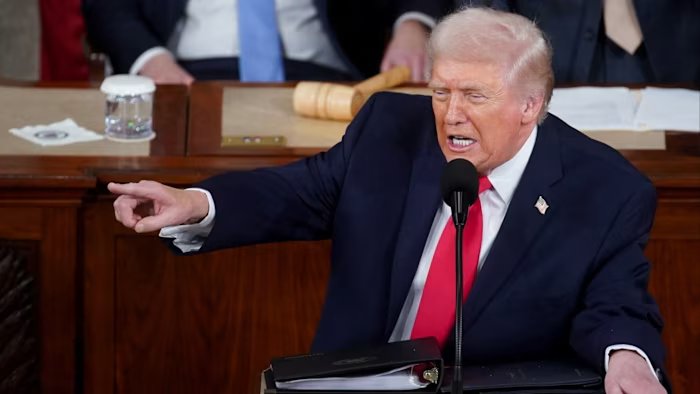
Good morning and welcome back. In today’s newsletter:
Donald Trump hits out at Iran’s nuclear ambitions in State of the Union speech
Friedrich Merz steps up scrutiny of Germany’s arms procurement
Rachida Dati vows to end French Socialists’ grip on Paris
How Deutsche Bank rolled out the red carpet for Jeffrey Epstein
We begin with Donald Trump, who has lashed out at Iran’s “sinister” nuclear ambitions in his State of the Union address as he presented Washington’s justification for possible military action.
What to know: The US president accused Tehran of seeking to rebuild its nuclear weapons programme amid a massive build-up of US naval and air power in the Middle East as he spoke before a joint session of Congress last night.
Trump said the US was still negotiating with Iran but Tehran was not relinquishing its nuclear ambitions and it continued to threaten America.
“They’ve already developed missiles that can threaten Europe and our bases overseas, and they’re working to build missiles that will soon reach the United States of America,” Trump said.
Why it matters: Trump’s comments on Iran come just before critical talks in Geneva tomorrow between US negotiators Steve Witkoff and Jared Kushner and senior Iranian officials, which could determine whether the White House launches a new attack on the Islamic Republic. Read more on last night’s speech.
Trump trade stalls: Global investors are going out of their way to avoid US markets, writes Katie Martin.
Here’s what else we’re keeping tabs on today:
Economic data: The EU releases January inflation data, while Germany publishes revised fourth-quarter GDP figures.
Results: Alcon, Aston Martin Lagonda, Diageo, Eon, Ferrovial, Heathrow, Iberdrola, Manchester United, Nvidia and Salesforce report earnings.
Live event: The FT Business of Football Summit begins online and at the Peninsula Hotel in London, continuing tomorrow. Register here.
Five more top stories
1. German Chancellor Friedrich Merz has stepped up scrutiny of military procurement amid mounting concerns that large manufacturers such as Rheinmetall will benefit disproportionately from the country’s €500bn defence budget over start-ups focused on new technology.
2. Rachida Dati has vowed to “smash the glass ceiling” by winning next month’s Paris mayoral election, a result that would end 25 years of Socialist control of the French capital. The rightwing politician with immigrant roots is polling strongly ahead of local elections in March.
3. HSBC has said it will not make further share buybacks until its capital ratios have improved following its $14bn privatisation of Hang Seng Bank, potentially extending its previous warning of a three-quarter suspension.
Read the full report.
4. Exclusive: Ineos is exploring asset sales and has held talks with creditors over refinancing some of its debt pile, as the chemicals empire built by UK billionaire Sir Jim Ratcliffe battles an industry downturn. Read the full report.
5. UK self-driving start-up Wayve has raised $1.2bn in new funding from investors including automakers Mercedes-Benz, Stellantis and Nissan, as it gears up to launch its first robotaxi service in London this year.
News in-depth

Tens of thousands of internal emails and documents released by the US Department of Justice paint for the first time a vivid picture of how Deutsche Bank rolled out the red carpet for sex offender Jeffrey Epstein.
We’re also reading . . .
Novo Nordisk Foundation: The world’s richest philanthropic organisation is boosting spending beyond Denmark to bolster Europe’s capabilities in fields including quantum computing and life sciences.
Tariff hit: The US has reimposed levies on Belgian diamonds after abandoning some of the exemptions it had granted under previous trade deals.
Defence doubts: Germany’s decision to develop a fighter jet with France was a “strategic mistake”, a former Airbus chief executive has said.
India’s geopolitical bets: Stung by Trump’s volatile foreign policies, New Delhi is deepening ties with the EU and “middle powers” such as Canada.
Chart of the day
Women pay a heavier price for having children. In countries with ultra-low fertility rates, efforts must be made to lower costs for parents and reduce the economic penalties on mothers, writes Martin Wolf.

Rising costs and economic uncertainty have intensified financial anxiety — particularly for women, who make up nearly two-thirds of UK debt advice clients. Join Claer Barrett, consumer editor, for a free webinar on March 5 in association with the FT’s FLIC charity.
Take a break from the news . . .
Our faces were once seen as immutable windows to the soul — but in the age of Botox and Instagram, they are something that can be altered and made fashionable. Is your face on trend?