dailynewsnblog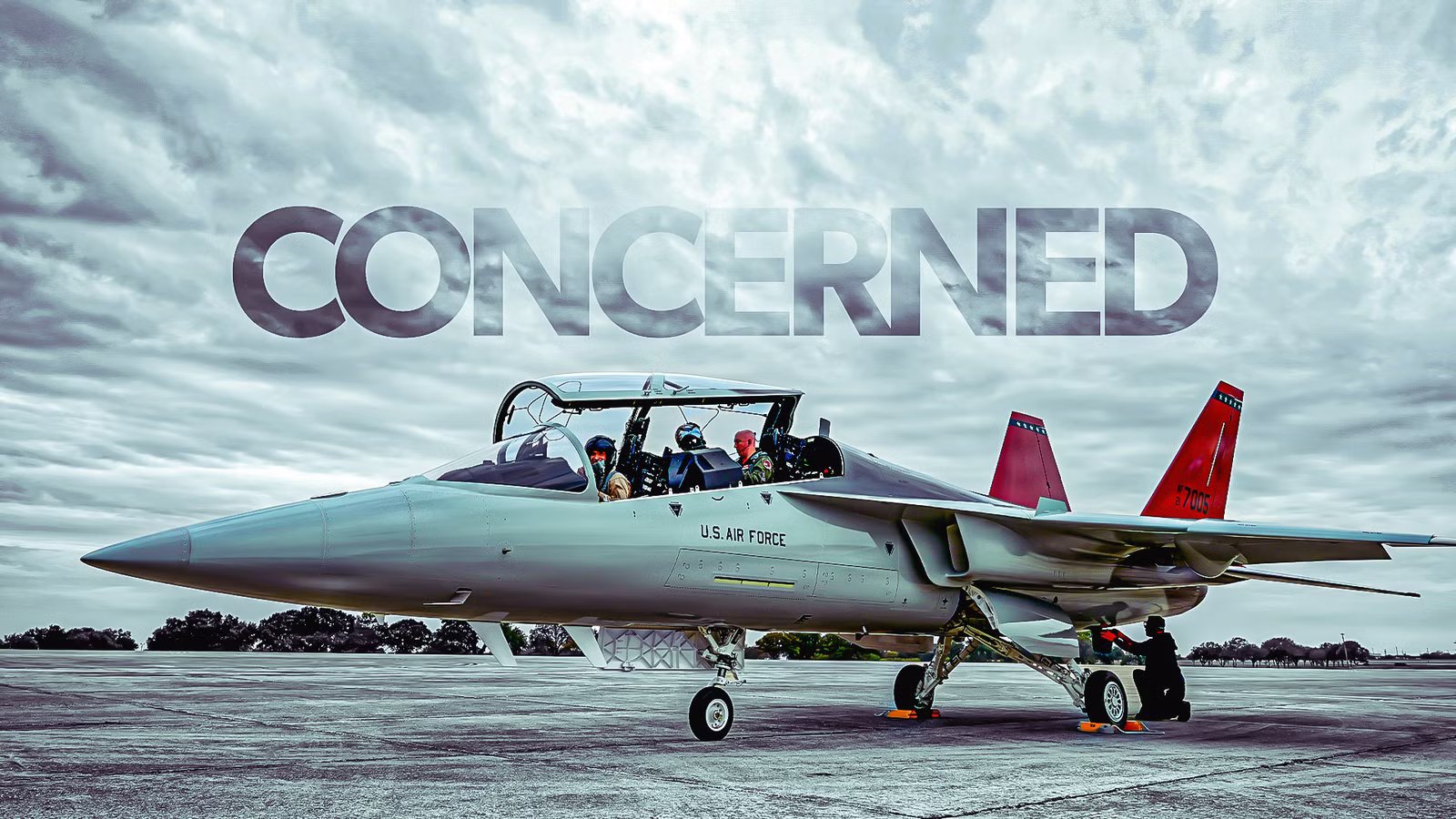
The United States Air Force has waited decades to replace its aging fleet of Northrop T-38 Talon trainers. When Boeing unveiled the T-7A Red Hawk, it was supposed to be the easy part of Air Force modernization: digitally engineered, cost-efficient, and purpose-built to prepare pilots for fifth-generation fighters. Yet years into the program, enthusiasm has given way to scrutiny. Recent coverage has focused heavily on cost growth and contractual losses, but that is only one part of the issue. The Air Force’s concern is broader and more structural. The Red Hawk sits at the foundation of pilot production, and any instability in that foundation reverberates through the entire force.
Engineering delays, environmental reviews, training doctrine evolution, industrial capacity, and budget prioritization all intersect in this program. The T-7A matters because it sits at the very foundation of combat airpower. Every future pilot assigned to aircraft like the F-35 or the B-21 will first pass through this system. If the trainer struggles, the entire force structure feels the consequences. We will examine why the T-7A matters so deeply to the United States Air Force — and why the concerns extend well beyond headlines about billions of dollars.
Replacing The T-38 Talon: Why The Stakes Are So High

For more than 60 years, the Northrop T-38 Talon has trained generations of Air Force pilots. First flown in 1959, the Talon was revolutionary for its era: lightweight, supersonic, and reliable. But the aircraft belongs to an analog generation. Even with avionics upgrades, it cannot replicate the fly-by-wire systems, sensor fusion, helmet-mounted displays, and the digital cockpits that define modern combat aircraft.
The T-7A Red Hawk was selected in 2018 as the Air Force’s Advanced Pilot Training (APT) solution. Developed by  Boeing in partnership with Saab, the aircraft promised to close the gap between legacy training platforms and fifth-generation fighters such as the Lockheed Martin F-35 Lightning II and the Lockheed Martin F-22 Raptor.
Unlike stealth bombers or sixth-generation fighters, a trainer aircraft does not need to penetrate advanced air defenses or redefine air combat. Its job is straightforward: prepare pilots for the jets they will fly in combat. But the transition affects a more complex reality than a simple aircraft model: the T-7A will define how students learn high-G maneuvering, energy management, formation flying, and tactical cognition in sensor-dense combat environments. In a few words, the transition regards the entire pilot training system.
However, the T-7A has become one of the most closely scrutinized programs in the Department of the Air Force, because the stakes are significant. Pilot production capacity directly influences squadron readiness, deployment cycles, and long-term force structure. The Air Force has already faced pilot shortages in recent years. If a next-generation trainer experiences developmental or fielding delays, the ripple effect can extend a decade into the future, impacting operational units long after headlines fade.
Engineering And Certification Friction: When Digital Design Meets Reality

The Boeing T-7A Red Hawk was heralded as a groundbreaking advancement in aircraft design, being the first US Air Force plane developed entirely through digital engineering techniques such as virtual modeling, advanced simulations, and model-based systems engineering. This approach aimed to minimize risks, speed up production, and outpace traditional methods used in legacy programs like the T-38 Talon.
However, the progression of the program throughout the physical testing phases revealed real-world challenges that digital models couldn’t fully anticipate, leading to necessary modifications and delays.
- Structural reinforcements: Structural testing highlighted the necessity for reinforcements in the fuselage and other components due to quality issues from suppliers.
- Escape system: Multiple revisions were required for the Collins Aerospace ACES 5 seats to accommodate a wider pilot weight range, addressing problems like sequencing errors and canopy interactions.
- Software integration: Especially for the embedded training system, required ongoing refinements based on flight test data to resolve issues such as wing rock at high angles of attack (self-induced oscillation due to interaction between the nonlinear unsteady flow field and the aircraft roll axis) and incomplete avionics maturity.
These aviation insights highlight the gap between digital predictions and physical realities, contributing to program setbacks with initial operational capability now targeted for 2027 instead of earlier projections.
Despite these hurdles, the T-7A program is advancing, with Boeing reporting progress in integrated simulations and dual flight testing sites. The digital-first methodology has enabled rapid prototyping successes, but the integration of physical validation has underscored the importance of hybrid approaches in aerospace development. Each engineering adjustment cascades through testing, certification, and syllabus development. The Air Force’s concern is less about isolated technical issues and more about how cumulative adjustments affect operational timelines.

Why The F-35 Is The US Air Force’s Most Important Fighter Jet
Discover why the F-35 is the US Air Force’s most critical fighter — from stealth and sensors to strategy, readiness, and future upgrades
Cost Growth And Budgetary Pressure

The T-7A’s financial strain has become harder to ignore as the program approaches Milestone C, the acquisition checkpoint that determines whether the aircraft can move into full-rate production. The Air Force is actively reviewing cost structure, sustainment planning, and schedule stability. This stage matters because it transitions the Red Hawk from development into scalable procurement, and any instability here affects long-term fleet planning.
The core of the issue stems from the program’s fixed-price development contract, awarded in 2018 with a total value of approximately $9.2 billion. Under this arrangement, Boeing and its partner Saab agreed to deliver the aircraft under a set financial framework, placing most development and cost risk on the contractors themselves. For the Air Force, this was intended to prevent unexpected overruns.
In practice, however, it has created a situation where Boeing has already absorbed over $2 billion in losses tied to engineering, production, and integration challenges, according to the available reporting. The Air Force must fund nuclear modernization, space capabilities, and future combat aircraft simultaneously. While a trainer may not carry weapons into combat, it underpins all combat aircraft readiness. That places the Red Hawk in a delicate position: strategically essential, but competing for finite modernization dollars.
The broader concern is whether financial pressure could translate into slower deliveries, adjusted procurement quantities, or constrained upgrade pathways over time. The Air Force is simultaneously funding the Northrop Grumman B-21 Raider, NGAD development, and continued Lockheed Martin F-35 procurement, plus the upgrades of many other types. In that environment, even a training aircraft must demonstrate cost predictability and schedule discipline. For the Red Hawk, Milestone C will signal whether the program has stabilized or whether its financial turbulence could ripple into pilot production capacity.
Training Doctrine Evolution: Can The Red Hawk Truly Prepare Fifth-Generation Pilots?

When the T-38 entered service, air combat emphasized stick-and-rudder proficiency and visual-range tactics. Modern air combat is increasingly software-defined, and pilots’ operations within training doctrine have evolved accordingly: today’s pilots must deal not only with aerodynamic performance but also within a network of sensors, satellites, datalinks, and multi-domain information flows.
The T-7A’s embedded training system incorporates a large-area display and an embedded training system intended to simulate radar, electronic warfare effects, and tactical data environments without requiring frontline fighter hardware. That digital backbone is central to the aircraft’s value proposition.
If simulation fidelity falls short, students and instructors may rely more heavily on ground-based simulators or accept reduced realism in airborne training, potentially creating a training imbalance. The Air Force’s scrutiny reflects the importance of cognitive preparation, not just aerodynamic performance.
In short, the task of the T-7A will not be to replace the T-38 just as a machine, but more of a broader shift in training philosophy, a part of a doctrinal evolution.

Disaster? Why The F-35 Program Is Under Fire Again
A storm of controversy surrounds the F-35 program, but what’s really behind the criticism?
Environmental Reviews And Community Impacts: The NEPA Factor

Beyond aircraft development lies another layer of complexity: environmental compliance. Under the National Environmental Policy Act (NEPA), the Air Force must conduct Environmental Impact Statements (EIS) before introducing new aircraft or modifying operational patterns at training bases.
The T-7A is scheduled for introduction at several major training bases, including Joint Base San Antonio – Randolph Air Force Base, Columbus Air Force Base, Laughlin Air Force Base, Vance Air Force Base, and Sheppard Air Force Base-Wichita Falls Municipal Airport.
Each installation requires a formal environmental review covering aircraft noise modeling, construction impacts, airspace adjustments, and long-term infrastructure planning. Even if aircraft are technically ready, base-level implementation depends on regulatory clearance and infrastructure readiness. In several cases, Final EIS documents and Records of Decision have already been signed, formally approving recapitalization. In other bases, the process remains in the Draft EIS and public comment phase. While the regulatory pathway is advancing, it still requires sequencing with funding allocations, facility upgrades, and aircraft delivery timelines.
Installation | NEPA Stage | What Is Proposed / Decided | Documented Environmental Process |
Joint Base San Antonio-Randolph (TX) | Final EIS complete, ROD signed | Replace T-38Cs with ~72 T-7A aircraft; requires construction/renovation of facilities, additional flight operations, and base personnel changes. | The final EIS published, and the preferred alternative selected, includes analysis of facility construction, operations, and environmental effects. |
Columbus AFB (MS) | Final EIS & ROD signed | T-7A recapitalization was selected under Alternative 3, signaling replacement of T-38Cs and continuation of pilot training. | Final EIS published May 3, 2024, and Record of Decision signed. |
Laughlin AFB (TX) | Record of Decision signed | Up to 79 T-7A aircraft will replace T-38Cs; initial delivery is limited to 51 aircraft per strategic-based decision. | Record of Decision signed Dec 6, 2024, based on the Final EIS. |
Vance AFB (OK) | Draft EIS released | Draft EIS published, and public comment period completed; evaluating replacement of T-38Cs with T-7A aircraft and associated facility impacts. | Draft EIS availability published Aug 29, 2025; public comment period concluded Oct 14, 2025. |
Sheppard AFB (TX) | Draft EIS complete | Draft EIS was released; the proposal includes the recapitalization of the T-38C fleet with T-7A aircraft and associated renovation/construction. | Notice of Availability for Draft EIS was published Dec 19, 2025; Final EIS is anticipated mid-2026. |
Even with decisions taken, infrastructure modifications, mitigation measures, and construction schedules must align with production tempo. For a program already navigating engineering adjustments and cost scrutiny, regulatory timing becomes another variable that can subtly influence when the Red Hawk fully reshapes the pilot training pipeline.
Industrial Base Stability And Long-Term Sustainment Risks

Beyond the engineering and cost, the most consequential variable may be industrial stability over time. The T-7A production line in St. Louis depends on a layered network of suppliers, avionics integrators, software developers, and maintenance training systems — all of which must remain synchronized for the aircraft to enter service at scale. In a defense industrial base that has faced supply chain volatility and workforce constraints in recent years, even small disruptions can slow production tempo or complicate sustainment forecasting. For a trainer aircraft that underpins the entire pilot pipeline, reliability matters as much as performance.
If deliveries slip, the fallback options are limited. The T-38 Talon fleet is aging rapidly, and keeping it flying grows more expensive every year. Structural fatigue inspections are becoming more frequent, and even upgraded avionics cannot disguise the jet’s 1950s-era design roots. The Air Force could lean more heavily on simulators, extend T-38 upgrades, or adjust class sizes, but each move carries trade-offs. More simulator time can help, but it cannot fully replace live flight. Extending the Talon costs money that was meant for modernization. Smaller classes slow pilot production at a time when demand remains high.
The T-7A may not generate the political urgency of a stealth bomber or next-generation fighter, but its role is just as structural. It sits at the front end of the pipeline. If industrial slowdowns, regulatory delays, or funding pressures hold it back, the effects will not be immediate; they will show up years later at squadron manning levels. That is the underlying concern. The Red Hawk was intended to stabilize and modernize pilot training. The Air Force now needs to ensure that getting it into service does not create a new bottleneck before the old one disappears.

![Revealed: Heathrow Secures New Airline With 13-Hour Nonstop Flights [Map]](https://dailynewsnblog.com/wp-content/uploads/2026/06/xiamenair-boeing-787-9-mock-up-image.jpg)