dailynewsnblog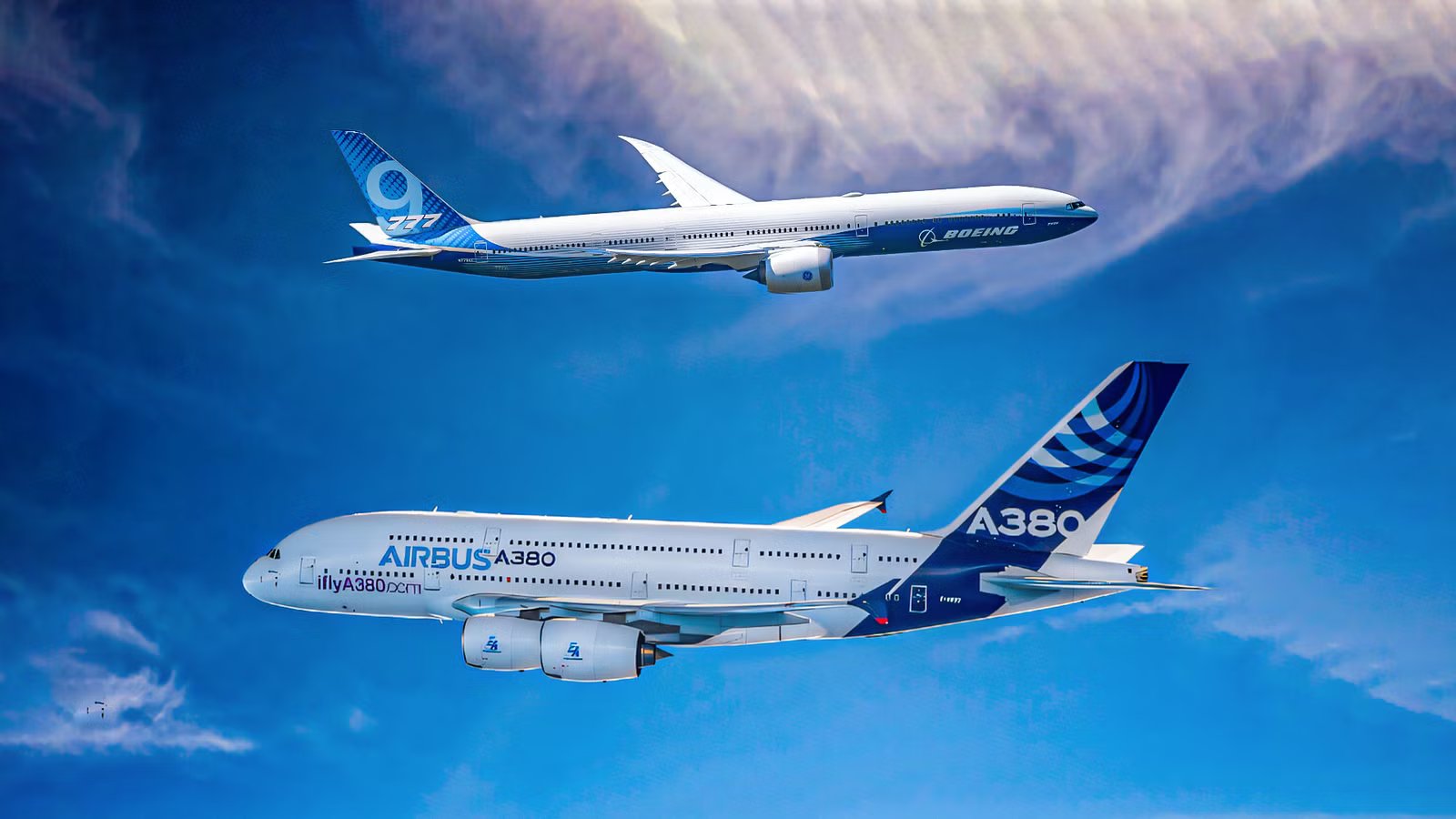
The Boeing 777X is not only Boeing’s latest aircraft project, but it’s also, in some metrics, the largest design to ever come out of Washington. Compared to the Boeing 747-8, it has a smaller fuselage and is rated for lower weights. However, the 777-9 variant is slightly longer while also having a greater wingspan (with wingtips extended, that is).
The largest Airbus in production is the A350-1000, a plane smaller than the 777X and almost identical to the prior 777-300ER in terms of dimensions. However, the largest Airbus ever is the famous A380. This colossal double-decker is the largest airliner ever made, the largest conventional plane currently flying, and the second-largest conventional aircraft to have been manufactured (behind the tragically destroyed Antonov AN-225 Mriya). How do these two giants compare?
The 777X Beats On Length

The Boeing 777-9 is 251 ft 9 in (76.73 m) long. This makes it the longest airliner ever put into production, ahead of the previous titleholder, the Boeing 747-8 (250 ft 2 in / 76.25 m). The A380, meanwhile, is 238 ft 8 in (72.73 m). This means that the A380 is 13 ft 1 in shorter or a full four meters.
Although the A380 is an immense airliner, its length is one of the few metrics that have been superseded by other aircraft. The 777-9 and 747-8 have already been mentioned, but the Boeing 777-300ER is also longer than the A380, at 242 ft 4 in (73.9 m). In Airbus’s lineup, the A350-1000 also beats the A380, as well as the out-of-production A340-600, which measured at 247 ft 5 in (75.4 m).
The reason why the otherwise huge A380 is relatively short is that the design was optimized for a larger A380-900. This gave it the economics of a shrink, whereas the A380-900 would have had more compelling per-seat costs. What Airbus ultimately did, however, was the equivalent of launching the A320 program with just the A319, or Boeing initially only offering the 747SP. These design choices, along with many other factors, contributed to the failure of the A380 program.
The A380 Reigns Supreme In All Other Metrics

The Boeing 777-9 has a wider wingspan than any Boeing 747 variant. The 747-8 has a wingspan of 224 ft 5 in (68.4 m), whereas the 777-9’s wingspan is 235 ft 5 in (71.75 m). This is more than any other passenger plane ever made, except the Airbus A380. Here, the superjumbo takes top position with a 261 ft 8 in (79.75 m) wingspan. This is only behind the Antonov AN-225, the Hughes H-4 Hercules, and the Stratolaunch.
Furthermore, while the Boeing 777-9 has a Maximum Takeoff Weight (MTOW) of 351T and the 777-8F is projected to lift up to 365T, the Airbus A380 is rated for up to 575T. The Boeing 747 is also rated for a higher MTOW in its recent iterations, with the 747-8 certified for 447T. Additionally, the Airbus A380 is also much taller than the Boeing 777X.
|
Specification |
Airbus A340-600 |
Airbus A350-1000 |
Boeing 777-300ER |
Boeing 747-400 |
Boeing 777-9 |
Boeing 747-8 |
Airbus A380-800 |
|---|---|---|---|---|---|---|---|
|
Length |
247 ft 5 in (75.4 m) |
242 ft 1 in (73.79 m) |
242 ft 4 in (73.86 m) |
231 ft 10 in (70.67 m) |
251 ft 9 in (76.73 m) |
250 ft 2 in (76.25 m) |
238 ft 8 in (72.73 m) |
|
Wingspan |
208 ft 2 in (63.45 m) |
212 ft 5 in (64.75 m) |
212 ft 7 in (64.80 m) |
211 ft 5 in (64.44 m) |
235 ft 5 in (71.75 m) unfolded, 212 ft 9 in (64.84 m) folded |
224 ft 5 in (68.4 m) |
261 ft 8 in (79.75 m) |
|
Height |
56 ft 7 in (17.29 m) |
56 ft (17.08 m) |
60 ft 8 in (18.5 m) |
63 ft 8 in (19.41 m) |
64 ft 1 in (19.53 m) |
63 ft 8 in (19.41 m) |
79 ft (24.09 m) |
|
Exit limit |
475 |
440 |
550 |
660 |
475 |
605 |
853 |
|
MTOW |
380T |
319T |
351T |
397T |
351T |
447T |
575T |
|
Typical economy layout |
2-4-2 |
3-3-3 |
3-3-3, 3-4-3 |
3-4-3 (lower deck), 3-3 (upper deck) |
3-4-3 |
3-4-3 (lower deck), 3-3 (upper deck) |
3-4-3 (lower deck), 2-4-2 (upper deck) |
|
Engines |
4x Rolls-Royce Trent 500 |
2x Rolls-Royce Trent XWB |
2x General Electric GE90 |
4x General Electric CF6, Pratt & Whitney PW4000, Rolls-Royce RB211 |
2x General Electric GE9X |
4x General Electric GEnx |
4x Engine Alliance GP7200, Rolls-Royce Trent 900 |
The Boeing 777X retains the same maximum takeoff weight (MTOW) as the prior generations of 777s. However, there are significant changes, including a new wing, a new vertical stabilizer, new engines, a new interior, and more. The new tail is 64 ft 1 in (19.53 m), while the old 777 reached a height of 60 ft 8 in (18.5 m). With so many design changes, this is one of the most substantial refreshes of any aircraft, comparable to the changes from the Airbus A300 to the A330.
Why The 777X Is So Huge

The Boeing 777-300ER is by far the most successful variant of the Boeing 777 family. It sold over 800 copies on its own and essentially rendered quadjets obsolete, especially against the Airbus A340-600, a thirsty quadjet that was too heavy for its size. But when Airbus redesigned the A350 to become a 777-sized airliner, Boeing’s star widebody was in serious trouble.
The smaller 777s were already losing ground to the Airbus A330-300, so the clean-sheet A350 XWB, with its carbon-composite construction and the latest engines, spelled the end for the 777. The response was to address the 777’s Achilles’ Heel (its undersized wing) and to update it to make it as competitive as possible. Given that the A350 is a brand-new airliner, it would be a tall task.
The wing was substantially enlarged to enhance fuel efficiency, and the fuselage was extended to reduce its per-seat costs. Furthermore, Airbus and Boeing prefer not to compete head-to-head, so stretching the 777X allows it to have its own market position. We see this in its orders, as many of its customers are also A350 operators who intend to use the 777X to offer a first-class cabin.
How The Size Of The 777X May Help Or Hurt It

As previously mentioned, the 777X offers more floor space than the competing A350-1000, helping it fill its own niche.  British Airways is a 777X customer and also an A350-1000 operator. It plans to offer first class on the Boeing, whereas its A350-1000s only fly with business class. The same is true for Cathay Pacific and Qatar Airways, among other notable examples. However, this size also presents a challenge.
The Boeing 777X is beginning to look similar to the Airbus A380, not just in its position as the largest airliner in production, but also in its orderbook. Of the type’s 500+ orders, 205 come from  Emirates. There was significant input from Middle Eastern airlines on the design of the 777X, which required a plane capable of ultra-long-haul flying from hot and challenging airports.
|
777X passenger customers |
Do they fly the A350? |
|---|---|
|
Air India |
A350-900, A350-1000 (on order) |
|
All Nippon Airways |
No |
|
British Airways |
A350-1000 |
|
Cathay Pacific |
A350-900, A350-1000 |
|
China Airlines |
A350-900, A350-1000 (on order) |
|
Emirates |
A350-900 |
|
Ethiopian Airlines |
A350-900, A350-1000 |
|
Etihad Airways |
A350-1000 |
|
Korean Air |
A350-900, A350-1000 (on order) |
|
Lufthansa |
A350-900, A350-1000 (on order) |
|
Qatar Airways |
A350-900, A350-1000 |
|
Singapore Airlines |
A350-900 |
This, however, makes the plane extraordinarily heavy compared to the competition. The fuselage was stretched to lower per-seat costs due to the weight of the wing and the legacy fuselage, but this makes it harder to fill versus an A350-1000. Airlines are buying it, as the 777X already has more than double the orders of the A380; however, the market remains more challenging for it versus the A350.

5 Design Innovations The Boeing 777X Will Bring To Airlines
Let’s examine some of the most prominent new features that the 777X has in store.
Other Changes Coming With The 777X

Beyond the size, the 777X is also coming with the General Electric GE9X. This engine is larger than the GE90, and can produce more power, yet it’s rated for less. This reduces overall stress on the engine. Furthermore, it extensively uses advanced materials throughout its construction which allow for higher pressure ratios and higher temperatures, thereby reducing fuel burn.
The 777X is also coming with a completely reworked cabin. Updated lighting technology, larger windows with dimming capabilities, and a lower cabin altitude are intended to make the 777X far more comfortable than the outgoing models. The cabin pressure is lowered to match the 787, while the sidewalls have been resculpted to provide more width in the cabin. This likely won’t be enough for wider seats, but this new width will make the aisles wider, allowing for easier movement.
Up front, the cockpit has been redesigned to appear similar to the 787. The 777 and 787 already benefit from reduced training courses for pilots, along with a common-type rating in some jurisdictions. These changes could allow for further reductions in the training courses to transition between the two. Furthermore, the software has been updated to make the 777X more intuitive for flight crews.
The Rundown

The Boeing 777X is the largest airliner currently on sale. It’s longer and wider than any Boeing ever made, while the Airbus A380 remains the world’s largest passenger plane. However, size is not the most important factor for airlines. Airlines want economics, and the 777X is against a ferocious competitor: the Airbus A350. This brand-new, super-efficient widebody has already captured a significant portion of the market, and the 777X is now delayed six years past its original target.
More seats mean that more tickets need to be sold, which drives down prices. In a competition of two airliners with equal per-seat costs, airlines will always choose the smaller plane because it’s less risky. Therefore, a larger plane needs to offer significantly better operating economics to have a business case.
The 777X has been sold to some airlines based on its size, as it isn’t so huge that it completely lacks a market. However, when the plane finally enters service, it will be evaluated on whether its operating costs are good enough versus the Airbus A350 to justify buying the bigger plane. From then on, only time will tell whether the size of the 777X is an advantage or its fatal flaw.