dailynewsnblog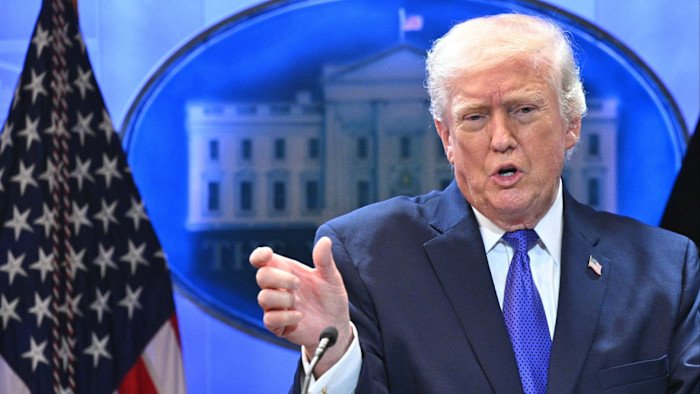
This article is an on-site version of our Trade Secrets newsletter. Premium subscribers can sign up here to get the newsletter delivered every Monday. Standard subscribers can upgrade to Premium here, or explore all FT newsletters
Welcome to an unprecedentedly extended edition of Trade Secrets. If you’ve been asleep for the past 72 hours, here’s what’s happened. On Friday, the US Supreme Court handed down its long-awaited ruling confirming that President Donald Trump’s emergency IEEPA tariffs were illegal. Hours later, Trump announced a worldwide tariff of 10 per cent. Less than 24 hours after that, he increased it to 15 per cent. Tomorrow is the State of the Union address, bringing who knows what fresh hell.
Sorry, but were you expecting the ruling to result in clarification and calm? The last few months, when other countries at least vaguely knew which tariffs they were haggling over, might start to seem like a halcyon age. In today’s newsletter I look at what trading partners and Congress could and should do now, and why other federal courts deserve much more credit than the Supremes. I also nominate a Trade Secrets Hero in each category. Charted Waters, where we look at the data behind globalisation, is on US stock prices.
Get in touch. Email me at alan.beattie@ft.com
Chaos returns, slightly more structured this time
First of all, let’s not go back to the logic-washing we saw early in the second Trump administration. What we’ve seen since Friday is not a cunning tactic of keeping ‘em guessing. It’s an enraged toddler lashing out after his favourite toy is taken away, or perhaps a wounded Trumpceratops thrashing around in pain after having been gored by a Scotusaurus Rex. (Sorry.)
The administration has signalled its strategy to replace IEEPA for a while. First, impose the Section 122 “balance of payments” tariffs as a 150-day stopgap. While there’s a very serious question about whether they too are legally vulnerable, litigation is unlikely to be done within that time. Meanwhile, rebuild some of the IEEPA wall with “national security” (Section 232) and “unfair foreign trade practices” (Section 301) duties. Those quote marks indicate the absurdity of all those rationales, and I’m using them again when saying that the administration wants to preserve its gunboat bilateral “deals”, most recently agreed with India.
This plan isn’t quite as bad as the nonsensical formula that created the supposed “reciprocal” IEEPA tariffs driven by White House China warrior and trade counsellor Peter Navarro. The US trade representative’s office, which has been much more involved this time, orbits planet earth at a somewhat lower altitude. But given the complexity of the investigations and justifications needed to authorise Section 232 and Section 301 tariffs, there will undoubtedly be months of manoeuvring, lobbying and litigation. Then there is the separate issue of companies being refunded for the IEEPA tariffs, which Scotus courageously made someone else’s problem by punting it to the Court of International Trade.
As many have noted, the blinding complexity of complying with tariffs can be as bad as the duties themselves, and this will make it worse. If, like me, you think that tariffs were already generally on the way down, this will probably hasten their decline and thus is a long-run positive, at the cost of more short-term uncertainty. Let’s remember that confusion is one of Trump’s tactics. (It’s one of the eight motives of his I’ve identified.) But Trump didn’t want this ruling, and the chaos here springs from his reaction to adversity, not a planned strategy.
Reopening the dodgy deals
Certain trading partners don’t look very clever right now, principally the UK, whose supposedly major achievement of a 10 per cent tariff in its early gunboat deal with Trump back in May has now been undone by the new 15 per cent minimum. The EU has a similar issue with the “Turnberry agreement” it was bullied into in July. On the other hand, it was an excellent day for the US’s most defiant partners, China and Brazil, as shown in this chart.

Wiser people than me have explained at length what legal status the gunboat “deals” have now that the IEEPA tariffs on which many were based are out of bounds. But the agreements — even the more detailed recent ones that bear the imprint of USTR negotiators — are legally so shaky that they de facto depend on whether the Trump administration can punish other signatories for abandoning them.
Assuming there isn’t a great collective global agreement to confront the US and tear the agreements up (which there won’t be), smaller countries in particular are probably going to sit tight for a while and see what happens. If there’s any room to fudge and delay, however, especially for countries it is harder for Trump to bully, they should take it. India has postponed a meeting to finalise the draft deal Trump made with Prime Minister Narendra Modi last month. This would be an excellent time for the Indian negotiators to lose their passports or have a long series of family emergencies. Japan could discover that stumping up $550bn in investment involves more technical difficulties than at first appeared.
China, which has already faced down Trump by making threats over rare earths, now has a timely opportunity at a forthcoming US-China summit to press home its advantage. But the trading partner with a wider systematic responsibility to stand up to the US is the EU. Its Turnberry capitulation, which involved the violation of the “most-favoured-nation” status that it swore it would never abandon, trashed the bloc’s claim to be a guardian of the rules.
The European parliament is likely today to defer the vote that would ratify the agreement. The EU should at the least set a high bar for resuming it, demanding certainty over US tariffs that Trump will find very hard to deliver, and meanwhile prepare a serious plan to use its anti-coercion instrument if required. The Trade Secrets Hero here is the veteran German Social Democrat MEP Bernd Lange, who has been chairing the parliament’s international trade committee roughly since the time when Charlemagne was king of the Franks. In his undemonstrative way Lange has consistently resisted capitulation to the US, and last week correctly described US tariff policy as “chaos” while calling for the implementation vote to be postponed. Let’s hope he prevails.
The Hill can reclaim its birthright over trade
It’s ironic that one of the arguments used by the three conservative Supreme Court justices who voted against the tariffs was the “major questions” doctrine, which holds that the executive requires “clear congressional authorization” for important and novel economic and political actions. The courts have thus shown much more willingness to stand up for Congress than has Congress itself. The Senate and House could have ended Trump’s misadventures before they started. Hill Republicans chose not to.
Still, the Scotus ruling happily coincides with the Republicans developing a bit of spine. The House recently followed the Senate in narrowly voting to give itself the power to end the state of emergency Trump used to justify the IEEPA tariffs, with three Republicans in favour. Then it voted down the “emergency” cited for tariffs on Canada. There’s no way either house will get the two-thirds majority needed to overcome a presidential veto, but dissent against Trump is growing. The Trade Secrets Hero here is Republican representative Don Bacon of Nebraska, who has strongly criticised the president and vowed to take back congressional authority over trade.
The stopgap Section 122 tariffs only need congressional approval to be renewed after their initial 150-day period, while Section 232 and 301 tariffs don’t need congressional approval at all. Previous attempts to assert more congressional control over the Section 232 tariffs failed. But unlike the IEEPA authority, Congress can harry the president during the consultations required to authorise 232s and 301s, holding public hearings, increasing reporting requirements and keeping up the barrage of public criticism. Legally it can’t stop him rebuilding the tariff wall, but it can raise the political cost.
The true judicial heroes of the hour
Not all heroes wear capes: some don black robes and usually spend their days in the grinding technicalities of antidumping duties on imports of mattresses from Vietnam and the like. I speak not of the Supreme Court, for whom excessive praise is sloshing around, but of the Court of International Trade (CIT), which first ruled the IEEPA tariffs unlawful in May, a decision then upheld by the federal circuit appeals court in August.
Many (including me) originally thought Scotus would roll over for Trump, based on the non-technical reasoning that it generally does. But its performance was still pretty unimpressive. The court did little more than the minimum needed to prevent the trashing of Article I of the US constitution and surrendering completely to the executive branch. And three justices couldn’t even put their names to that.
This whole absurdity could have been headed off last summer if the Supreme Court had simply declined to take the case and let the lower courts’ rulings stand, indicating that the case wasn’t worth discussing further. Instead, the Supremes created prolonged uncertainty and imposed unrecoverable damage of hundreds of billions of dollars on US domestic companies and consumers to whom the costs of tariffs were passed on. It was an expensive exercise in attention-seeking, for sure.
The Scotus decision last week to kick the refunds question back to the lower courts underlines that the real US constitutional guardians are the diligent nerds in the CIT up in New York. The CIT is not normally involved in high-profile politics; the average American almost certainly has never heard of it. But Trump’s abuse of presidential authority over trade has got to the point where the court making entirely reasonable decisions has serious implications for executive power.
It’s not easy to be a check or balance when Trump’s furious personal denunciations are just a Truth Social post away. Accordingly, the Trade Secrets Heroes of the judiciary are the CIT generally and the justices in the IEEPA case in particular.
In fact, the CIT’s role in the Trump tariffs may not be over. Even if the courts cannot move fast enough to stop the Section 122 tariffs, Jennifer Hillman, the academic and former USTR general counsel who was in a minority in accurately predicting the Supreme Court vote on IEEPA, thinks the Section 301 tariffs are also liable to challenge for being unconstitutional. Wouldn’t that be fun?
Charted waters
One of the indicators to watch while Trump is thrashing around putting in new tariffs is how stock and bond prices react. The rally in US stocks has faded this year and might well be susceptible to a tariff shock.

Trade links
Kevin Hassett, director of the White House National Economic Council, made and then withdrew the bizarre suggestion that Federal Reserve researchers be disciplined for publishing a paper suggesting that Trump’s tariffs are being paid by US businesses and consumers.
Martin Sandbu argues that Europe needs to weaponise its economic chokepoints.
Ahead of German Chancellor Friedrich Merz’s visit to Beijing this week, the Economist looks at how Germany fell out of love with China.
UK trade policy looks in a bit of trouble just now. The latest embarrassment is the shelving of a project to build a frictionless post-Brexit border, the difficulty of which trade experts were warning about a decade ago.
Monica de Bolle at the Peterson Institute says that Trump’s latter-day Monroe Doctrine in the Western Hemisphere is aimed at pushing back against Chinese influence.
Trade Secrets is edited by Harvey Nriapia
Recommended newsletters for you
The AI Shift — John Burn-Murdoch and Sarah O’Connor dive into how AI is transforming the world of work. Sign up here
FT Swamp Notes — Expert insight on the intersection of money and power in US politics. Sign up here