dailynewsnblog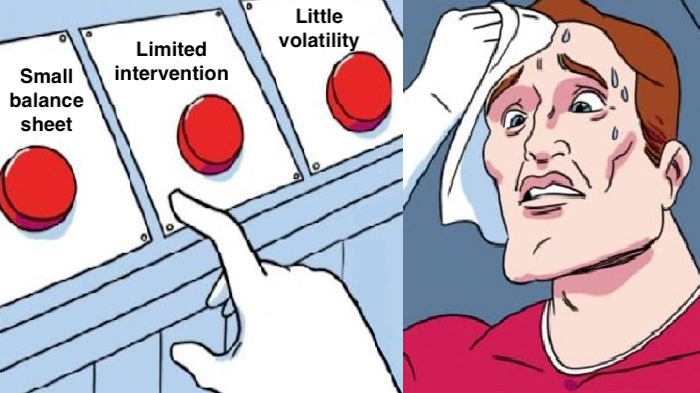
Stay informed with free updates
Simply sign up to the Central banks myFT Digest — delivered directly to your inbox.
Last December, Federal Reserve chair Jay Powell said the central bank would begin reinflating its balance sheet. Fed chair-nominee Kevin Warsh wants to shrink it. There is no real right answer unfortunately, as both are arguably trying to solve an impossible equation.
The best-known trilemma in economics is that countries can only choose two out of 1) fixed exchange rates; 2) unfettered capital; and 3) independent monetary policy. Although some Asian countries have made a fair stab at achieving all three, history is littered with examples of ultimately ruinous attempts to do so. It’s therefore sometimes also called the “impossible trinity” of monetary economics.
Two senior economists at the Federal Reserve — Burcu Duygan-Bump and Jay Kahn — have now proposed a new trilemma: central banks have to choose between having a small balance sheet; limited market interventions and tranquil interest rates.
As Duygan-Bump and Kahn wrote in a paper published last month:
Compromising on any of the three goals carries significant costs: 1) A large balance sheet increases the central bank’s structural footprint in financial markets and could crowd out private sector credit intermediation. 2) High money-market volatility can dampen rate control, impeding the implementation of monetary policy and leading to unexpected funding stress and liquidity shortages. 3) Frequent market interventions expand the central bank’s footprint through daily market operations, potentially impairing price discovery and market discipline.
To be sure, the central bank can opt for an interior solution and tolerate some rate volatility (for instance, around calendar quarter-ends), some extra market operations, and a slightly larger balance sheet. But we hope the trilemma framework laid out here clarifies the tradeoffs central banks face.
All the arguments that Duygan-Bump and Kahn explore are hardly new. In some respects this is the defining monetary debate of the post-GFC era. Kahn in particular has previously written lots of cool research on money markets that touches on it. But it’s the first time Alphaville has seen the argument laid out in a nice, clean and elegant trilemma framework.
Look, there’s even a diagram (which we couldn’t resist drawing on):

And it’s particularly timely right now, given the looming regime change at the Federal Reserve.
If confirmed as Fed chair, Warsh is unlikely to be as hawkish as his reputation indicates. After all, he wouldn’t have received Trump’s nomination if he hadn’t firmly nailed his flag to the rate-cutting mast. But Warsh’s one constant view as he has morphed from old-skool ‘hard money’ fiscal conservative Republican into a low-rates Trumpist is that the US central bank’s balance sheet is egregiously bloated after a decade of various crisis-fighting programmes.
This has led to dangerous economic and financial distortions, he argues. As Warsh put it in a speech a year ago:
Immunologists describe a phenomenon where the immune system’s response to a virus may impede the response to a subsequent variant. They call it immunological imprinting. I proffer a theory of economic imprinting whereby the policy choices of prior periods make the economy more vulnerable to shocks and less able to adjust organically.
Each time the Fed jumps into action, the more it expands its size and scope, encroaching further on other macroeconomic domains. More debt is accumulated . . . more capital is misallocated . . . more institutional lines are crossed . . . risks of future shocks are magnified . . . and the Fed is compelled to act even more aggressively the next time.
Simply stated, path dependency is driving policy. We need to be careful that it’s not driving into a ditch. It’s not just dangerous for our economy . . . its risky business for central bank legitimacy . . . and riskiest for our citizenry.
For dataviz afficionados, we thought we’d re-up Toby’s chart of the Fed’s balance sheet over the past century here:

The trilemma posited by Duygan-Bump and Kahn indicates that Warsh can have his smaller balance sheet, but it will either have to lead to more frequent central bank interventions (à la September 2019) or much greater destabilising money market volatility.
Alphaville last year laid out a low conviction, somewhat controversial argument that this might actually be healthier in the long run. The lack of money market volatility and the central bank backstop clearly encourages the growth of financial leverage, and this is now reaching worrying levels.
Occasional bouts of choppiness would unquestionably be unpleasant, but could be beneficial to the financial system as a whole — just like how controlled fires can control the growth of dead leaves and branches, regenerate the ecosystem and mitigate the risks of an larger, uncontrollable and dangerous wildfire.
But as Kahn and Duygan-Bump’s research indicates, there aren’t any easy options here. As they conclude:
A larger balance sheet stabilizes rate control and reduces the need for intervention but expands the central bank’s structural footprint. A smaller balance sheet limits that footprint yet either requires more active liquidity management or tolerates greater rate variability. No operating regime can simultaneously achieve all three goals.