dailynewsnblog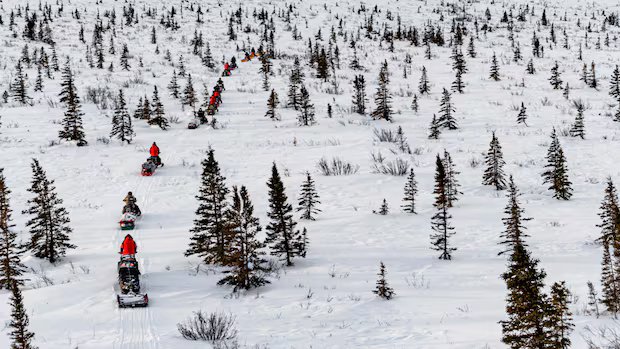

Listen to this article
Estimated 4 minutes
The audio version of this article is generated by AI-based technology. Mispronunciations can occur. We are working with our partners to continually review and improve the results.
From a 4,500-kilometre journey across the Arctic to a convention hall in Whitehorse, activity on Arctic security is picking up.
Delegates from across the circumpolar world are in Whitehorse for the Arctic Summit, which promises a heavy focus on infrastructure, while Canadian Rangers and members of the Canadian Forces will largely forego infrastructure to embark on an epic trek from Herschel Island to Churchill, Man.
All the activity comes at a time of increased international focus on the Arctic, and as the Canadian government considers major investments in Northern infrastructure. The summit agenda features a heavy focus on infrastructure that can be used by both civilians and the military, and the vast trove of critical minerals scattered across the Canadian North.
Retired general Wayne Eyre, a former Chief of Defense Staff and panelist at this year’s summit, said a shifting geopolitical landscape means old assumptions about Arctic security are out of date.
“This is an increasingly important region for the world,” Eyre said. “As we take a look at the globally integrated security environment, our world is becoming much smaller and our Arctic is no longer as secure as it once was.”

“Smaller” in the Arctic is relative. As the summit continues, one of the largest editions of Operation Nanook-Nunalivut ever mounted gets underway across the territories.
More than 900 kilometres north of Whitehorse, members of the 1st Canadian Ranger Patrol Group have been stormbound for three days at Shingle Point, on the Yukon’s north slope. They are travelling more than 4,500 kilometres via snowmobile to Churchill, Man., with stops at numerous communities and North Warning System installations along the way.
Heavy snow and high winds delayed the patrol because Inuvialuit rangers judged it unsafe to continue, said Whitney Lackenbauer, an academic and honorary colonel with the Canadian Rangers who’s on the trip.
“The last couple of days have reminded us the value of the Canadian Rangers being rooted in their communities,” he said. “So having rangers with us from Inuvik and from Aklavik who have cabins up here at Shingle Point… meant that they knew when we should pause.”
Even rangers from elsewhere in the Arctic have a few things to learn about how the weather varies from place to place, said Master Cpl. Tony Kunuk, a Canadian Ranger from Igloolik, Nunavut.
“I’m out of my element at this time,” he said. “Where I’m from, there’s no trees. We’re lucky that we have people from Inuvik and Aklavik that are talking about the environment, how it can change over here on a dime.”
“And we get to sit down, thanks to this third day of bad weather, we’re talking about histories and whatnot and getting to know each other a little bit more. It’s working out pretty good so far,” Kunuk added.
Operation Nanook-Nunalivut runs until April. The event includes several exercises at different locations around the Canadian Arctic and will involve roughly 1,300 hundred Canadian personnel, plus soldiers from the United States, France, Belgium and Denmark. Parks Canada and the RCMP are also involved.
The operation will also include the firing of two M777 howitzers. The heavy artillery pieces will be test fired near Cambridge Bay, Nunavut. The Canadian Armed Forces say it will be the first time the weapons have been fired North of 60.
The Arctic Summit wraps up in Whitehorse Wednesday.