dailynewsnblog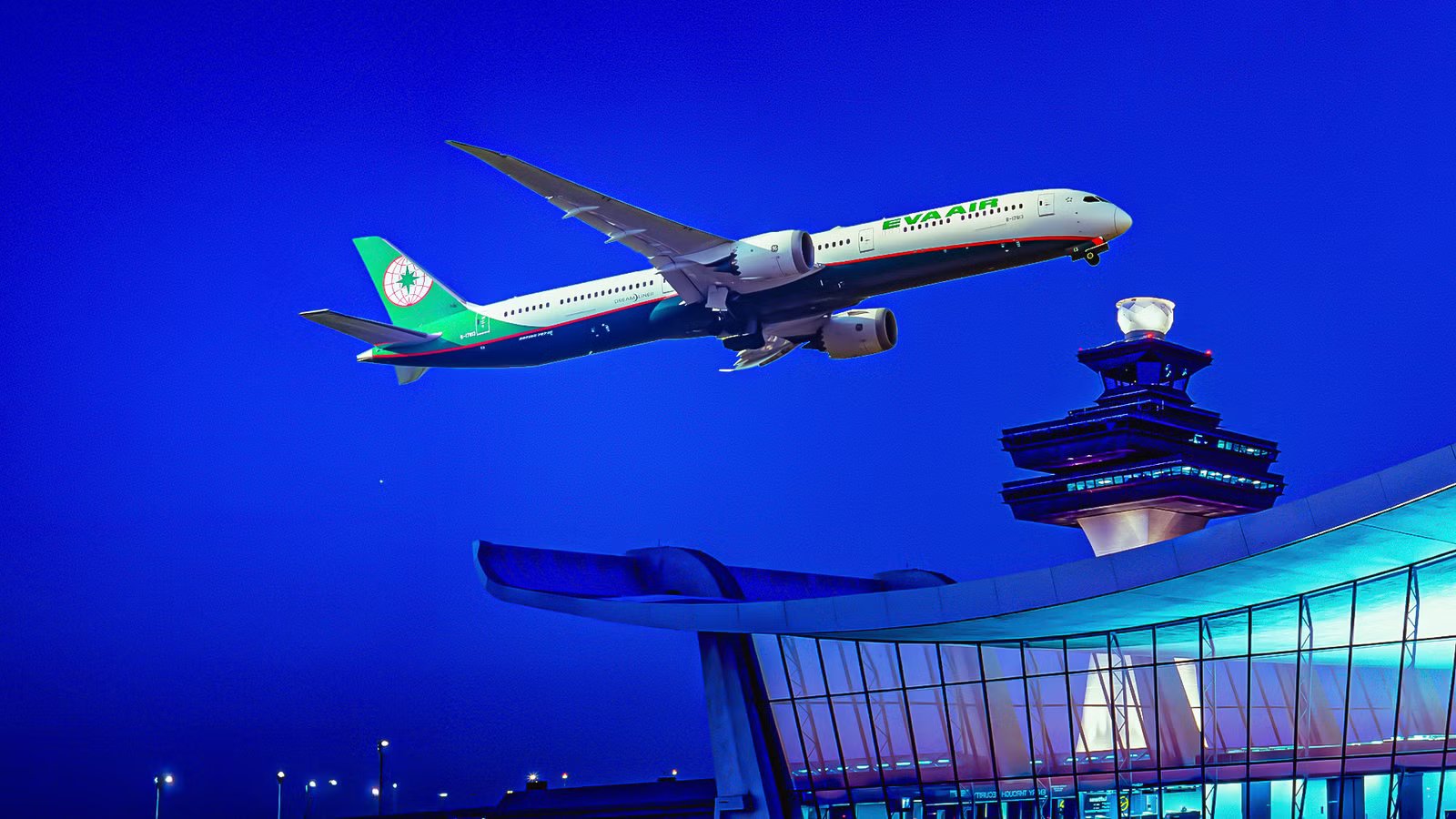
For decades, the United States West Coast has long dominated transpacific aviation, something which makes sense geographically. The region is, unsurprisingly, a natural bridge between Asia and North America. However, that long-standing norm is being quietly rewritten. Increasingly, airlines are looking towards serving Washington, D.C, with nonstop transpacific flights. The airport sits at the intersection of global diplomacy, defense, finance, and advanced technology. The area has something that few other East Coast cities can match, with a rare blend of premium corporate demand, political relevance, and an internationally-oriented population providing a strong customer base.
This shift has been underscored by EVA Air, which has confirmed that it will launch nonstop service to Washington Dulles International Airport (IAD) on June 26. For these routes, the carrier plans on using the Boeing 787-9. The carrier does not see Washington as just another US destination, but rather a strategic hub that is capable of linking Asia directly to the political and economic center of the Mid-Atlantic region. As airlines increasingly rethink network design choices beyond key West Coast hubs, the facility’s combination of premium traveler density, global relevance, and strong onward connectivity positions it as a compelling contender in the next era of transpacific aviation sector growth.
A Brief Overview Of Where Washington Dulles Stands In The Industry

There are a few different airports serving the Washington, D.C., metropolitan area. The largest and most important of these is Washington Dulles International Airport (IAD), which is objectively the region’s exclusive true intercontinental workhorse. It is where widebodies, long stage-length routes, and most international growth are concentrated. A major reason for this is structural, as Reagan National Airport (DCA) is constrained by the Federal Aviation Administration (FAA) perimeter rule, which limits most nonstop flights in distance, making long-haul flying essentially impossible from the facility.
As a result, it is somewhat unsurprising that IAD has increasingly become the region’s exclusive intercontinental hub. The airport sits in Northern Virginia, west of downtown Washington, D.C., allowing it to effectively serve business travelers flying to the nation’s capital. There are dozens of carriers operating flights in and out of Dulles, but the largest is undeniably United Airlines. As a result, the facility is also one of the largest US hubs for the global Star Alliance, of which United is the most important American member
In the intercontinental market, Dulles’ competitive edge is its hub connectivity. United uses IAD as a major connecting point, operating roughly 220 daily departures with United Airlines and United Express flights, as well as a large domestic network that feeds long-haul services. On the international side, the airline lists 26 daily nonstop flights from IAD to more than 30 international destinations, with the carrier offering particularly strong coverage across Europe, Asia, and Latin America. Demand undoubtedly exists, with the airport seeing more than 27 million passengers pass through its doors in 2024, including a record 10.38 million international travelers. Capacity is also a key part of the story, with the airport currently planning to expand its facilities to 218 gates to accommodate an increasing number of international travelers each year.
What Routes Are Currently Operated From Dulles To Asia?

Washington Dulles’ nonstop Asia network is much smaller than most West Coast hubs, but it punches far above its weight, because each route ties into a major connecting hub. Today, long-haul service is offered to Tokyo Haneda Airport (HND), with both United Airlines and All Nippon Airways (ANA) operating daily nonstop services between the two population centers. This gives the airport two-airline frequency into one of the most premium long-haul destinations in Asia. Haneda also functions as a major connecting hub for passengers that are looking to travel onward to other destinations in Asia.
Nonstop flights to Seoul Incheon International Airport (ICN) are also operated. Korean Air, South Korea’s flag carrier, flies this route daily, tapping into the facility’s role as a Northeast Asian transfer gateway with dense onward options throughout Korea, Japan, China, and Southeast Asia. Mainland China also remains a served destination from the capital, with Air China operating nonstop flights between Dulles and Beijing Capital Airport (PEK). These flights are important for origin-and-destination government, diplomatic and corporate travel, which leans in favor of direct routes.
On the US side, the United Airlines hub at Dulles and  Star Alliance feed make these flights work by feeding travelers from interior cities all across the nation. Most notably, Dulles is currently missing a nonstop link to India. Air India has suspended service from Delhi (DEL) to Washington, D.C, once service was suspended in September 2025. A final carrier, Air Premia, also needs to be mentioned. That airline aims to launch four-times weekly service from Seoul to Dulles starting on April 24, 2026.

Washington Dulles’ 5 Largest Airlines By Market Share
The airport is one of America’s largest and most important facilities.
A New Service That Brings A Lot To The Table

EVA Air’s new nonstop route from Taipei’s Taoyuan International Airport (TPE) to Washington-Dulles is a good example of how the airport plans to continue growing in the transpacific market. It is a nonstop link that will commence on June 26. In the opening phase of service, the airline plans on flying this route four times per week using a  Boeing 787-9, an aircraft that is well optimized for this kind of service. The jet offers a three-cabin layout designed to capture premium demand while still offering enough seats to support broader leisure traffic.
This balance is also an important piece of the puzzle. Rather than overcommitting capacity from day one, EVA Air is entering the market with a frequency that can serve the schedule of business travelers and build loyalty while remaining in a safe range for turning a profit. The carrier thus believes it can turn a profit if demand between these cities proves durable. For Dulles, the airline’s new route is a headline addition to a rapidly-growing long-haul portfolio, as well as that of the Star Alliance.
We spoke with EVA Air’s Executive Vice President for North America, Andrew Su, regarding the route’s new launch. His sentiments helped confirm many of our hypotheses about why the carrier chose Dulles to be its newest US gateway. In a statement, he had the following words to share:
“We are going to launch our service to Washington, DC. The reason we introduced this new destination is that it is the gateway connecting the world to the political and economic heart of the United States, Washington, DC.”
Why Does Serving Dulles Make Sense For The Carrier?

Washington, D.C., is undeniably a market of interest for Eva Air due to its maturity and size. For starters, and as Andrew Su was quick to point out to us, it is the seventh-largest metropolitan area in the United States. The aircraft has a very well-developed collection of Star Alliance partners in its network, which enables seamless connections to cities all across the United States, as well as onward to Central and Latin America.
This can enhance travel flexibility and convenience, strengthening the case for serving the city. Washington, D.C., is also a concentration for highly educated and high-earning talent, a group that has been consistently linked to high levels of premium demand. The city also has extensive employment, including being home to the headquarters of more than 20 S&P 500 corporations across different sectors like defense, technology, and finance.
Su’s words mostly echoed this commentary, highlighting the city’s strong business demand and extensive growth in recent years. What he followed up by touching upon is that the challenge ahead for EVA Air is very much execution. When discussing launch plans for the route, he had the following words to share:
“We are estimated to have our service in the summer, and in the beginning, we will operate four weekly routes with 787-9 aircraft.”
Why Does This Make Financial Sense For The Airline?

From a financial perspective, a route from Taipei to Washington, D.C., works because it pairs premium-oriented demand with efficient, right-sized widebody capacity. The Washington, D.C., region primarily concentrates on government travel, multiple kinds of defense contractors, technology, and finance, all of which are segments more likely to pay for business and premium economy. These are all segments the airline wants to financially target.
The Boeing 787-9 keeps trip costs low, and a four-times-weekly start limit makes a lot of sense as the market continues to mature. In just as important fashion, the route is a blue ocean, as no airline currently links these destinations. As a result, EVA Air can capture time-sensitive travelers who otherwise aim to connect through West Coast hubs or other Asian cities like Tokyo or Seoul. Those kinds of travelers often pay more for convenience.
Connectivity multiplies an addressable market beyond local Washington, D.C.,-oriented traffic. United’s Dulles hub can feed passengers from inland US cities, all while Taipei equivalently serves as a powerful onward gateway across Asia. This combination creates a plausible path to profitability from day one.

EVA Air Reveals 16‑Hour Nonstop Washington Dulles Flights In 2026
A bold new route is on the way, marking the first time two distant cities will have nonstop flights.
What Is Our Bottom Line?

At the end of the day, Washington, D.C., is one of the most capable long-haul hubs on the planet. The facility caters directly to high-end travel demand from those coming to the city on business. This is where most carriers, including Taiwanese EVA Air, make their money.
EVA Air has not been hesitant to analyze the kind of demand that exists at this kind of facility. The carrier has identified the area’s potential for a nonstop connection from the carrier’s principal Taiwanese hub. On top of this, the airline certainly has to execute on its operational objectives.
The carrier’s nonstop services to the capital and destinations beyond the it make it a key piece of the Star Alliance’s East Asian network. The airline’s capabilities are undoubtedly impressive, and few do not expect Washington, D.C, to develop into the kind of hub these carriers are suggesting it will be.