Four years after Vladimir Putin ordered an invasion of Ukraine, Russia’s economy has entered a “death zone,” said Alexandra Prokopenko, a fellow at the Carnegie Russia Eurasia Center.
In a recent Economist op-ed, the former Russian central bank adviser drew on a term from mountain climbing when high altitude forces the body to consume itself faster than it can repair itself.
“Russia’s economy is stuck in what might be described as negative equilibrium: holding itself together while steadily destroying its own future capacity,” she wrote.
The economy isn’t headed for an imminent crash, but GDP has stagnated, oil revenue has been halved amid Western sanctions, and the government’s budget deficit is rapidly draining reserves.
At the same time, two economic systems have emerged. One is comprised of the military and related industries that receive priority from the Kremlin. And then there’s everything else that’s been “left in the cold,” Prokopenko explained.
“The most dangerous feature of this new structure is the fuel it burns,” she added. “Russia’s economy now runs on what might be called ‘military rent’: budget transfers to defense enterprises that generate wages and economic activity.”
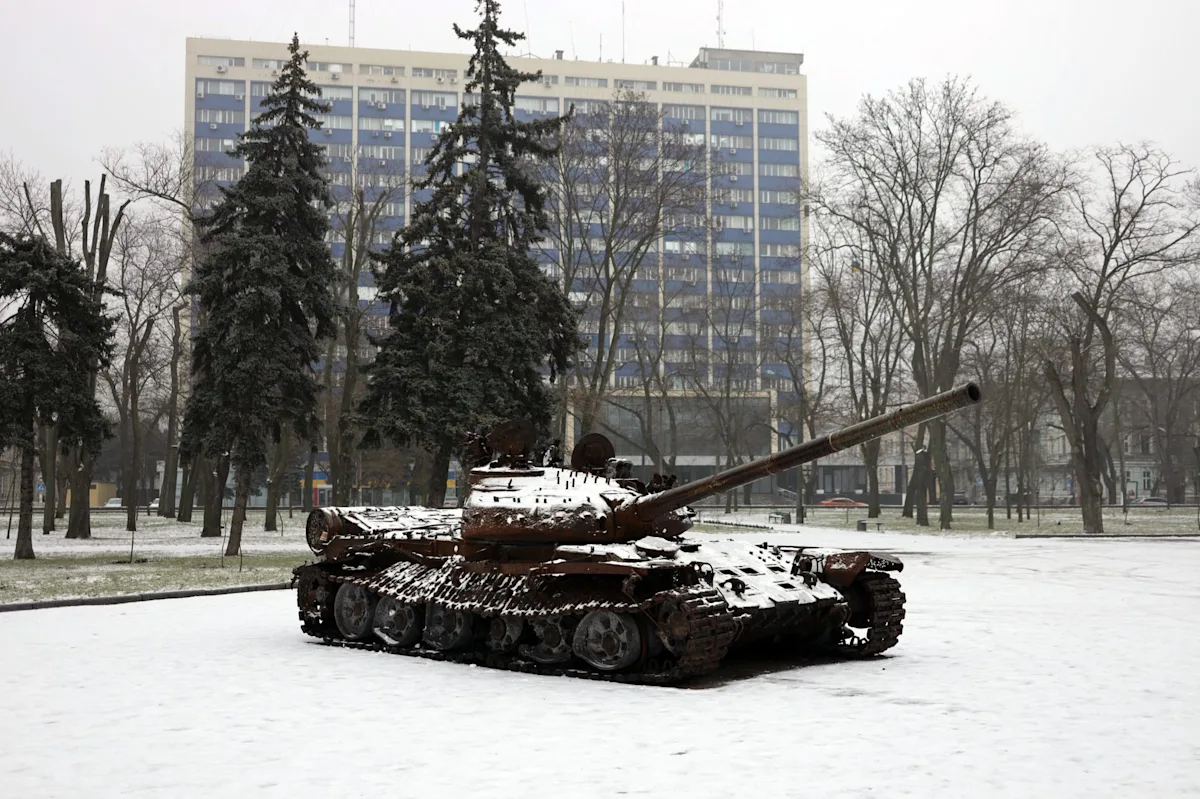
But the transfers are aimed at assets designed for destruction, Prokopenko pointed out. In other words, the money that keeps Russia’s factories humming pays for tanks, armored vehicles and other weapons that eventually get destroyed or damaged, making them useless for future economic growth.
Similarly, money spent to attract fresh recruits to Russia’s army doesn’t retrain them to become more productive. Instead, many die or return home permanently wounded. The Center for Strategic and International Studies has estimated Russian military casualties at 1.2 million, including 325,000 killed.
“The body is metabolizing its own muscle tissue for energy,” Prokopenko said.
While the central bank has cut interest rates to prop up growth and the Kremlin has taken steps to rein in the budget deficit, Russia’s economic predicament can’t be fixed with monetary or fiscal policies, she wrote.
In fact, interest payments on government debt this year are already set to exceed spending on education and health care combined.
Unlike a cyclical downturn such as a recession, Prokopenko argued that what Russia is suffering from is more akin to altitude sickness—”the longer you stay, the worse it gets, regardless of rest.”
But Putin can’t afford to climb back down the mountain as the economy has becoming increasingly reliant on the defense sector while a military demobilization would likely trigger an economic crisis. And rather than end the war, Putin insists on continuing as he waits to see if Ukraine or its Western backers crack first.
“Russia can probably continue waging war for the foreseeable future,” she predicted. “But no climber can survive the death zone indefinitely—and not all climbers who attempt the descent survive it.”
Alarm bells about the economy have been coming from inside Russia in recent months. Russian officials warned Putin that a financial crisis could hit by the summer, sources told the Washington Post earlier this month.
They pointed to weak oil revenue, which crashed by 50% in January from a year earlier, and a budget deficit that continues to widen, even after Putin hiked taxes on consumers.
A Moscow business executive also told the Post that the crisis could arrive in “three or four months” amid spiraling inflation, adding that restaurants have been closing and thousands of workers are getting laid off.
The economic strains go back to Russia’s invasion of Ukraine four years ago. As sanctions took hold and Putin mobilized the economy for a prolonged war, a tight labor market and high inflation forced the central bank to keep interest rates high. Recent easing has failed to prevent spending declines in several consumer categories.
With companies feeling the squeeze of high rates and weaker consumption, more workers are going unpaided, getting furloughed, or seeing their hours cut. As a result, consumers are having trouble servicing their loans, raising concerns of a crash in the financial sector.
“A banking crisis is possible,” a Russian official told the Post in December on condition of anonymity. “A nonpayments crisis is possible. I don’t want to think about a continuation of the war or an escalation.”
At the same time, Western officials have been trying to dispel the notion that Russia is winning. Indeed, Ukraine has even launched a counterattack in recent weeks to take advantage of Russian troops getting cut off from SpaceX’s Starlink internet service.
The Institute for the Study of War estimated that Ukraine has liberated at least 168.9 square kilometers of territory in the southern part of the country since Jan. 1.
Russia’s military is now suffering more casualties than it can recruit, according to Christina Harward, deputy Russia team lead at the Institute for the Study of War.
She wrote in the New York Post on Sunday that Putin may even need to begin a limited, rolling military call-up to sustain his war, adding that his bravado in negotiations is really a bluff.
“With recruitment rates declining, inflation rates rising and his troops’ ability to actually seize the territory he so desires in question, it won’t be long before Putin has to force his population to suffer economic hardship—and death,” Harward said.
This story was originally featured on Fortune.com


 dailynewsnblog