dailynewsnblog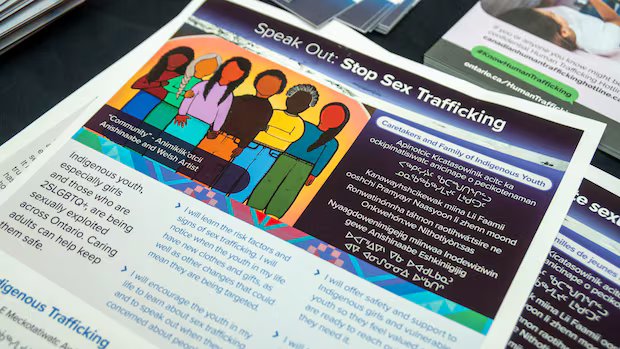

Listen to this article
Estimated 4 minutes
The audio version of this article is generated by AI-based technology. Mispronunciations can occur. We are working with our partners to continually review and improve the results.
Raising awareness about what constitutes human trafficking and signs that could save someone from being exploited is important work in Thunder Bay, Ont. — which federal data suggests is an especially problematic hub for trafficking in Canada.
“It’s happening here in Thunder Bay. A lot of people don’t think it is, but it is,” Cindy Paypompee, co-chair of the Thunder Bay Coalition to End Human Trafficking, said Friday.
Paypompee was interviewed by CBC News ahead of National Human Trafficking Awareness Day on Sunday. The coalition — formed in 2018, and consisting of law enforcement, health, education and social service providers — held an awareness event at the Intercity Shopping Centre on Friday.
According to Statistics Canada, over 5,000 human trafficking incidents overall were reported to police between 2014 and 2024. Thunder Bay, with a population of about 118,000, saw the highest average annual rates in the country during that decade.
Thunder Bay’s average annual rate was 8.0 per 100,000 population, compared to the national average of 1.5 per 100,000 population, according to the data agency’s latest report, released in December.
Vulnerable individuals — including migrants, youth in care, Indigenous women and girls, and those experiencing poverty — are especially at risk, the report says.
Ontario and Nova Scotia are the only provinces with rates exceeding the national average, and both had the highest rates in 2024, the report says.
‘We’re just doing this on our own’
For Paypompee and others with the coalition, doing what they can to help prevent human trafficking is important work in progress.
“This is not a funded coalition. We’re just doing this on our own, the organizations,” said Paypompee, who works at Beendigen (also known as the Anishinabe Women’s Crisis Home and Family Healing Agency).

(Sarah Law/CBC)
Paypompee hopes to create a pamphlet or resource guide that can be dispersed widely to help protect people from exploitation.
For now, information is being shared on the coalition’s website.
“Signs of a person who may be trafficked, safety planning, local resources in Thunder Bay,” she said, “just to bring awareness to people … of what trafficking is, and help somebody who may need the help.”
Issue largely ‘behind closed doors’
Steven Kearney is in Lakehead University’s accelerated social work program. As part of the one-year course, students research an issue in northwestern Ontario.
Kearney is among several people in the program who chose human trafficking as their subject.
“There’s so many crossovers between a number of other issues — gender-based violence, domestic violence, murdered and missing Indigenous women and girls — and human trafficking is a piece that I think we don’t always know how to recognize properly because it’s so behind closed doors,” he said.

(Sarah Law/CBC)
This semester, the students were tasked with developing a mock advocacy campaign, which Kearney and his peers decided to bring to the community at Friday’s event.
Connecting with people at Thunder Bay’s shopping mall allows organizations to share information with a wide cross-section of people who may not know much about the issue beyond what they’ve seen in the media, said Kearney.
“In big media and television and movies, it looks like international crime and this big ring of moving people, but it’s so much deeper than that,” he said.
“For me, awareness is just demystifying and getting away from that big media bias. This isn’t Taken with Liam Neeson, right?” he said about the 2008 film focusing on the trafficking of a CIA agent’s teen daughter and her friend. “This is an issue that’s a little more subtle.”
When Paypompee started this advocacy work, she said, she approached an elder for advice. The elder shared a phrase with her, which became the name of Beendigen’s annual anti-human trafficking conference, run alongside the Nokiiwin Tribal Council.
“The name that we came up with is Wi Na Wenjikaazo, which means in Ojibway, ‘They are taken care of,’” said Paypompee.
“We just want people … who are being trafficked [to know] that there are people who are willing to help.”