dailynewsnblog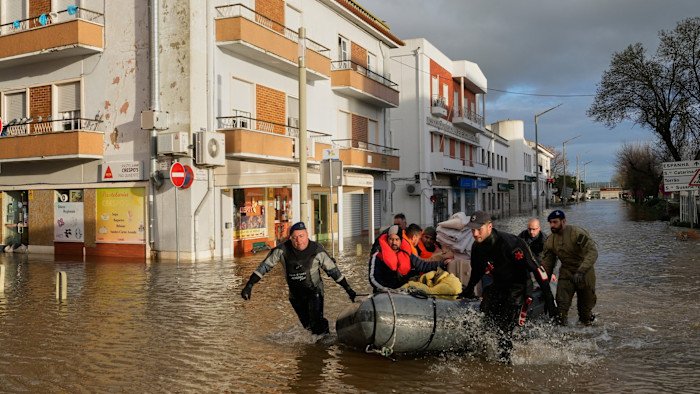
A wave of extreme rain and flooding across the Mediterranean countries and north Africa has battered the winter growing regions that feed Europe, disrupting supplies of fruit and vegetables and threatening food price rises.
Spain, Portugal, Morocco and parts of Italy and Greece function as Europe’s winter “pantry”, exporting tomatoes, cucumbers, avocados, peppers, berries and citrus fruit northwards when domestic output is limited.
But extensive damage to crops and infrastructure in recent weeks could quickly ripple through wholesale markets and supermarket supply chains, warn economists.
“When you have the types of floods that we’re seeing in Europe and north Africa, combined also with the very wet winter here in the UK . . . there’s no way around it: we’ll see the pressure on vegetable and fruit prices,” said David Barmes, policy fellow at the London School of Economics’ Centre for Economic Transition Expertise.
Spain, which recorded its wettest January in 25 years, has already recorded damage to 22,000 hectares of agricultural land, according to insurance association Agroseguro. Luis Planas, Spain’s agriculture minister, said the affected area could “nearly double” once assessments were complete.
The ruin extends beyond crops to irrigation systems, farm machinery and rural roads, complicating harvesting and distribution even where produce survives.

In western France, some agricultural areas have endured more than 36 days of continuous rain and successive storms have led to the overflow of the Garonne river and parts of the Loire into orchards and vineyards.
The concentration of European winter fruit and vegetable supply in a handful of regions makes markets particularly sensitive to weather shocks.
In January last year, Spain accounted for more than 70 per cent of UK sweet pepper imports and 65 per cent of cucumbers, while Morocco supplied more than a third of British strawberry and raspberry imports, according to UK trade data.
“The biggest, probably most proximate impact [from the recent weather] is the impact on fresh produce from Spain and Morocco,” said Tom Lancaster at the Energy and Climate Intelligence Unit, a UK-based think-tank. “If supply tightens, buyers may find themselves competing for smaller volumes,” he said. “You might also see an impact on quality: fruit damaged by heavy rain doesn’t travel or store as well.”
The Netherlands imports 35-40 per cent of its fresh vegetables from Spain, Morocco and Portugal, which together also provide 15-20 per cent of its fresh fruit imports during January and February, according to ING.
In Andalusia, one of Spain’s main agricultural regions, farmers’ association Asaja estimates that 20 per cent of all production has been lost. In one province alone, Córdoba, Asaja said losses totalled €700mn, with olive groves accounting for €550mn of that sum and further damage to cereals and citrus.
Last week Pedro Sánchez, prime minister, visited the storm-hit town of Huétor Tájar, west of Granada, where the mayor explained that 80 per cent of its population depended directly or indirectly on the region’s asparagus production. With harvesting due to begin within weeks, mayor Fernando Delgado said that as much as a third of the crop remained underwater.

The adverse weather across Andalusia and other major growing regions in southern Europe meant “prices would be higher year on year”, said Thijs Geijer, a senior economist covering food and agriculture at ING, adding that consumers would see fewer discounts. But he noted that the effect on inflation data could be muted in the Netherlands, where the affected products carry little weight in the consumer price index.
Barmes said that the latest storms were part of a wider pattern of climate shocks feeding into food price inflation. His recent research has shown that the gap between UK and euro area food inflation in recent months was largely driven by a small number of climate‑sensitive items — including chocolate and olive oil — some of which carry a much heavier weight in the UK shopping basket, leaving British consumers more affected when extreme weather hits.
“To me, there’s little doubt that we’ll see pressure on food prices later in the year, even if some of it will be more short term,” he said. “It’s very difficult to substitute away from Spain and Morocco in particular for certain parts of the winter vegetable basket, so I think we’ll see that [impact] quite soon, and then later, we’ll probably see effects also on fruit, and then also on meat and dairy . . . and olive oil.”
Central banks have begun acknowledging the influence of extreme weather on inflation dynamics. In its August 2025 monetary policy report, the Bank of England noted that climate-linked disruptions were contributing to higher UK food prices and complicating efforts to return inflation to its 2 per cent target.
Governments have pledged support for affected farmers through insurance payouts and EU crisis reserve funds linked to the bloc’s Common Agricultural Policy. Spain has vowed to give farmers €2.2bn in direct aid and spend €600mn on rebuilding infrastructure.
But economists say the broader concern is structural. “I think we’re really seeing that this is not a one-off,” said Barmes. “These types of climate-related supply disruptions are becoming more frequent, severe, and geographically widespread.”
Additional reporting by Carmen Muela in Madrid
Climate Capital

Where climate change meets business, markets and politics. Explore the FT’s coverage here.
Are you curious about the FT’s environmental sustainability commitments? Find out more about our science-based targets here