dailynewsnblog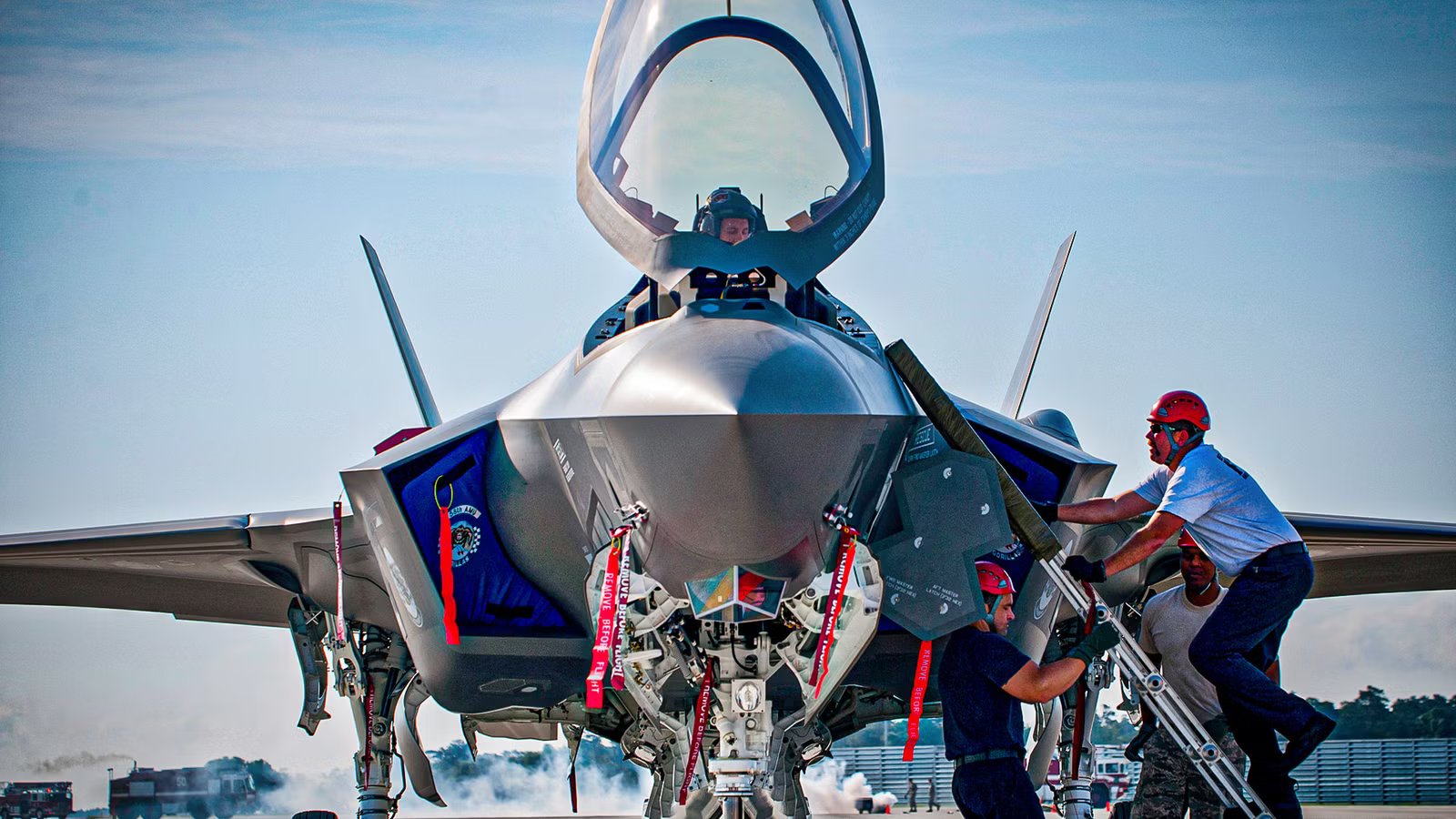
When you think of the most powerful and technologically advanced air forces on Earth, it’s natural to picture sleek stealth fighters, hypersonic weapons, and highly trained pilots in high-tech suits and helmets, almost like a sci-fi scene. But this isn’t science fiction; it’s all real and can be seen in the USA — a place where the future of airpower is tested, refined, and proven. The place we are going to talk about today is Eglin Air Force Base in northwest Florida. Covering an area larger than many US cities and run by arguably the most capable test wing in the world, Eglin is the heart of United States Air Force innovation. In our article, we’ll look at Eglin’s size, history, capabilities, and strategic importance, which make it one of the most formidable military installations on the planet.
Far more than a simple base, Eglin is a massive compound of research, development, testing, and evaluation. From the earliest days of World War II to the cutting edge of multi-domain operations today, this installation has grown into the centerpiece of America’s ability to turn concepts into combat-ready technologies. You’ll learn how its sheer size enables unique testing freedom, why its facilities are critical to modern warfighting, and how the people who work there transform ideas into proven performance under pressure.
Immense Scale: A Landscape Designed For Innovation

Eglin Air Force Base’s most immediately striking feature is its sheer physical size. According to the US Military Installations, the base spans roughly 726 square miles (1,875 square km) of integrated land, an area larger than many microstates, and contains more than 70 specific test and training areas. This massive footprint allows Eglin to run full-scale weapons tests, flight tests, and integrated scenarios without ever having to worry about interfering with everyday civilian activities outside its boundaries, even though the base shares some of the runways with Destin–Fort Walton Beach Airport (VPS), which is located within the base, but adjacent to the city of Valparaiso.
But the base’s reach extends far beyond its land mass. It also controls an expansive airspace of more than 130,000 square miles (337,000 square km), stretching over the Gulf of Mexico (America), and a water range of roughly 123,000 square miles (319,000 square km). That combination of land, sea, and sky makes Eglin’s environment one of the most comprehensive real-world proving grounds imaginable, where air-delivered systems can be tested from takeoff to impact in conditions that closely mirror actual combat.
This geographic extent allows facilities like the Eglin Gulf Test Range to evaluate entire weapon systems, from missiles and guided bombs to electronic warfare suites, throughout their development, from launch to final effect. With such a large territory available, engineers and pilots can test systems thoroughly, observe their performance, and make improvements before they are deployed in combat.
In comparison to other military installations, Eglin’s scale is exceptional. While a typical Air Force base might operate within a few dozen square miles, Eglin’s combined land and controlled airspace creates an environment where entire integrated systems, or the “systems of systems,” can be exercised together. This level of complexity and size simply can’t be replicated at smaller scales or in isolated facilities.
Roots In History: From World War II Proving Ground To Modern Powerhouse

Eglin’s story begins during the buildup to America’s entry into World War II, when the US Army Air Corps recognized the need for an isolated location to test emerging aircraft and armaments. According to the official Eglin AFB website, on 27 June 1940, the US Forestry Service ceded part of the Choctawhatchee National Forest to the War Department, and what would become Eglin was designated as a proving ground for aircraft armament and gunnery training.
During the war, pilots bounced through the base’s ranges training for combat missions, while test teams developed tactics and techniques, including ways to defeat German V‑1 flying bomb launch sites, that proved critical in shaping Allied air operations.
As the Cold War dawned and weapons became more complex, Eglin’s mission evolved. The Air Force established the Air Force Armament Center here, merging development and testing and laying the foundation for what would, decades later, become the 96th Test Wing — the lead test and evaluation unit for everything from bombs to avionics.
These early decades also saw the construction of the highly instrumented Eglin Gulf Test Range, a feature that remains central to the base’s modern capability and continues to be upgraded to support ever more sophisticated testing requirements.
Today, Eglin stands not just as a historical artifact of American airpower, but as a living, constantly evolving hub of research and experimentation where the future of warfare is shaped before any system enters service.

Top 5: These Are The Largest Air Force Bases By Area
All five bases are operated by the United States Air Force.
The 96th Test Wing: Where Theory Meets Reality

At the core of Eglin’s mission is the 96th Test Wing, a unit that combines technical expertise with operational rigor to ensure that the Air Force’s weapons, aircraft systems, and guidance technologies perform as expected — not just in lab conditions, but in the chaos of real battle.
According to the 96th Test Wing official website, rather than simply cataloging data in a quiet simulation environment, 96th Test Wing personnel conduct developmental tests and evaluations across the entire system lifecycle. They start early in a program’s development, follow it through integration and refinement, and validate it under operational stress. Pilots, engineers, and maintainers work side by side to rig weapons to aircraft, fly them through complex scenarios, track telemetry in real time, and analyze results at all hours.
This work is a blend of mental stamina, physical precision, and technical proficiency where even tiny errors in data or execution can have outsized consequences. Flight tests at Eglin put systems under pressure, pushing them beyond design envelopes so that their real-world performance and limitations are exposed and understood.
Furthermore, the 96th Test Wing’s task is not limited to aircraft testing. Its evaluations include non-nuclear munitions testing, guidance systems, navigation suites, countermeasures, radar signatures, unmanned vehicles, command-and-control networks, and more. The Wing also oversees the extensive land and overwater ranges surrounding Eglin that allow these tests to be conducted safely and effectively.
In an era when precision-guided munitions and integrated sensors determine battlefield success, having a base dedicated to advancing these technologies through the toughest evaluations offers a strategic edge.
Flight Tests And The Multi Domain Test Force: Proving Lethality Under Pressure

The tests at Eglin are designed to demonstrate lethality under conditions that mimic real combat. One of the most significant advancements in recent years has been the creation of the Multi-Domain Test Force (MDTF), a team designed to integrate air, land, sea, space, and cyber elements into test campaigns that truly reflect how future conflicts will be fought.
Modern warfare is usually defined by how all domains interconnect. To meet that reality, test exercises like Emerald Flag, Orange Flag, Black Flag, and Gray Flag bring together platforms, sensors, command systems, and warfighters from across services and technologies, as described on another Eglin AFB page. These events are operationally representative scenarios built to test everything from connectivity to kill-chain integration, survivability to tactical adaptability.
One of the recurring events referenced by Eglin is Emerald Flag, described as an operationally representative test event that integrates multiple platforms and capabilities in scenarios designed to reflect real-world combat conditions. The goal is to validate the entire kill chain — from detection and identification to engagement and battle damage assessment.
According to base reporting, these events bring together warfighters, engineers, analysts, and maintainers in a collaborative test environment. This ensures that data gathered in flight or during live-fire exercises is fed directly into the system refinement process.
Test Flag Event (TFE) Structure
|
Event Name |
Focus Area |
Location |
Purpose |
|
Emerald Flag |
Joint-domain effectiveness |
Eglin AFB, FL |
Test integration of air, land, sea, space, and cyber assets |
|
Orange Flag |
Kill-web integration, survivability |
Edwards AFB, CA |
Multi-domain, multi-platform testing of sensors, shooters, and networks |
|
Black Flag |
Operational integration |
Nevada Test and Training Range |
Ensure combat-ready operational capability |
|
Gray Flag |
Maritime & Navy collaboration |
NAS Point Mugu, CA |
Extend testing environment to naval operations by the US Navy |
Source: Air Mobility Command
In these environments, pilots fly alongside unmanned systems, cyber teams evaluate vulnerability responses, and command elements see how digital links hold together under stress. Data from these events feeds into acquisition timelines, helping decision-makers adjust designs before systems are fielded.
The result is a tighter “digital thread” linking modeling, simulation, and real-world validation, reducing risk before systems are deployed operationally, and also one of the reasons Eglin remains a leader in defense R&D. It’s not enough to build a weapon that should work; at Eglin, every capability is validated to work together.

US Air Force 350th Spectrum Warfare Wing’s Bamboo Eagle Exercise: What To Know
Unprecedented multidomain coordination and EW integration define the 350th SWW, forging the edge of modern warfighting readiness.
Facilities And People That Define The Edge

Behind every successful test is the infrastructure and people who make it all work — and Eglin’s facilities are among the most advanced anywhere. Beyond the ranges themselves, the base operates in numerous specialized environments where specific aspects of system behavior can be isolated and pushed to extremes. And there are some of the most qualified people working there — engineers with deep technical knowledge, pilots who fly into the unknown with precision, analysts who parse terabytes of data, and support crews who keep everything running — all of whom form a community that thrives on challenges most others avoid.
One of the most prominent labs is the McKinley Climatic Laboratory, a massive testing environment that exposes aircraft and components to extreme temperatures, humidity, and weather conditions. This allows engineers to see how systems behave in conditions far beyond what typical flight tests could replicate.
|
Facility / Test Area |
Type / Function |
Notes / Capabilities |
|---|---|---|
|
McKinley Climatic Laboratory |
Environmental test facility |
A world-class laboratory that simulates extreme weather from arctic cold to desert heat; able to accommodate full-scale aircraft. |
|
Guided Weapons Evaluation Facility (GWEF) |
Weapons and systems evaluation |
Laboratory environment for precision guided technology and seeker/sensor systems testing. |
|
Eglin Gulf Test & Training Range |
Overwater and land test range |
Extensive range covering large swaths of airspace over the Gulf of Mexico and land for flight test, weapons, and multi-domain evaluation. |
|
Santa Rosa Island Range Complex |
Overwater/land range sub-complex |
Component of the overwater test range with tracking and telemetry systems; provides test and training support. |
|
Armament/C2 Systems Test Environment |
Integrated systems testing |
Environment for evaluating command/control integration with armament systems. |
|
Multi-Spectral Test & Training Environment (MSTTE) |
Sensor and spectrum testing |
Environment supporting multi-spectral testing (EO/IR, RF, etc.) for guidance and countermeasure systems. |
|
Joint Preflight Integration of Munitions & Electronic Systems (J-PRIMES) |
Pre-flight integration lab |
Facilities for munitions, electronics, and system integration analysis. |
|
Central Control Facility (CCF) |
Data coordination & analysis |
Central node for managing live data from range instrumentation and test activities. |
|
Air Force Armament Museum |
Museum / public outreach |
Displays historical and modern armament and weaponry adjacent to the base. |
Sources: Eglin AFB
On Santa Rosa Island, towers and instrumentation provide open-air hardware‑in‑the‑loop testing for precision weapons and sensors, simulating real battlefield conditions and enabling line‑of‑sight evaluations across land and sea.
And because testing doesn’t stop at launch or impact, Eglin’s facilities also support electronic warfare evaluations, communications assessments, and environmental testing, all aimed at ensuring robustness and reliability in complex scenarios.
It’s these facilities, along with vast ranges and skilled personnel, that make Eglin a one-stop destination for turning bold defense ideas into real, combat-ready systems.
A Base That Helps Win Wars

In the realm of airpower and modern military operations, having a base that can truly test, refine, and validate complex systems is an indispensable asset. Its massive land and airspace, world-class facilities, multi-domain test events, and a culture rooted in operational realism all combine to create an installation that is both unmatched and, in many ways, unstoppable.
Whether it’s the precision-guided weapons that define conflict in the 21st century or the integration of cyber and physical systems that make networks resilient, Eglin’s contribution to US Military capability is profound. It’s a place where possibilities are transformed into proven performance, and where tomorrow’s frontlines are shaped long before warriors reach them.
Because of all this combined: the size, the mission, the people, and the outcomes, Eglin Air Force Base stands not just as one of the largest Air Force bases in the world, but as one of its most strategically vital, relentlessly capable, and fundamentally unstoppable military installations.