dailynewsnblog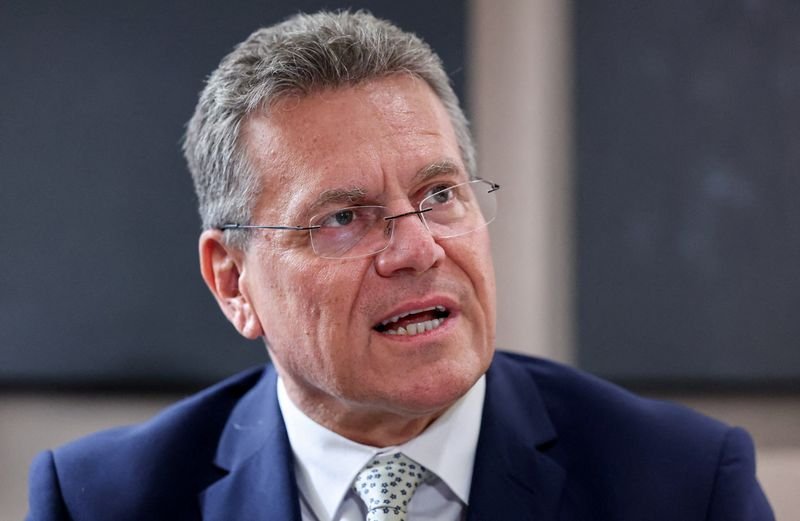
By Philip Blenkinsop
NICOSIA, Feb 20 (Reuters) – The European Union should be ready to put into force its contentious free trade agreement with South America’s Mercosur bloc in the coming months despite opposition from France and a legal challenge, EU trade chief Maros Sefcovic said on Friday.
The deal with Argentina, Brazil, Paraguay and Uruguay could remove some 4 billion euros ($4.7 billion) of duties on EU goods exports, making it the bloc’s biggest ever free trade agreement in terms of potential tariff reductions.
Signed in January after 25 years of negotiations, the accord has strong support from Germany and Spain, but faces opposition led by France over concerns that increased imports of cheap commodities, like beef and sugar, will harm domestic farmers.
The European Parliament voted last month to challenge the agreement in the bloc’s top court, which could delay the deal by two years and potentially derail it. However, the European Commission could decide to apply the agreement on a provisional basis far sooner.
Sefcovic suggested on Friday that was a possibility.
“When our Mercosur partners will be ready with the ratification, we should be ready as well,” Sefcovic told reporters before a meeting of EU trade ministers in Cyprus.
“We expect that Argentina might be the first one to ratify. I think they’re going through the decisive phase already this week,” he added.
FAST-TRACK APPROACH
Sefcovic said the EU executive was discussing with Mercosur and EU countries, and European Parliament members, how to proceed, adding that delays were costly as the EU seeks to offset lost business due to U.S. tariffs and reduce dependence on China, notably for critical minerals.
He referred to a study by the ECIPE think-tank which estimated that the bloc sacrificed 291 billion euros in gross domestic product between 2021 and 2025 due to its failure to ratify the deal earlier.
Bernd Lange, chair of the European Parliament’s trade committee, said the bloc should first ask how quickly the EU Court of Justice might be able to rule.
If six months was possible, then the agreement could be paused. If not, it might be put into force in April or May, he said.
Sefcovic said he would also discuss with EU ministers speeding up the implementation of free trade agreements, saying the bloc could use recently concluded deals with India and Indonesia as test cases for a fast-track approach.
($1 = 0.8500 euros)
(Reporting by Philip Blenkinsop;Editing by Helen Popper)