dailynewsnblog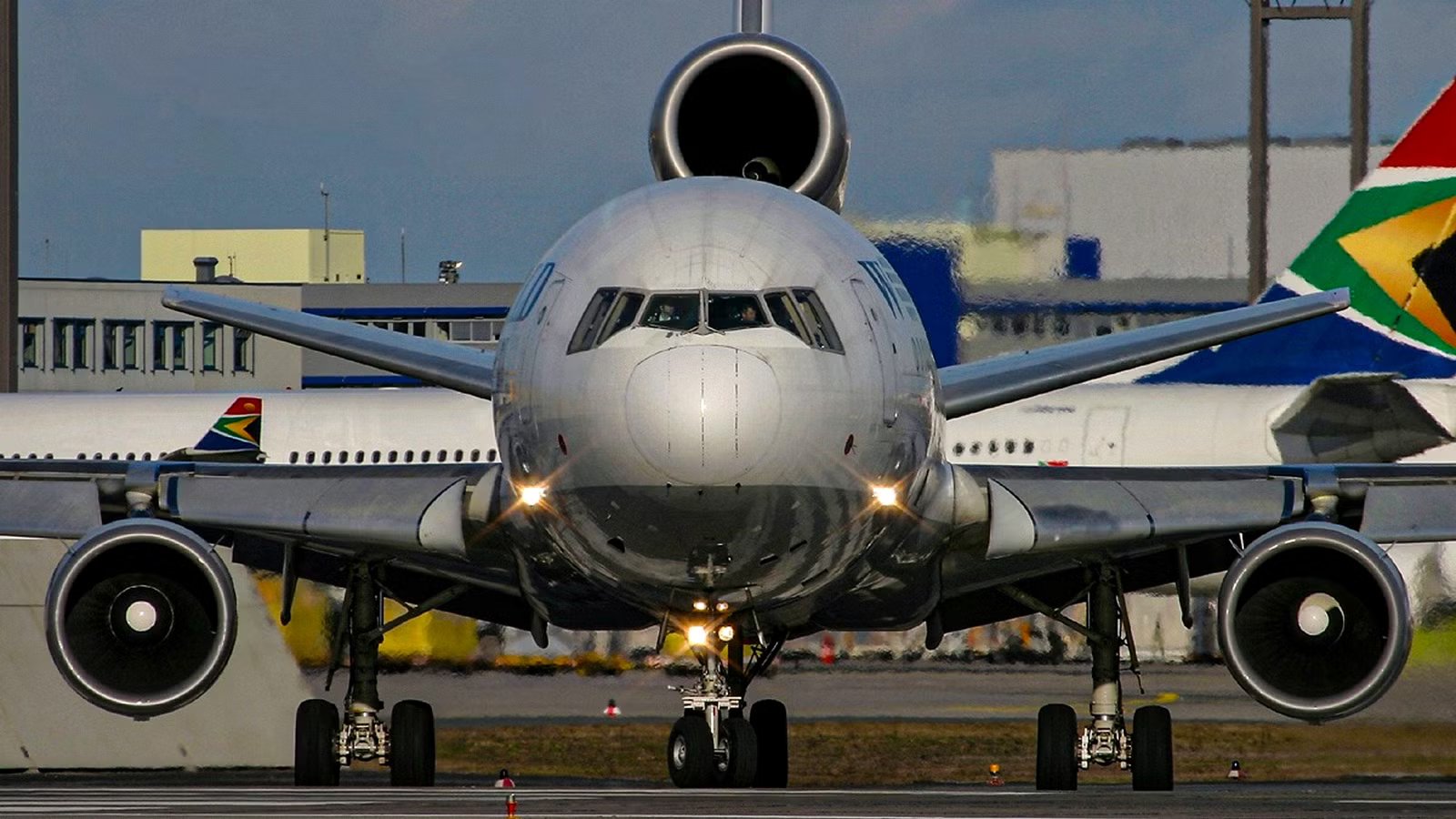
When one observes a trijet on the ramp at an airport, their eyes will be naturally drawn directly to the aircraft’s tail. On the McDonnell Douglas MD-11, the center engine is not fed in the same way that most traditional trijets are. The  Boeing 727 and the Lockheed L-1011 both use a pronounced S-duct, with an intake on top of the fuselage that curves down to an engine buried deeper in the jet’s tail. The MD-11’s tail engine, by contrast, is a much more direct and straight-through arrangement carried at the base of an aircraft’s vertical stabilizer. This leads the inlet, ducting, and fan presentation to differ in significant aerodynamic and maintenance-related ways from that of a traditional three-engine aircraft.
This design choice reflects the unique design complexity of the Douglas DC-10 and the McDonnell Douglas MD-11 family’s priorities, which aim to keep the tail installation structurally robust and avoid the manufacturing complexity of a tightly curved duct. This also packages the third engine in a way that still preserves a clean widebody wing and underwing engine layout. It also creates a handful of quirks that are extremely unique to the aircraft, such as tail-engine access that can involve climbing up into the tail structure during periods of maintenance.
A Brief Overview Of The MD-11 Itself

Undoubtedly, the best place to start here is with the McDonnell Douglas MD-11 itself. The aircraft was designed to modernize and economically extend the Douglas DC-10’s impressive commercial success formula into the 21st century. It kept the aircraft’s iconic trijet layout, including a pair of underwing engines and a tail-mounted center engine, all while introducing a stretched fuselage, aerodynamic refinements, winglets, and a more advanced two-crew glass cockpit that cut operating costs and improved range-related performance relative to earlier generations of the type.
In terms of broader numbers, the aircraft type is typically described as a medium-to-long range widebody capable of high-capacity passenger layouts with up to 410 seats in a dense configuration. The aircraft has also been capably deployed as a freighter. The jet, as a result, has found a second life with a number of cargo operators. The jet’s efficiency lags behind that of modern widebodies, but these airlines do not particularly care about overall fuel efficiency because they simply do not have the same sky-high aircraft utilization rates as most commercial airlines in the market today.
When it comes to the jet’s performance and mission capabilities, published specification summaries commonly place the MD-11 in the 7,000+ nautical miles class (around 13,000 km), depending on what specific variant one may choose to operate and what particular assumptions of the aircraft’s cargo and passenger payload it chooses. The jet has cruise speeds that sit in the high-subsonic widebody band as well. A capable widebody model that hauled passengers around the globe for decades, the jet has an impressive reputation for overall reliability. This makes it the kind of model that operators greatly appreciate, despite production ceasing relatively early, primarily due to post-merger commercial simplifications made by Boeing after acquiring McDonnell Douglas.
Powerful Engines Were Behind The MD-11’s Capabilities

The McDonnell Douglas MD-11 was offered with multiple different engines as potential powerplants. The most frequently cited engine is the General Electric CF6-80C2D1F, a high-bypass turbofan that was developed especially to suit the thrust needs of the MD-11. Creating an engine in need of such unique aerodynamic capabilities was not always the easiest thing to do. In published operator material, the -80C2D1F is capable of providing around 61,500 lbf (around 273.6 kN) of takeoff thrust, according to Aircraft Commerce.
The engine offers impressive consistency across all three of the jet’s powerplants. This was something that was necessary due to the aircraft’s complex engineering. The MD-11 was entering the market when two-person cockpits were increasingly becoming the standard, and crew workload in a two-person cockpit environment was also a key factor of concern. This meant that having a high-performing, easy-to-manage power plant was essential.
From the perspective of hardware, the CF6-80C2 family is associated with a 93-inch (2.36 m) fan and a modern widebody core architecture for its era. This allowed the MD-11 to comfortably meet range and payload targets while keeping commonality with other CF6-powered fleets. Other MD-11 customers selected Pratt & Whitney’s PW4000 options. Some references also note a Rolls-Royce RB211 offering, illustrating that the MD-11’s powerplant story was as much about airline preference, supporting networks, and overall operating economics.

Is The McDonnell Douglas MD-11 Done Flying For Good?
The aircraft was once a long-haul workhorse.
What Were The MD-11’s Capabilities?

From an operational perspective, the McDonnell Douglas MD-11 was designed to serve as the principal long-haul widebody that could carry either a large passenger load or a massive amount of freight. The other important piece of this was that the aircraft could comfortably and easily be flown by a two-pilot crew. In passenger service, it could be arranged with up to 410 seats in high-density layouts. However, most airlines deployed it in a low-capacity fashion with more diverse multi-class layouts.
The aircraft was certainly a long-range jet, although it did not have the same long-range capabilities as many of today’s latest models. The jet’s maximum range sits at roughly 7,144 nautical miles (13,231 km). Normal cruising speeds are typically listed at around 519 knots (961 km/h), and a typical service ceiling of roughly 32,600 ft (9,940 m). This is useful for when the aircraft is flying longer routes and wants to maintain a higher altitude in order to improve cruise efficiency.
When it comes to the aircraft’s capabilities as a freighter, this is where the model really shines. The jet’s practical edge is payload-range flexibility. The jet is capable of carrying a payload of up to 201,035 lbs (91,185 kg), all while still coming along with reasonable range performance of around 3,486 nautical miles (6,456 km). At heavier weights, it also demands a serious amount of runway, with minimum takeoff distances increasing sharply as the jet approaches its maximum takeoff weight. This makes the jet an incredibly unique model, especially in situations where carriers want a jet with both freighter and passenger capabilities.
What Other Carriers Elected To Purchase This Jet?

Airlines have purchased the McDonnell Douglas MD-11 because it serves a relatively narrow sweet spot within the market. The aircraft offers DC-10-style widebody capacity and long-haul range. The aircraft offers updated avionics and crew concepts, as well as better economics in theory. Additionally, a factory freighter option, which proved especially valuable, made the jet particularly appealing to multiple types of operators. The original launch commitments on their own also came from a wide mix of flag carriers and cargo players, including the Italian Alitalia, Finnair, Korean Air, Swissair, Thai Airways, VARIG, and Federal Express (FedEx).
In service, the aircraft has been the best-known passenger McDonnell Douglas MD-11 variant, with customers of the type including Swissair, KLM, Delta Air Lines, and Japan Airlines. These carriers all generally used the type on long-haul trunk routes where a trijet’s performance and overall redundancy still appealed in the early 1990s.
In terms of cargo operations, the aircraft maintains an even stronger legacy. FedEx bought 22 McDonnell Douglas MD-11Fs, and Lufthansa Cargo purchased 14 of the type, all while other operators and leasing pathways helped the type proliferate through freighter conversions and secondary-market deals. This thus allows the jet to offer dynamic long-haul capabilities in both the passenger and commercial freighter spaces.

Why The McDonnell Douglas MD-11’s Nose & Main Landing Gear Needs 12 Tires
The heavy weight of the aircraft combined with the aircraft’s design requires 12 tires on the main landing gear.
The McDonnell Douglas MD-11 In The 2020s

In the 2020s, the McDonnell Douglas MD-11 almost exclusively serves as a cargo aircraft, with the last scheduled passenger operators of the type retiring it in 2014. The decade started with major operators still relying on the jt for defense, long-range lift, and other assets, but retirements accelerated as fleets modernized.
Lufthansa Cargo withdrew its last McDonnell Douglas MD-11 in October 2021, and the final remaining US operators were pretty much limited to FedEx and UPS. This role has shifted in the wake of a November 2025 UPS MD-11 crash near Louisville, which triggered an industry-wide pause. The FAA issued an Emergency Airworthiness Directive, effectively grounding the type. Both UPS and FedEx parked their fleets pending inspections and repairs.
By the time January 2026 came around, UPS announced that it had completed the retirement of its MD-11 fleet during the fourth quarter. This effectively ended UPS’s operations with the type. Meanwhile, FedEx indicated that it expected to return MD-11s to service by May 31, 2026, all while smaller operators like Western Global faced major disruption from the prolonged grounding of the type.
What Is Our Bottom Line?

At the end of the day, the McDonnell Douglas MD-11 is undoubtedly an impressive and capable aircraft. The jet’s long-haul capabilities made it particularly useful for carriers that were looking to expand their transoceanic reach. The aircraft’s third engine made for impressive redundancy.
There were a few reasons why the MD-11’s third engine had to be specifically engineered for the task at hand. This engine required impressive aerodynamic engineering. The heavy engine offers aerodynamic balance for the aircraft as a whole.
Today, the aircraft’s footprint is mostly limited to its cargo operations, as one would expect for such an old aircraft. The jet’s future is also somewhat up for discussion, given a recent accident.