dailynewsnblog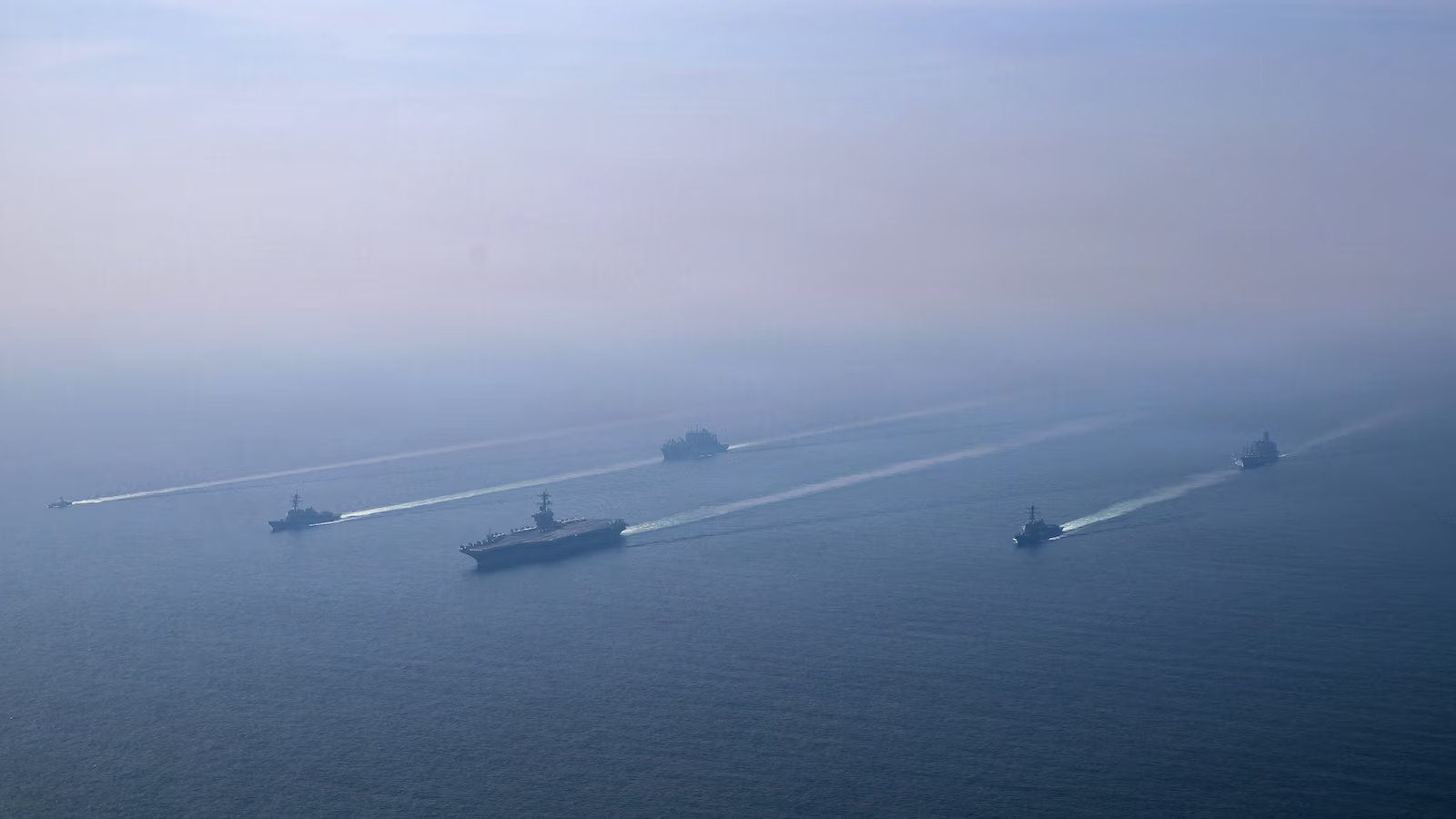
President Donald Trump on Thursday was considering a range of options for military strikes against Iran, including a possible limited strike aimed at enhancing the United States’ negotiating position, a person familiar with the planning told ABC News.
The president was also considering larger-scale strikes on government, military and nuclear targets, the person said.
The options, first reported by The Wall Street Journal, came as the president declared a 10-day deadline — “15 maximum” — for the two sides to cut a deal on its nuclear and ballistic missile program.
If Iran didn’t meet U.S. demands, Trump said, “really bad things” would happen.

Nimitz-class aircraft carrier USS Abraham Lincoln, Arleigh Burke-class guided-missile destroyers USS Michael Murphy, and USS Frank E. Petersen Jr., fleet replenishment oiler USNS Henry J. Kaiser, Lewis and Clark-class dry cargo ship, USNS Carl Brashear and U.S. Coast Guard Sentinel-class fast-response cutters USCG Robert Goldman and USCGC Clarence Sutphin. Jr. sail in formation in the Arabian Sea, Feb. 6, 2026.
Petty Officer 1st Class Jesse Monford/US Navy
“We’re either going to get a deal or it’s going to be unfortunate for them,” he said Thursday.
The U.S. military in recent weeks has surged more than 100 aircraft and a dozen ships, including two aircraft carriers, to the Middle East — an extraordinary buildup of military assets in such a short period.
Sources say the assets in place are enough to sustain a weeks-long campaign against the Islamic government, stoking widespread speculation that the U.S. was on the brink of war.
It’s not clear though whether Trump’s show of force itself is a kind of negotiating tactic to force Iran’s hand to make concessions, or if he is intent on trying to topple the regime, which experts say is at its weakest since its 1979 revolution.
Last June, White House press secretary Karoline Leavitt cited a “substantial chance of negotiations” with Iran, telling reporters in a briefing that the president planned to make his decision “within the next two weeks.”
Two days later, Trump bombed three of Iran’s nuclear sites in a carefully planned operation.
Now, U.S. officials say that Trump wants Iran to agree to remove any remaining enriched uranium from the country, as well as cap its long-range missile stockpile and stop supporting militant groups in the region like Hezbollah and the Houthis, which the U.S. considers terror groups.
Iran has not agreed. Sources told ABC News that following talks in Geneva this week, Iran would offer a new written proposal in the next two weeks.
On Wednesday, Trump huddled with his top advisers in the White House Situation Room to discuss his options.
On Thursday, Trump told attendees at the inaugural meeting of his Board of Peace that everyone would find out what might happen within the next 10 days — a deadline he later adjusted to 15.
“They cannot continue to threaten the stability of the entire region, and they must make a deal,” he said. “Or if that doesn’t happen, I maybe can understand. If it doesn’t happen, it doesn’t happen. But, bad things will happen if it doesn’t.
Included in the military buildup are two aircraft carrier strike groups — the USS Gerald Ford and the USS Abraham Lincoln — along with more than a dozen destroyers and cruisers, and squadrons of fighter jets.
Once the Ford arrives from the Mediterranean, troop levels in the region are expected to reach 40,000 personnel.
It’s possible the president would wait until the carrier is in a certain position before striking, although officials caution the military is capable of striking Iran without it.
Experts say the list of assets suggest there is a comprehensive initial target list for an effort that could be sustained, possibly for weeks.

An EA-18G Growler, attached to Electronic Attack Squadron 133, launches from the flight deck of Nimitz-class aircraft carrier USS Abraham Lincoln, Jan. 24, 2026.
Seaman Apprentice Cesar Zavala/US Navy
“The U.S. is clearly preparing to take significant military action if the negotiations between it and Iran fail,” said ABC contributor Mick Mulroy, a former deputy assistant secretary of defense for the Middle East.
Sen. Lindsey Graham, a close Trump ally, told reporters any military action has to be big enough to take down the regime.
“When you go, I want to go big,” he told reporters at the Munich Security Conference last week. “If you go — and it’s up to the president — I mean, this is literally the best chance.”
The risks, though, of a major U.S. attack are substantial. Iran has threatened a significant retaliatory response and plans to target U.S. naval assets specifically if attacked, Mulroy said.
A letter from the Iranians Thursday night to the United Nations Secretary General warned what would happen if the U.S. strikes Iran, saying “all bases, facilities, and assets of the hostile force in the region would constitute legitimate targets.”
Among the 35,000 U.S. troops in the region are 2,500 troops stationed in Iraq, 1,000 in Syria and 4,000 in Jordan.
Last summer, following the U.S. bombing of nuclear sites in Iran, Tehran retaliated by launching a barrage of missiles at al Udeid Air Base in Qatar, which typically has 10,000 personnel on site.
Officials have said they expect any future attack on U.S. assets to be substantially more devastating if the Iranian regime fears it’s on the brink of collapse and believes it has nothing to lose.
“If successful, this conflict could expand beyond either country’s preference,” Mulroy said.
Another concern, particularly among some Israeli officials, is that Trump will seek out a deal — even if it’s a bad one — for the sake of declaring victory.
The Israeli government was fiercely opposed to the 2015 U.S.-Iran nuclear deal under former President Barack Obama, and some Israelis are now worried Trump will offer concessions for the sake of declaring “peace through strength.”
“That’s the risk we’ve been running since day 1,” a former Israeli official told ABC News.
Graham last week shrugged off the risks of not taking military action.
“Is it complicated? Yeah, but this is ridiculous to think that you’ve got to answer every question before you can take evil down,” he said.
ABC’s Selina Wang, Mariam Khan, Shannon Crawford and Will Gretsky contributed to this report.