dailynewsnblog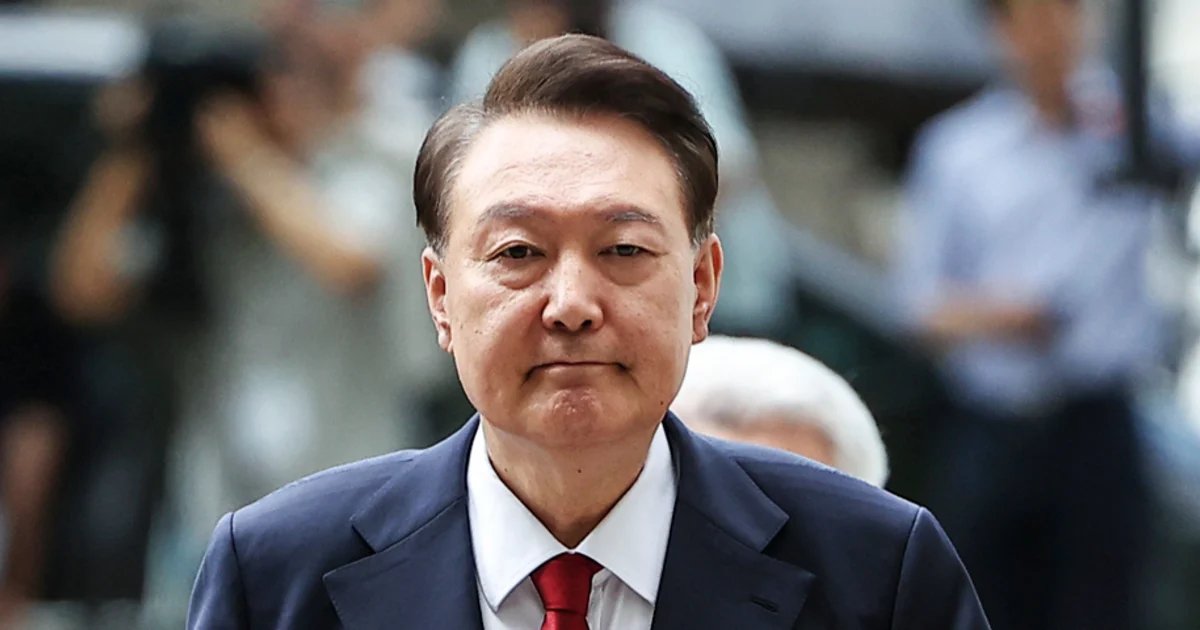
Impeached former President Yoon Suk Yeol could face the death penalty if he is convicted Thursday over his failed attempt to impose martial law on South Korea.
A Seoul court is set to deliver its highly anticipated ruling in the insurrection trial of Yoon, whose short-lived power grab sent the U.S. ally into political turmoil.
The verdict and sentence, set to be broadcast live across the nation, will be handed down by a three-judge panel at the capital’s Central District Court in a hearing scheduled to start at 3 p.m. local time (1 a.m. ET). Security at the court was heightened on Thursday in preparation for the possibility of large crowds.
Yoon, 65, has pleaded not guilty to insurrection, the most serious of a range of charges he faces in connection with his martial law order. If he is convicted, he faces a minimum sentence of life in prison, though prosecutors have asked for the death penalty.
The court will also rule on seven former military officers and senior police officials accused of participating in the imposition of martial law, including former Defense Minister Kim Yong-hyun, with prosecutors seeking prison terms of 10 years to life.
Yoon’s 2024 martial law order, the first of its kind in South Korea in more than 40 years, shocked a country that became one of Asia’s most vibrant democracies after having spent decades under military-authoritarian rule. South Korea was mired in months of political uncertainty as the chaos from the decree was followed by Yoon’s impeachment and a power vacuum at the top of government.
The episode has also deeply divided the politically polarized public, with Yoon’s conservative supporters cheering his attempts to fight impeachment and arrest in an echo of scenes in the United States.

The crisis began in December 2024 with Yoon’s surprise late-night announcement in a nationally televised address that he was suspending civilian government in South Korea, including a ban on all political activity and censorship of the news media.
Yoon, who was elected president in 2022, said the martial law order was necessary because “anti-state” forces in the opposition-controlled parliament had paralyzed the government through budget cuts and efforts to impeach multiple senior officials.
The order did not last long, however, as lawmakers rushed to the National Assembly in dramatic overnight scenes, pushing past troops sent there by Yoon and voting unanimously against it in an emergency session. Yoon lifted the order about six hours after he imposed it.
Lawmakers impeached Yoon about 10 days later, and in January 2025 he became South Korea’s first president to be arrested while in office. South Korea’s Constitutional Court upheld his impeachment in April.
Yoon, a former prosecutor, also faces eight criminal trials over the martial law order and other allegations, and he was sentenced to five years in prison last month in the first of those verdicts. He is appealing that ruling.
Other trials are still ongoing, including one in which he is charged with treason after he was accused of ordering that drones be sent into North Korean airspace to provoke a confrontation that could justify martial law.
Yoon denies wrongdoing, saying that he had the right as president to declare martial law and that the order was a short-term, symbolic effort to raise public awareness of the threat from opposition lawmakers.
Prosecutors in the insurrection trial said that the martial law order was a long-planned effort to extend Yoon’s rule indefinitely in violation of the constitution and that he was driven by a “lust for power.”
Other officials from Yoon’s administration have also received prison terms over their roles in carrying out the martial law order. Former Prime Minister Han Duck-soo, 76, was sentenced to 23 years last month, while former Interior Minister Lee Sang-min, 61, was sentenced to seven years last week.
Yoon’s wife, former first lady Kim Keon Hee, was also sentenced to 20 months in prison for bribery last month in a case that is unrelated to the martial law order.
All of the rulings can be appealed.
The country is now led by President Lee Jae Myung of the liberal Democratic Party, who was elected in June.
Ahead of the verdict on Thursday, Lee noted reports this week that the people of South Korea, formally known as the Republic of Korea, had been nominated for the Nobel Peace Prize for resisting the martial law order, describing his country as “a model for human history.”
“The Republic of Korea does it!” he said in a post on X.