dailynewsnblog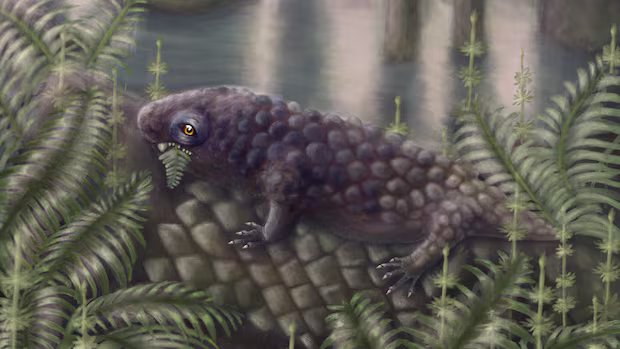
A newly discovered, football-sized creature that could grind its teeth like a hard-core plant-eater — back before that was really a thing — may be the earliest vertebrate herbivore ever found.
Tyrannoroter heberti lived about 315 million years ago, during the late Carboniferous Period, in a dense, ferny swamp on what is now Cape Breton Island in Nova Scotia. At that time, known four-legged animals, or tetrapods, like it ate mostly other animals, including insects, since they hadn’t yet come up with a way to chew and digest leaves and bark.
The new species is the earliest four-legged animal with the right kind of teeth for a plant-based diet, according to a new study describing it. That “kind of reshapes our understanding of how fast this transition happened,” said Arjan Mann, lead author of a study published last week in Nature Ecology and Evolution.
The tyranno-microsaur
Tyrannoroter was a “microsaur” — a small, lizard-like creature related to reptiles and mammals that lived before reptiles and mammals existed.
A large part of its skull was among several animal fossils found tangled up in the roots of an huge, ancient, petrified tree stump sticking out of a seaside cliff on Cape Breton Island.
Award-winning amateur paleontologist Brian Hebert found the stump, which is around three or four metres across, about nine years ago. Tyrannoroter‘s species name, heberti, honours him.

Mann worked with Hebert and helped excavate the stump during his PhD with Carleton University paleontologist Hillary Maddin.
Tyrannoroter‘s skull looks like it belonged to a group of microsaurs called pantylids, says Mann, curator of early tetrapods and fossil fish at the Field Museum of Natural History in Chicago.
Entire bodies of similar specimens that were about 20 million years younger, such as an animal called Pantylus, have been previously described by paleontologists. They have short, squat bodies with large rib cages and adaptations for digging. Mann says he believes Tyrannoroter would have looked similar.
Most pantylids were tiny — just five or 10 centimetres long. The researchers think Tyrannoroter was huge by comparison — about the size of a football. That’s why they gave it the name Tyrannoroter, which means “tyrant digger.”
Plant-eating pioneer
Tyrannoroter‘s most distinctive feature is multiple rows of what Mann describes as “Hershey-kiss” shaped teeth. He says they were ahead of their time — adapted to eat shoots, leaves and other high-fibre plant matter.
“This is, like, the earliest animal that’s known that has these kinds of teeth,” he told CBC News. The teeth are similar in shape to those of insect-eating animals, but the extra rows or “batteries,” give them the surface area needed for grinding.

Mann notes that’s also why humans, who also eat vegetables, have flat tops on their molars.
Four-legged animals first moved onto land about 375 million years ago, during the Devonian, the period before the Carboniferous.
At that time, plants, which had a 100-million-year head start on land, were abundant. But tetrapods had neither the teeth to chew them nor the ability to digest them — which usually requires teaming up with gut microbes that can break down cellulose.
Making space for that process requires a larger gut cavity, Mann said. That’s why many modern herbivores such as cows and hippos (and herbivorous dinosaurs like triceratops) are large and rotund.
While tetrapods couldn’t eat plants back in the Devonian and early Carboniferous, leaves at that time already had damage suggesting that they were being eaten by insects.

Mann and his colleagues suggest the ancestors of animals like Tyrannoroter may have gained the ability to digest cellulose by eating those insects.
And they suggest the wide, squat bodies of pantylids could be evidence that they had cellulose-digesting microbes in their guts.
Mann says he has a lot of vegetarians and vegans in his own family, and “it’s cool to know” how long ago animals were experimenting with that kind of diet.
He said knowing when herbivores arose is also useful for scientists who study evolution, since herbivores tend to have a huge influence on plants and their ecosystems.
Robert Reisz is a paleontologist at the University of Toronto Mississauga who has researched the origin of herbivory in other early tetrapods, but wasn’t involved in the new study.
He said the paper is great for Canadian paleontology, and the suggestion that Tyrannoroter was a herbivore is “an interesting idea worth investigating further.”
For example, he suggests looking for scratches on the teeth that can tell you the direction its jaw or teeth were moving as it chewed plants. He acknowledged that the researchers did find wear on the tops of the teeth, but could be caused by eating other hard materials.
He also says he doesn’t think it’s possible to infer Tyrannoroter‘s body shape based on just its skull.
Previously, the oldest tetrapod showing evidence for being a herbivore was Desmatodon, which lived about 303 to 306 million years ago.
If Tyrannoroter is a herbivore, too, Reisz said, “it would push that timeline back, but only a little.”