dailynewsnblog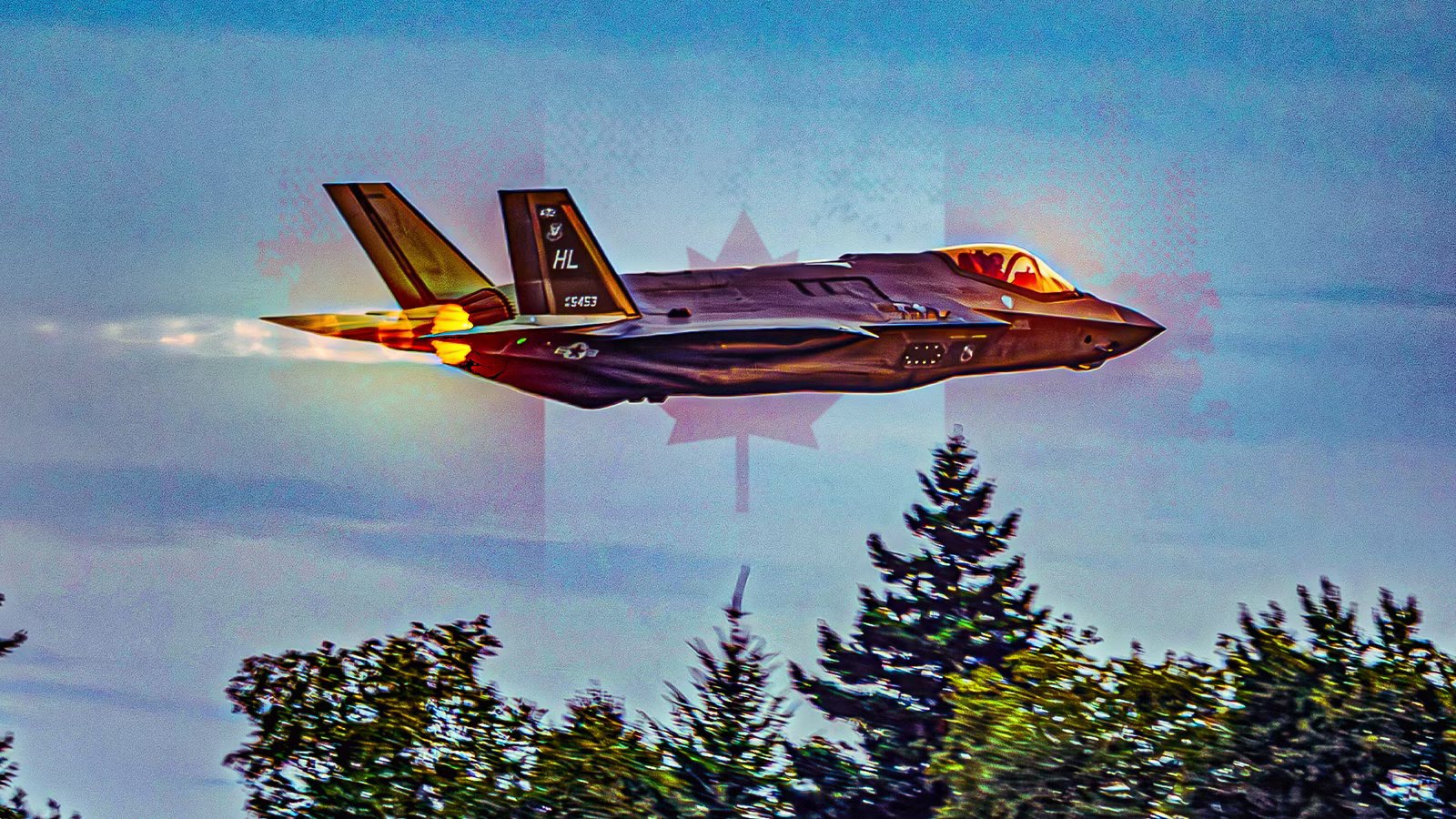
The Lockheed Martin F-35 Lightning II has taken its place in the history of the single most expensive defense-industrial project in America, and likely world history, which is not only taking its toll on the United States, but the related cost to partners is still proven to be a sticking point. Canada is struggling with the consistently increasing cost of their procurement program for 88 examples of the F-35. To date, the Canadian F-35 program has exceeded its original budget by $8 billion, according to The Independent.
This has created an issue with the North American Aerospace Defense Command (NORAD) where the US Armed Forces may be required to deploy more of its own F-35 fighter jets if Canada cannot afford its own. This would mean a higher number of airframes need to be procured by the US. President Donald Trump’s administration has notoriously pressured the Canadian government on numerous policy fronts, which has only served to exacerbate the complications with the Royal Canadian Air Force (RCAF) F-35 deal.
Trump Breaks Up The World’s Best Friends

Long characterized by the longest shared border in the world and deep integration through treaties like NORAD, the historic partnership between the United States and Canada is now under unprecedented assault. Canada has been forced to reconsider its reliance on US military technology, especially the purchase of F-35 fighter aircraft, as a result of growing trade disputes, rhetoric regarding Canadian sovereignty, and threats to defense cooperation during Donald Trump’s second term.
President Trump has even called for Canada’s annexation as the ’51st state,’ hinting that he may use ‘economic power’ to achieve this. Tensions have increased to the point that Trump’s incoming Secretary of Commerce, Howard Lutnick, has indicated that the United States may soon withdraw from the Great Lakes and NORAD treaties, as well as Canada from the ‘Five Eyes’ intelligence-sharing collaboration.
On February 1, the Trump administration launched a trade war, imposing almost universal tariffs on Canadian and Mexican imports. In early 2026, Trump threatened to ‘decertify’ any Canadian-made aircraft, including Bombardier business jets, as reprisal for Canada’s failure to certify specified Gulfstream models. Canada’s initial 2022 plan was to acquire 88 F-35 fighter planes for 19 billion Canadian dollars. However, the changing political climate has forced a major re-evaluation.
Where The Program Stands Today

Canada has legally committed to and begun payments for the first 16 F-35 aircraft, with the first delivery expected in late 2026. According to reports, Canada has started paying for long-lead components for 14 more F-35s than the initial 16 in order to keep its place in the manufacturing sequence, even though the deal has been officially reviewed.
Due to strategic and financial considerations, the remaining 72 planes’ status is still uncertain. A rising number of people believe that Canada depends too much on the US defense sector, particularly in light of the US’s reputation as a ‘hostile power’ that threatens annexation. Industry Minister Mélanie Joly and the Carney administration have made it clear that Canada did not get enough industry advantages from the initial F-35 agreement.
The F-35 program was expected to provide a long-term underpinning for Canada’s aerospace industry, which is the world’s fifth-largest. Canadian jobs are vital to the F-35 program’s survival in Canada, since the aerospace industry is closely integrated into the aircraft’s worldwide supply chain, making any cancellation a significant economic risk for domestic enterprises, according to Mélanie Joly, Minister of Industry, who spoke to CBC News.
“The government is interested in all major projects that can not only protect Canada’s security and sovereignty, but also create jobs across the country.”
Saab’s Gripen E is being carefully considered by Canada as a replacement for the jet billets that are still unfilled. According to 19fortyfive, Sweden has suggested constructing these jets in Canada, which could yield the creation of 12,600 jobs. Saab suggests constructing a domestic production line in Canada, in contrast to the F-35, which is put together in Texas. In Ontario and Quebec, regional sustainment and upgrading hubs will be established as part of this.
The Best Value For Canada

Despite political tensions, the internal Canadian Defence Ministry reports that Air Force leaders strongly favor the F-35. That is due to both the unrivaled tactical power of the 5th-generation stealth fighter and the deep connection that the F-35 program has with the Canadian Aerospace sector. Over 110 Canadian companies have contributed to the F-35 supply chain to date, with approximately 30 firms currently active.
These active firms employ roughly 2,000 to 3,300 workers domestically on F-35-specific tasks. If Canada cancels the remaining 72 jets, these firms could lose an estimated $10.6 billion USD in future contracts and thousands of high-tech jobs. Saab offers a 100% value offset, meaning every dollar spent on the jets would be reinvested into the Canadian economy.
Vincent Rigby, who previously served as national security and intelligence adviser to Justin Trudeau’s government, spoke about the order to The Hill.
“We defend the North American continent very closely with the United States. I think our national interest in that respect will always converge, we hope. At the same time, they’re saying stuff, doing stuff that really puts us in a difficult position.”
“And so one of the things that we’ve been thinking about more and more is we should be buying less from the United States and diversifying our defense relationships, buying more equipment, procuring more stuff from Europe, from the Indo-Pacific region, from countries like South Korea. And this is a big break. This is a real, real departure.”
Despite the incredible technological superiority of the F-35 over the Saab Gripen E, the Canadian government is seriously considering reinvesting in domestic aerospace and defense, given the instability of the American supply chain under the administration of Donald Trump. Canada once built the most advanced interceptor in the world, the CF-105 Arrow. Its controversial cancellation in 1959 remains a bitterly contested point of national pride to this day.
![6822773-16x9 - F-35A flies for the 2021 Toronto Air Show [Image 3 of 17]](https://static0.simpleflyingimages.com/wordpress/wp-content/uploads/2025/02/6822773-16x9.jpg?q=49&fit=crop&w=140&h=98&dpr=2)
Trump’s Tariffs Raise Questions For Canada’s Participation In F-35 Program
Are currently paused US tariffs a threat to the Royal Canadian Air Force’s F-35 buy?
Canadian Aerospace: Punching Above Its Weight

Canada is more than just a customer of the American defense industrial complex; it is an aerospace superpower in its own right, with a history that rivals any other great power. Canada boasts the fifth-largest aerospace industrial capacity in the world. Unlike most nations, 80% of Canada’s aerospace manufacturing is export-oriented. A significant portion of the world’s civil and military fleet flies on Canadian-made engines thanks to the Pratt & Whitney Canada factories.
Saab has offered to build a production line in Canada. This would transform Canada from a parts supplier for the F-35 into a manufacturer of its own frontline fighter. The Avro Arrow was the Pinnacle of that domestic aerospace excellence, but it was never realized as a production aircraft due to US influence.
Canada became the third nation in space with the Alouette 1. The Canadarm, a staple of the Space Shuttle and ISS, established Canada as the global leader in space robotics. Bombardier and De Havilland are juggernauts of the regional air travel sector and also produce some of the best business aircraft in the world.
Canada’s aerospace sector is diverse enough that losing F-35 contracts, while painful, would not destroy the industry. The capacity to pivot toward civil aviation, drones, and European defense contracts is a viable ‘Plan B.’ Canada is also increasingly looking toward the Global Combat Air Programme (GCAP) in collaboration with the UK, Italy, and Japan for the 6th-generation fighter project, according to 19fortyfive.

How Many F-35s Are In Service With The US Air Force?
The US Air Force has over 400 and perhaps closer to 500 F-35s in inventory, while Lockheed has delivered over 1,000 F-35s in total.
The Calculus Of Canadian Sovereignty

The Trump administration’s threats to annex territory or impose 25% tariffs on Canadian aerospace components have changed the math. Relying on the F-35 means relying on ALIS/ODIN, a cloud-based logistics system hosted on US servers. If the US decides to ‘lock out’ Canada during a trade dispute, Canada’s entire air force could be grounded. Relying 100% on the American defense industrial base makes Canada a ‘vassal’ to US domestic politics.
Choosing the Saab Gripen for the immediate future and joining the Global Combat Air Programme (GCAP) for the long term represents a fundamental shift from integration to autonomy. By partnering with the UK and Japan (GCAP), Canada aligns itself with other international powers that share its concerns about the threat of American isolationism.
The Saab deal includes a Canadian Production Centre. This allows Canada to re-learn how to build entire fighter jets, a skill lost since the Avro Arrow. Under the F-35 program, Canadian companies are build-to-print contractors; they follow Lockheed Martin’s blueprints but don’t own the Intellectual Property (IP).
Joining GCAP as a Tier 1 partner would give Canadian firms a seat at the design table for 6th-generation technologies. This ensures that the IP stays in Canada, preventing the ‘brain drain’ of engineers to the US that suffered when the Arrow was axed.

F-35 Production Is Outpacing All Other Allied Fighter Jets Combined
The reign of the Lightning II.
The Disbanding Of NORAD

One of the largest fallouts of the sovereignty path for Canada would be the collapse of the NORAD Alliance. This has historically been the basis for the argument that Canada should share military assets and platforms that the US Armed Forces operate. In 2026, the argument that the F-35 or nothing is increasingly viewed as economic protectionism, given the proliferation of Link-16 and Link- 22 data sharing across multiple Allied platforms produced in Europe and other nations.
The US would be in a strategically compromised position if Canada chose the Saab Gripen because it would create a technological and operational ‘blind spot’ in North American defense. The US relies on Canada through the NORAD alliance to provide a seamless, integrated shield against threats over the Arctic. US officials have warned that if Canada’s fleet is less interoperable, the US Air Force would be forced to fly more missions in Canadian airspace to fill the security gap.


![Historic: Air Canada Launches 1st Flights On These 2 New Transatlantic Routes [Map]](https://dailynewsnblog.com/wp-content/uploads/2026/06/air-canada-boeing-787-8-taxiing.jpg)