dailynewsnblog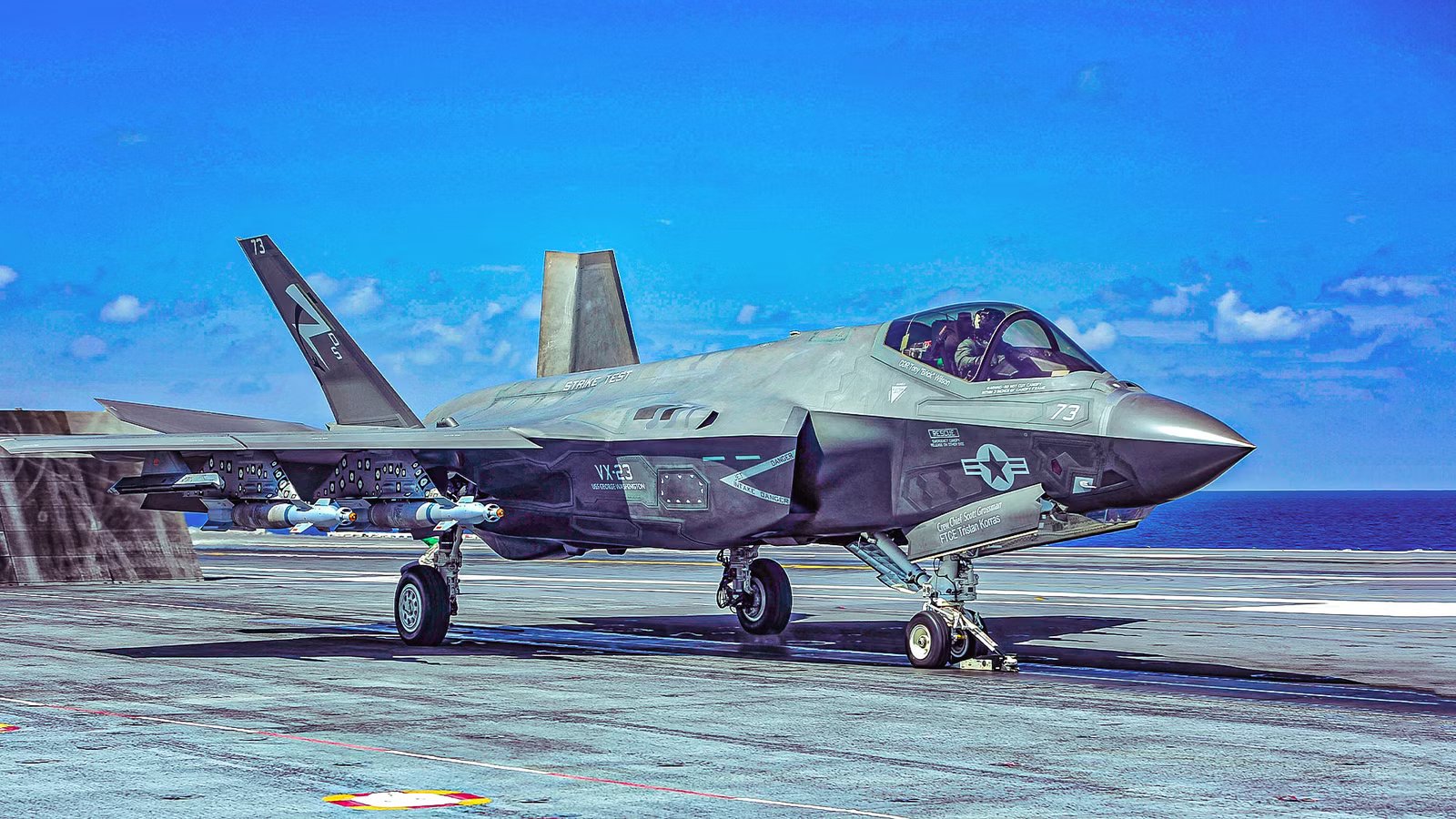
The Lockheed Martin F-35 Lightning II is not just a stealthy sensor node with wings attached, but it is also a supersonic fighter built to sprint when the mission demands it. The number most people cite is the aircraft’s maximum speed of around Mach 1.6, but that headline figure hides the realities of how jets actually fly. The aircraft’s top speed changes with altitude and outside air temperature, and it changes depending on the kind of munitions payload the aircraft has with it.
A clean, high-altitude test profile is not the same as an operational F-35 Lightning II hauling fuel, weapons, and mission systems. Maximum speed, however, is only one metric. There are many other ways to determine how specifically the aircraft performs. In this article, we will put the F-35 Lightning II’s published top speed into context, including the approximate miles-per-hour and kilometers-per-hour equivalents, and why different sources may quote slightly different values.
What Exactly Is The Lockheed Martin F-35 Lightning II?

The Lockheed Martin F-35 Lightning II is a fifth-generation multirole fighter aircraft that has been designed to combine stealth, advanced sensors, and precision strike capabilities. It was developed in a highly versatile aircraft family, and it comes in three separate variants. The first of these is the runway-based F-35A, the short takeoff and vertical landing F-35B, and the carrier-capable F-35C with a larger wing and reinforced landing gear.
Across all the aircraft’s versions, the jet’s core advantage is information. The jet is equipped with an AESA radar, distributed infrared cameras, electro-optical targeting systems, and electronic support measures that feed a fused picture directly to the pilot. This picture can be easily shared with other aircraft, ships, and ground forces over secure links, improving overall coordination and thus survivability.
Rather than relying only on the jet’s top speed, the F-35 is fully optimized to operate in the most contested airspace, detect threats extremely early, and cue weapons accurately. The jet is capable of carrying weapons internally in order to preserve low observability or externally when maximum payload is an exclusive priority. A jet powered by the Pratt & Whitney F135 engine, the aircraft delivers very high thrust and supports a supersonic dash when required.
Integrated electronic warfare, modern datalinks, and mission software make the jet as much a sensing and command node as it is a traditional fighter on its own. The plane is operated by the US military and many partner nations, and the program, as a result, has begun to emphasize commonality, interoperability, and an upgrade path over decades of service.
The Development Of The F-35 Lightning II

The F-35 Lightning II program grew out of the US’s Joint Strike Fighter program in the 1990s, which aimed to replace several aging aircraft with a single family of stealthy, multirole jets sharing a common core design. The key requirement was to deliver three distinct versions from a mostly shared airframe. The family includes a conventional takeoff and landing fighter for the Air Force, a short takeoff/vertical landing model for the Marines, and a carrier-capable variant for the US Navy.
This third kind of aircraft offers carrier takeoff barrier arrested recovery compatibility. In 2001, Lockheed Martin’s X-35 beat Boeing’s X-32 in the Joint Strike Fighter competition, and the program moved into system development. From the start, engineers had to balance stealth shaping, internal weapons carriage, and sensor integration with demanding performance and basing needs, as the F-35B’s lift-fan system and the F-35C’s larger wing and stronger landing gear systems were extremely unique.
This program’s development path was marked by extensive challenges, as well as financial pressures placed on the F-35 development program by foreign customers and the Department of Defense. Over time, successive hardware and software blocks expanded weapons compatibility, improved overall sensor fusion, and dynamic electronic warfare suites. This further improved large-scale reliability and maintainability.

How Many Miles Per Gallon Does An F-35 Get?
Jet fighters are not necessarily known for their fuel efficiency, but is the F-35 Lightning II any different?
So, How Fast Can The F-35 Really Go?

Across all three of the aircraft’s variants, the F-35’s published top speed is Mach 1.6, which equates to roughly 1,200 mph (1,930 km/h), and is typically reached at altitude in a clean or combat-clean setup. The F-35A, the aircraft’s conventional takeoff model, is the lightest and generally the quickest to accelerate and climb for any given thrust setting. The F-35B is also supersonic, with the aircraft most notably being marketed as a supersonic short takeoff and vertical landing jet.
However, this plane’s lift-fan system and associated doors add both weight and complexity, so high-speed dashes tend to cost more fuel and energy. The carrier-capable F-35C has a larger wing and sturdier landing gear for deck work. It pays a small drag and weight penalty, but it still carries the same Mach 1.6 headline and is promoted as able to reach it with a full internal weapons load.
In day-to-day operations, the F-35’s speed advantage is often about keeping stores internal. Fewer aircraft pylons and tanks mean less drag, better transonic acceleration, and more efficient supersonic bursts.
This also highlights the aircraft’s improved capabilities over many legacy fighters, which always have to make a tradeoff between supersonic capabilities and range. If the jet is loaded with external stores, acceleration, and top-end performance drop, supersonic time is much more limited by fuel burn and operational limitations than the engine’s raw capabilities.
How Does The F-35 Compare To Its Competitors?

On paper, according to Lockheed Martin, the F-35’s Mach 1.6 top speed puts it behind quite a few speed-oriented fighters. Boeing lists the F-15EX Eagle II as having a top speed of Mach 2.5, while the United States Navy cites the F/A-18E/F Super Hornet as having a top speed exceeding Mach 1.8, with European peers all advertising higher numbers as well. Eurofighter markets the Typhoon at Mach 2.0, all while the Royal Air Force’s public specification sheet quotes Mach 1.6.
Dassault lists the Rafale’s top speed as Mach 1.8, while the Saab Gripen E is commonly known to fly faster than Mach 2. The standout, however, is the Lockheed Martin F-22 Raptor. The United States Air Force emphasizes its ability to supercruise above Mach 1.5 without the use of an afterburner. This ultimately lets the aircraft sustain high-speed operations in a far more efficient manner than fighters that need to light afterburners in order to remain supersonic.
As such, in a pure maximum speed race, the F-35 is not the overall winner, and it certainly is not trying to be. The aircraft was designed primarily around its advanced stealth capabilities, internal bays, and sensor apertures, prioritizing survivability and first-look capabilities over headline speed capabilities. Even the F-16 Fighting Falcon can fly at Mach 2, underscoring just how common these high-mach figures are among conventional, non-stealth-oriented designs.

F-35 Lightning II Vs Eurofighter Typhoon: How Do Their Radar Systems Compare?
Stealth design meets superpower sensors, a radar showdown between F-35 Lightning II and Eurofighter Typhoon. Who dominates the skies?
What Were The Jet’s Financial Considerations?

Lockheed Martin’s core financial decision in choosing to develop the F-35 was undoubtedly the decades of order sustainment and aftermarket services it could secure from the type. It accepted heavy up-front development and production costs and, through the JSF partnership model, spread development and procurement risk across the United States military and foreign operators.
As the aircraft’s production line continued to mature, Lockheed pushed multi-lot purchase orders and tighter supply negotiations to drive unit costs down and protect margins through learning-curve efficiency. The outcome is thus a franchise program. In 2024, the F-35 generated around 26% of Lockheed’s total net sales and roughly 65% of aeronautics sales, ultimately giving the company unusually stable volume.
However, those same long contracts and upgrade commitments created extensive downside. Delays led the Pentagon to withhold millions of aircraft and forced Lockheed to hold jets in inventory, ultimately placing aggressive pressure on cash flows. Sustainment performance scrutiny also raises the risk of tougher terms in follow-on support details. That mix of recurring revenue and execution risk is ultimately the economics behind the program.
The Bottom Line

At the end of the day, the F-35 Lightning II was built to serve as a capable stealth fighter, and it has been optimized to serve the needs of multiple branches of the United States military. The aircraft, however, has not been engineered to provide the maximum possible speed output of any fighter ever developed.
There are other fighter jets operated by the United States Air Force and United States Navy, but these are mostly air superiority fighter jets designed for maximum dogfighting capabilities. The F-35 Lightning II is not intended to serve as a dogfighter but as an integrated multirole combat platform, and one that will be a key piece of the Air Force’s arsenal for years to come.
As a result, there is no other conclusion to make than that the F-35 is designed to operate at supersonic speeds, but not the most impressive ones ever recorded by a US-built fighter aircraft. Rather, the aircraft was meant to be a silent killer in the sky and an aircraft providing exceptional combat advantages to any operator.