dailynewsnblog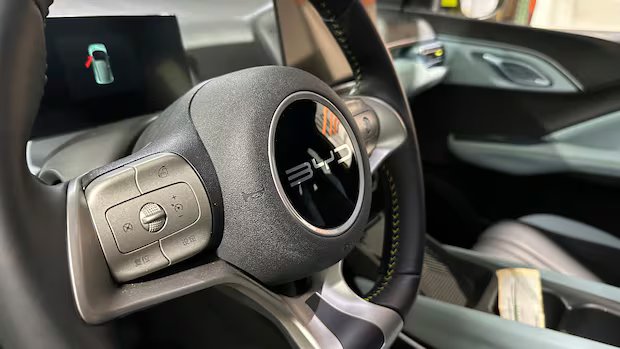
Weeks after Ottawa announced that it would allow a limited number of Chinese-made vehicles into the Canadian market, some have warned that the move puts data privacy at risk. But that might not be a significant turn-off for consumers who are in the market for a new car.
While roaming the Canadian International AutoShow on Friday, Dianne Dougall and Pat Shephard — who were scouting for a new EV to replace their Tesla — said that a Chinese-made EVs would “absolutely” interest them.
Privacy wouldn’t pose any more of a concern than any other connected vehicle, they said.
“That’s true about all of our data being stored with many countries,” said Shepard. “And particularly with the United States; that should also be a concern. So is it more concerning? No.”
“I would definitely look into them,” said Debbie Perriccioli, from Waterdown, Ont., who was also at the auto show and said her vehicle lease is up soon. She called privacy “a thing of the past” and said it wouldn’t stop her from buying a Chinese-made vehicle.

Canada is about to allow Chinese-made electric vehicles into the market, prompting some concerns about cybersecurity, but are they warranted? For The National, CBC’s Jennifer Yoon breaks down three things to know about the privacy risks.
Some preliminary data reflects that sentiment. Sixty-one per cent of Canadians surveyed by Leger between Jan. 30 and Feb. 2 were in favour of Chinese EVs in the Canadian market. When asked whether they had any concerns, a higher number of respondents cited vehicle quality and impacts on the Canadian auto industry (both 38 per cent) — ahead of those who cited privacy and security (33 per cent).
The experts who spoke to CBC News for this story agreed that data security is a major issue for most modern, digitally connected vehicles — regardless of where they are manufactured — but noted that Canada’s privacy laws aren’t strong enough to protect consumers from having their data obtained by the manufacturing country, including China.
‘Computers on wheels’
“All vehicles are basically computers on wheels now,” said David Masson, vice-president and field chief information security officer at Darktrace, an AI and cybersecurity company. “It doesn’t really matter where the vehicle comes from, or whether it is electric or runs on gasoline or diesel or the breath of angels.”
Over the last decade, China has passed a series of national security and intelligence laws that oblige Chinese companies to cooperate with the government when asked. A similar law in the U.S., called the Cloud Act, compels American technology companies to share data gathered in foreign countries with the government if asked.
And the list of data collected by modern vehicles is long: your voice, your location, how fast you’re driving, what kind of music you listen to, what your surroundings are, whether you’re falling asleep at the wheel — not to mention all of the data accessible through smartphones plugged into the vehicle.
It’s in that vein that Pierre Poilievre and Doug Ford have criticized the deal with China, with the Conservative leader calling the EVs “roving surveillance systems” and the Ontario premier denigrating them as “spy cars.”

Ontario Premier Doug Ford said on Monday that it’s ‘fine’ Prime Minister Mark Carney didn’t call him before agreeing to allow 49,000 Chinese EVs into the market. ‘I thought we had a good enough relationship that he’d give me a quick text or a little bit of communication. That never happened,’ Ford said.
Leaders in the automotive industry are also concerned. “[It’s] a bad idea to allow Chinese vehicles into the Canadian market,” said Brian Kingston, chief executive of the Canadian Vehicle Manufacturers’ Association, during a news conference at the auto show.
Besides being a ‘trade irritant’ that would hamper the success of domestic-made autos, “there’s a range of security and national security related issues,” with Chinese autos, said Kingston. “If a social media platform is considered a threat to Canadians, I find it surprising that a connected vehicle is now even allowed in.”
No robust system in place
Ottawa once shared the same worries about privacy. Back in June 2024, former deputy prime minister Chrystia Freeland said that cybersecurity was a chief concern as the government weighed 100 per cent tariffs on Chinese EVs to curb the cheap models from flooding the market.
Now, the federal government says the vehicles will have to abide by Canadian security standards to be sold here.
During a recent parliamentary committee hearing, Public Safety Minister Gary Anandasangaree said that Ottawa would ensure “safeguards” are put in place to prevent the vehicles from transmitting information back to China.
On The Coast10:44How much impact could Chinese EV imports have on the Canadian auto market?
David Chao, vice-president of the Automobile Journalists Association of Canada, explains the degree of impact that Canada’s EV trade deal with China could have on the domestic auto sector.
“You’d have to have policies around where the data goes, what kind of data is collected, who has access to that data, what its use is, and then you’d actually have to have penalties for the misuse of that data,” said Beth-Anne Schuelke-Leech, an associate professor at the University of Windsor and a policy director at school’s Shield Centre for Automotive Cybersecurity.
“Most consumers do not care about their privacy. So they rely on the regulations and policies to protect them,” she said. “We just don’t have a robust system for that kind of security.”
So far, BYD appears to be the only major Chinese automaker that is formally registered to import passenger cars into Canada, according to a Transport Canada database. It’s unclear whether that is a new development, as the company opened a bus assembly plant in Newmarket, Ont., in 2019.
China doesn’t need autos to spy, says analyst
The Canadian government has scrutinized other Chinese companies, namely ByteDance’s TikTok and telecom giant Huawei, over national security concerns. Huawei was banned from Canada’s 5G network in 2022, and the Trudeau government ordered TikTok Canada to shut down its business operations (an order since been overturned by a federal court).
The idea that allowing Chinese-made vehicles into Canada is a new breach of data security is “probably incorrect,” said Stephanie Carvin, a national security analyst and associate professor at Carleton University’s Norman Paterson School of International Affairs.

The National’s Ian Hanomansing asks cyber security experts Brian Haugli and Alana Staszcyszyn about how worried TikTok users should be about having the app on their devices.
“They’re spying on us right now. They have everything they need,” she said, adding the larger concern is about economic national security and the impact that the entry of the cars could have on Canada’s domestic automobile market.
“We know that companies like BYD receive large amounts of support from the Chinese state in terms of loans, money support, weaker labour laws,” said Carvin.
“Canadian manufacturers cannot compete with a car company where a certain percentage of every car is effectively subsidized by the state.”