dailynewsnblog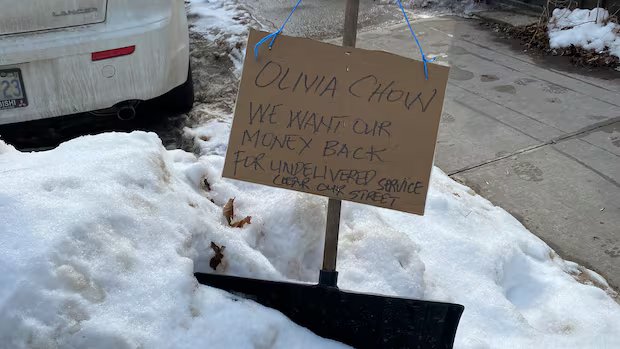

Listen to this article
Estimated 4 minutes
The audio version of this article is generated by AI-based technology. Mispronunciations can occur. We are working with our partners to continually review and improve the results.
Some residents are still struggling to get by as snow clearing efforts continue three weeks after Toronto’s record-breaking snowfall.
The lack of snow clearing on sidewalks forced Regal Heights neighbourhood resident Megan Rodd to walk on the road when taking her two young children to daycare.
“It’s pretty dangerous because there’s traffic coming from both ways,” she said. “I was super frustrated.”
At the end of last month, Toronto was hit with more than 50 centimetres of snow. Experts called it the snowiest January since records began in 1937.
In a statement to CBC Toronto, a spokesperson for the city said snow removal is an “intense, multi-step process” that includes many crews and heavy machinery.
“Crews continue to remove snow on bikeways, narrow residential streets and sidewalks,” Jas Baweja said. “If a snow event is forecasted, snow removal may be paused as the same crews are deployed to salting and plowing.”
Baweja said the city first looks to remove snow in high-priority areas, such as hospitals, bridges, school zones and streetcar routes. That process is 95 per cent complete, he added.
But Rodd says the area she struggled to get through with a stroller is the back of a high school.
“That area is kind of like no man’s land,” she said. “It was just a very narrow area and it was still that slushy snow, you could not push a stroller through it.”

Rodd says she reported it to 311 and was told the area had already been flagged by others and cleared by the city. That’s when she took to a Facebook group to hear what others in the community had to say.
“Somebody from the neighbourhood responded to that post and they said that they were going to take it upon themselves,” she told CBC Toronto Sunday. “Super appreciative to him — just stepping up for the community and doing that was huge.”
Amanda Floyd and Ryan Floyd, who live near Dundas Street W. and Dupont Street, were walking their dog along the snowy streets Sunday.
“I’ve definitely seen, as a pedestrian, cars pulling up onto the sidewalk where there isn’t a snow bank to allow other cars to pass,” she told CBC Toronto. “We have to wait because I can’t get past the sidewalk with the stroller.”
But it’s not just moms with strollers who find it difficult to make their way around their neighbourhood. Juan Carlos Balders, who lives in the same neighbourhood as the Floyd family, says it’s been difficult without a car.
“[It’s] very dangerous, slippery,” he said. “It takes a lot of effort, too, to walk through the snow.”
Former city councillor and York University professor Joe Mihevc says the city doesn’t have a model which removes snow, but rather one that pushes snow into piles. He said that system works most of the time and costs less overall.
“We’re not really a big snow climate,” he told CBC Toronto Sunday. “For 10 inches, 12 inches of snow a year, is it really something that our residents, our taxpayers would want to do?”
Though the city usually prepares for a normal level of service, it has increased it since the snowstorm, Mihevc says. He added he’s seen snow removal crews working full-time around the city.
“If we got this level of snowfall every winter, then clearly the City of Toronto would need to recalibrate. But because it is a one-off event, I think the right response for Torontonians is to understand it,” he said.
“Let’s all be patient and allow the city crews to do their work,” Mihevc said. “Frankly, this is Canada. This is the way it is in this country. We’re a snow country.”