dailynewsnblog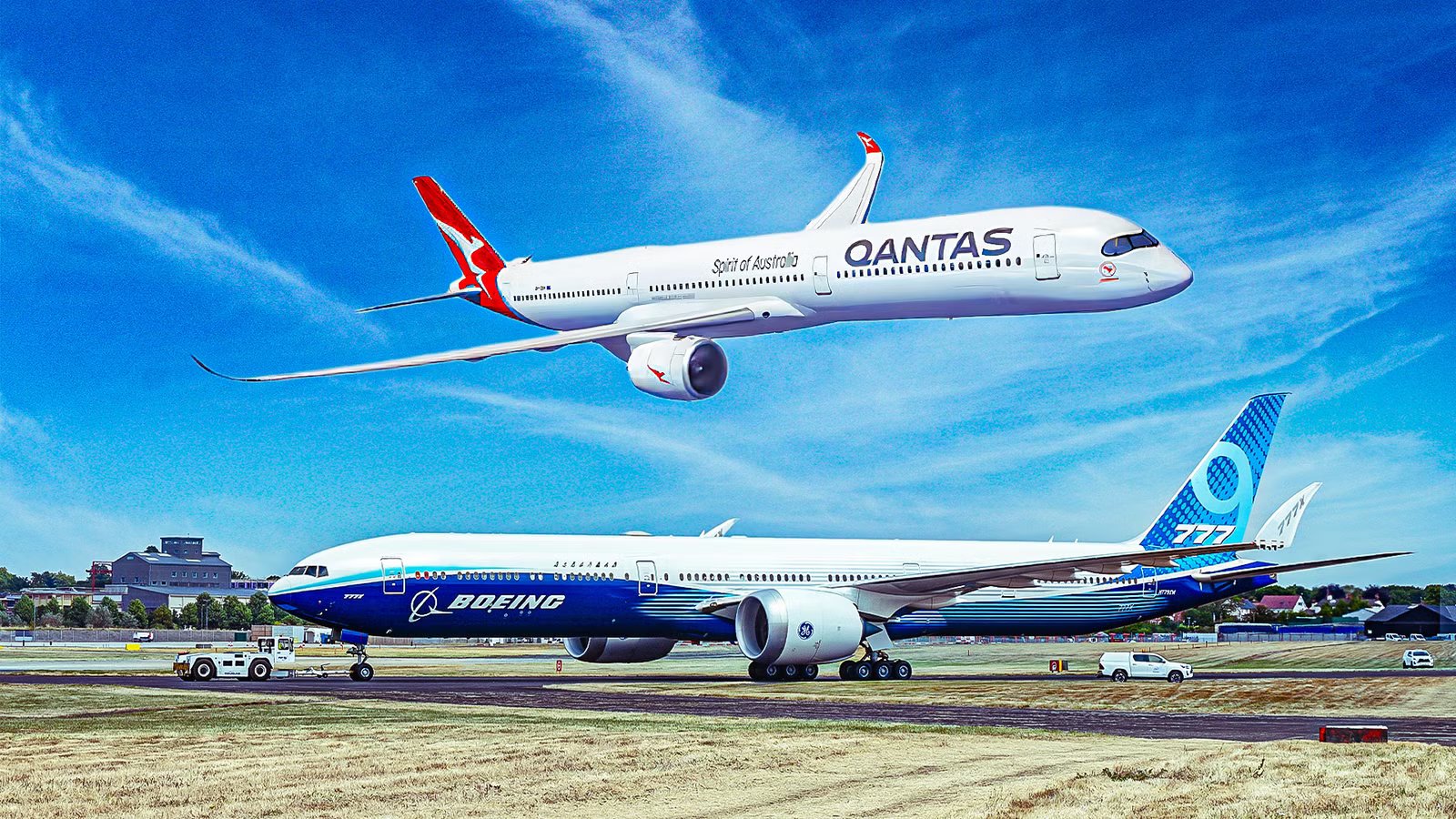
The race for dominance in ultra-long-haul flying has entered a new era with the development of next-generation widebody airliners that can connect the farthest points on the globe without stopping. At the center of this evolution are a pair of flagship twinjets produced by  Boeing and Airbus, the industry’s two foremost engineering powerhouses. The Boeing 777X and the Airbus A350-1000ULR are both models that offer impressive capabilities. These jets represent the forefront of long-range aviation, embodying the latest advances in aerodynamics, materials, fuel efficiency, and overall cabin comfort. Airlines around the world are evaluating these jets not only for their range and operational economics, but also for how they can unlock new nonstop routes that have historically been impractical, such as services from Sydney to London or New York from the East Coast of Australia.
One of the most high-profile programs pushing this boundary is Qantas’ Project Sunrise, which aims to launch the longest commercial flights ever flown when the airline’s custom-designed Airbus A350-1000ULR enters service in 2027. While Boeing’s 777X family has also been in contention for ultra-long-haul missions, Airbus’ ULR variant has been chosen for these record-breaking and industry-changing services. A direct comparison of these aircraft, especially in terms of overall range, highlights how far modern airliners can go and what capabilities airlines will leverage in order to improve global connectivity.
A Brief Overview Of The Airbus A350-1000ULR

The Airbus A350-1000ULR is a specially adapted version of Airbus’ latest A350 variant, a jet that has been engineered to set new standards in nonstop flight capabilities. An aircraft that was developed in collaboration with Qantas for its Project Sunrise initiative, this variant incorporates additional fuel capacity, including a significant rear center fuel tank and optimized systems for it, to improve range. This allows the aircraft to comfortably fly for durations of around 22 hours without stopping.
This configuration is tailored to service some of the longest city pairs on earth, such as routes from Sydney Airport (SYD) to London Heathrow Airport (LHR) and New York’s John F. Kennedy International Airport (JFK). These nonstop routes will cut flight times by up to four hours when compared with more traditional one-stop services. While Airbus has not publicly published a formal range number like Boeing, industry estimates suggest that the A350-1000ULR’s capabilities extend beyond 9,700 nautical miles (18,000 km), allowing it to cover ultra-long sectors with reserves for weather, routing, and payload requirements.
In addition to its range, the aircraft benefits from the Airbus A350 family’s hallmark features, including an advanced composite airframe, fuel-efficient Rolls-Royce Trent XWB engines, and a passenger-centric cabin design that emphasizes comfort and wellbeing over extended flights. With deliveries to Qantas slated to begin in late 2026 and commercial operations in 2027, the A350-1000ULR aims to redefine the limits of nonstop air travel in the modern era.
The Boeing 777X Is A Modern Behemoth

The Boeing 777X family is the latest iteration of the manufacturer’s flagship long-haul widebody family, with the plane designed to deliver improved efficiency and performance over its predecessors. It includes two primary passenger models, the Boeing 777-8 and the Boeing 777-9, with a production freighter also part of the program. The jet features advanced technologies, such as new high-efficiency General Electric GE9X engines, improved composite wings with folding wingtips for airport compatibility, and updated flight systems that were derived in part from the Boeing 787 Dreamliner.
The Boeing 777X represents Boeing’s strategy to offer airlines larger capacity and longer range capabilities while reducing operating costs and emissions compared with earlier generations of widebody jets. In terms of range, the Boeing 777-8 variant leads the family with a maximum range of around 8,745 nautical miles (16,190 km), ultimately enabling ultra-long routes across continents. This is all while the Boeing 777-9, which has a slightly longer fuselage and greater seating, has a range of around 7,285 nautical miles (13,500 km). This makes the aircraft one of the largest and most capable widebody aircraft to ever be produced by Boeing, as well as one of the most complex and advanced flying machines ever produced.
These capabilities naturally position the Boeing 777X as a competitive choice for carriers targeting long-haul and ultra-long-haul operations, connecting distant city pairs with high payloads and passenger counts. The plane’s large twin-aisle cabin also provides modern passenger amenities and spacious interiors, making it attractive for premium services on flagship routes. Boeing is positioning the aircraft to succeed in an era of constrained hub airports.

Here’s How Far The Ultra-Long-Range Airbus A350s Can Fly
Find out the exact ranges for each A350 variant. You can then learn more about how advanced materials and design decisions facilitate the range.
A Comparison Of The Two Jets’ Operational Capabilities

From an operational perspective, the Boeing 777X family and Qantas’ Airbus A350-1000ULR are both optimized for different missions. Boeing positions the Boeing 777X (especially the Boeing 777-9) as a high-capacity long-haul workhorse for dense hub-to-hub markets, advertising two-class layouts of up to 426 passengers, with 395 for the longer-range Boeing 777-8. In order to preserve gate compatibility despite its huge new wing, Boeing has folding wingtips that can make the jet fit within most major airport gates that would fit predecessor models.
By contrast, the Airbus A350-1000ULR is tailored for ultra-long-and-thin routes where endurance matters more than raw seat count. Qantas says its specially configured aircraft will fly up to 22 hours nonstop, made possible by an additional center fuel tank and enhanced systems. The manufacturer notes that this model has been deliberately de-densified to 239 seats to protect payload-range capabilities and improve comfort on the longest flight sectors.
In network terms, the Boeing 777X shines when overall demand, cargo, and slot constraints reward the plane’s scale, whereas the A350-1000ULR shines when airlines want to launch nonstop routes that would be marginal with a larger, heavier cabin. This difference also shapes overall utilization. A Boeing 777X can cycle through a broader mix of long-haul legs, all while a 22-hour ULR mission demands bespoke crew, recovery, and maintenance buffers during irregular operations and weather events.
How Have Both Jets Sold?

In pure overall sales volume, the Boeing 777X has easily drawn the larger order backlog, but its sales story is inseparable from the uncertainty of its production and certification schedule. The largest individual customer for the type, Emirates, expanded its Boeing 777X order book to 270 aircraft at the Dubai Airshow in November 2025. This was an enormous vote of confidence for the program that also shows how demand for the model is only concentrated among a few massive intercontinental superconnectors. Delays and certification timing have had commercial consequences on the program, with Boeing removing a full 33 orders from its backlog amid these extensive delays.
This left the airline’s Boeing 777X backlog by the time the end of September 2025 came around. Reuters has also indicated that Boeing plans the first flight of its Boeing 777X in April 2026, with the first delivery of the type currently slated for 2027. The Airbus A350-1000 is a model that has sold in a significantly steadier fashion. Importantly, it has already been delivered and has been in operational service for years. As of January 2026, the Airbus A350-1000 stood with more than 360 orders and 109 jets delivered so far.
Airbus is also adding more orders for the type. Just this month, legacy carrier Air Canada disclosed a firm order for eight Airbus A350-1000s in February 2026. The Airbus A350-1000ULR is much more niche, with Qantas having an order for 12 on the type for Project Sunrise. The first aircraft is scheduled for delivery in 2026. The Boeing 777X thus sold better on paper, but the Airbus A350-1000 has already proven itself in operational service.

Boeing 777X Vs. Airbus A350-1000: Who Will Win The Battle For Tomorrow’s Flagship?
The 777X is nearly ready for service, how will it fare against Airbus’ A350?
Why Did Qantas Choose The Airbus A350-1000ULR?

Qantas elected to choose the Airbus A350-1000ULR because it best fits Project Sunrise’s core requirement. The aircraft can reliably operate nonstop services from Australia’s East Coast to London and New York. The jet is equipped for missions as long as 22 hours. For the first time, Australia will now be a one-flight destination for most travelers.
The jet has been modified with an additional rear center fuel tank and enhanced systems, ultimately providing the fuel and systems margin needed for headwinds, alternates, and operational contingencies on record-length sectors. Qantas is also pairing that capability with a deliberately low-density 238-seat cabin, so that the jet can carry the required fuel while keeping a premium-heavy mix and preserving overall payload range performance, according to the airline.
Lastly, the carrier is designing its onboard product around passenger comfort and well-being for extreme durations. This included a dedicated Wellbeing Zone and science-backed features aimed at minimizing jet lag. These nonstops also cut down total journey times by up to four hours over other itineraries.
What Is Our Bottom Line?

At the end of the day, the Airbus A350-1000ULR is designed and optimized for one specific purpose. The aircraft has been chosen as the design that will soon serve the world’s longest individual nonstop route, and it will do something that has simply never been done before by an aircraft in the history of commercial aviation.
Boeing’s 777X is not some specially-designed game-changer. It is yet another upgrade of an aging family, and, while it provides extensive gains in terms of overall efficiency, it cannot quite match the performance on long-range sectors that the A350-1000ULR really brings to the table.
The Airbus A350-1000ULR can simply fly distances that no other commercial airliner can match, making it the obvious choice for a route as lengthy and momentous as the connection between Sydney and London/New York. At the same time, Airbus was really willing to customize this jet to specifically suit Qantas’ needs.