dailynewsnblog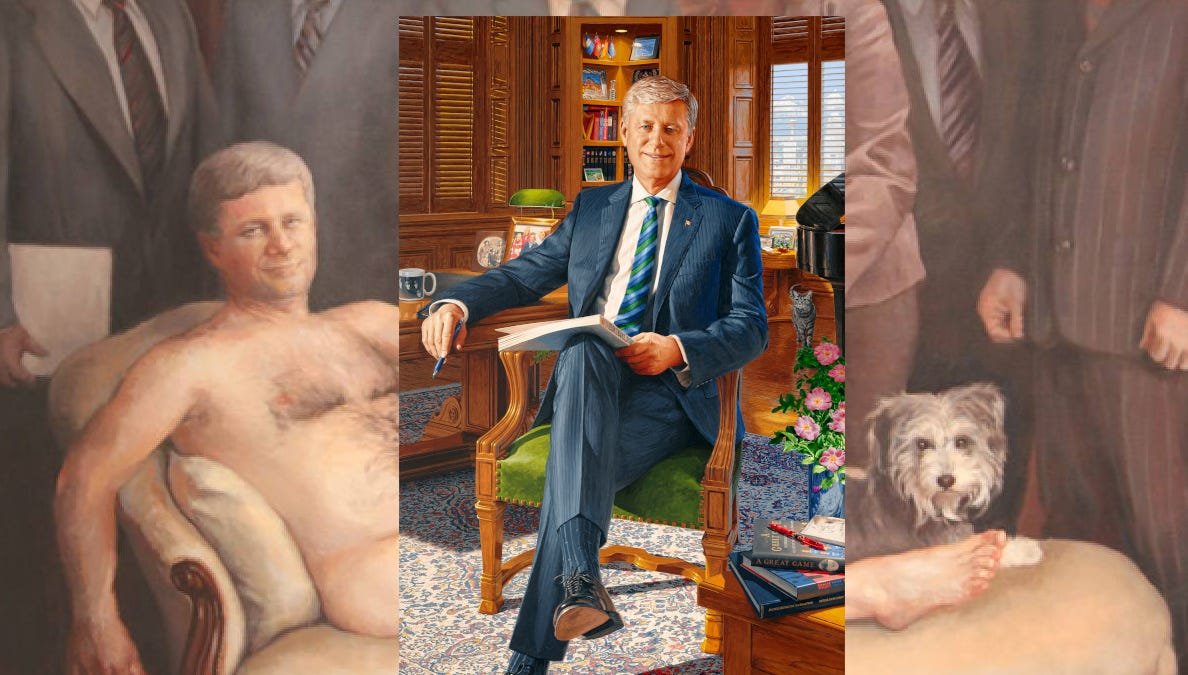
Traditionally, when the portrait of a Prime Minister is hung in Parliament, it is deferred until their political career is firmly finished. It is fitting, given former Prime Minister Stephen Harper’s irreverent legacy, that the hanging of his portrait last week was the occasion through which he reminded us of his tendency to gaslight his country.
Seeing Harper stumble back onto the Canadian stage over the past week is causing some degree of whiplash. As a leading figure in laying the groundwork for the Maple MAGA movement, his sudden national unity and sovereignty bent raise a different red flag from the one he is waving.
His call for unity in the face of an American threat he has spent his career courting is so profoundly ironic as to be completely absurd. He is right, of course: we do need an unprecedented degree of unity to protect Canadian political, military, and economic sovereignty at this extraordinarily dangerous time. But unity is more than words, and he spent his career undermining both our sovereignty and our unity.
Having the global chairman of the illiberal alliance known as the International Democratic Union — the organisation that directly bonds Pierre Poilievre and Donald Trump’s political movements — be the one calling for that unity has to be seen as a warning. Last time he succeeded in a call for unity, it was to bring the Canadian Alliance and the Progressive Conservative parties together into a regressive far-right political movement in which the Progressive Conservatives simply ceased to exist.
The legacy of that movement and the government it produced two years later is a big part of why Canada is the divided misinformation hellscape in which we now find ourselves.
Stephen Harper’s idea of unity brought us electoral fraud, the overtly racist barbaric cultural practices hotline, and an anti-science bent that enabled the anti-vax movement that is killing Canadians.
The return of measles to Canada today can trace its origins to a government that spent years muzzling government scientists, undermining public healthcare, and systematically ignoring empirical data.
He often spoke of protecting our Arctic sovereignty while simultaneously cutting military spending, deferring capital investment, and closing Veterans Affairs services and offices. It was on his watch that Canada’s fighter jet fleet renewal first washed up on the rocks after a scathing report from Auditor General Michael Ferguson showed to what extent F-35s are a bad investment.
He portrays himself as a defender of democracy but his own Parliamentary Secretary, Dean del Mastro, was hauled away in chains and jailed for violating election finance law in the 2008 election.
Shortly after that election, the Harper minority government faced a united opposition about to vote non-confidence, which would leave an open a question as to whether it would cause an election or if the Governor General would offer the opposition an opportunity to govern given that the new government had not yet had an opportunity to gain the confidence of the House. To avoid the question altogether, he had Parliament prorogued, generating what was described as a Parliamentary crisis.
This carried his government through until 2011 when it became the first ever to be found in contempt of Parliament — which is a vote of non-confidence.
The resulting election, when Harper won his majority in 2011, was marred by robocalls in which thousands of mainly Liberal voters were illegally redirected to fictional voting stations through fraudulent automated phone calls purporting to be from Elections Canada, which saw young Conservative staffer Michael Sona imprisoned in spite of substantial evidence of being the party’s fall guy rather than the mastermind. The case was pursued by the Commissioner of Canada Elections.
Following that debacle, Harper’s Minister of Democratic Institutions, one Pierre Poilievre, introduced the only legislation ever passed in his name in his multi-decade career in Parliament: the Fair Elections Act. The act aimed to legalise means of vote suppression for demographics unlikely to support the Conservatives. Then it moved the Commissioner of Canada Elections out of the physical office of the Chief Electoral Officer, adding a hurdle to the application and enforcement of electoral law.
After losing in the 2015 election under those rules, in spite of his efforts to defang the Commissioner of Canada Elections, Poilievre was forced into a Compliance Agreement with the same commissioner for conflating the actions of his government with those of the Conservative Party. In the dozen bullet points signed by the current Conservative leader and Harper protégé, Poilievre acknowledged that his acts were intended to mislead the public:
The Contracting Party’s intention in wearing clothing bearing the CPC party logo during the government funding announcement was to link the UCCB benefit to the party and the Conservative government and to provoke the media to cover CPC involvement in the funding.
That compliance agreement cited a 2010 report by Conflict of Interest and Ethics Commissioner Mary Dawson unambiguously entitled: “The use of partisan or personal identifiers on ceremonial cheques or other props for federal funding announcements.” That report addressed the widespread Conservative practice of using cheques bearing their party logo for the announcement of government funding.
His approach to governance conflating himself with the state, his party with the government, was identified as authoritarian long before it ended.
Harper’s idea of unity when he came into the public spotlight was to describe Atlantic Canada as having a ‘culture of defeatism.’ Now, nearly a quarter-century later, his ringing endorsement of our federation is that he did not sign the Alberta petition to end the country. Perhaps he is trying to make sure he stays in line with “old-stock Canadians.”
That the Canadian public and media have largely forgiven and forgotten his numerous sins in government, for which this is hardly an exhaustive list, is baffling. Whole categories of topics like the sale of the Canada Wheat Board to Saudi Arabia warrant their own separate entries but are too numerous to even list.
It speaks to the success of the former Prime Minister’s skill at gaslighting the country. When he speaks today of bringing the country together, it is impossible not to wonder where that belief in our unity and collective success was through the decade he ruled over our country.
Stephen Harper’s official portrait was unveiled in Ottawa last week as part of the celebrations of the 20th anniversary of his election as Prime Minister and represented the presumed completion of his exit from politics. His magnanimous statements this week and the hanging of his portrait should not prevent us from remembering the legacy behind the image, and the track record in government that so thoroughly contradicts his words.
His official portrait may be full of symbolism about him and his time in office, but one could argue that the unofficial portrait released by Margaret Sutherland in 2013 offered no less an accurate portrayal of who he was as our Prime Minister.