dailynewsnblog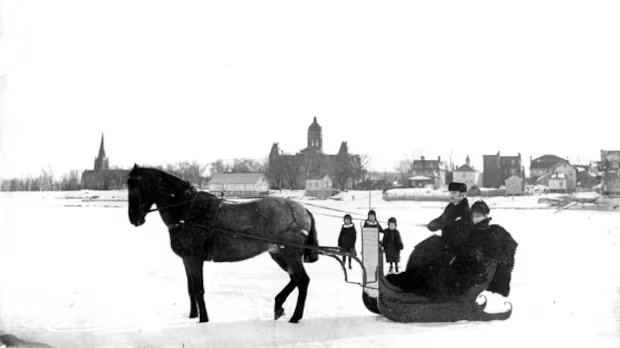

Listen to this article
Estimated 4 minutes
The audio version of this article is generated by AI-based technology. Mispronunciations can occur. We are working with our partners to continually review and improve the results.
Getting around New Brunswick in the winter time is rarely a piece of cake.
Snow, ice, sleet and wind often make travelling the roads in the province treacherous during the colder months.
But it’s nothing like what people living in 19th century New Brunswick had to put up with.
They would have to travel via sleigh, over long distances, often on frozen rivers.
“It’s a heck of a commute when you think about it,” said historian James Upham.
Long, cold journeys
When we think of sleigh rides today, we often picture peaceful, picturesque recreational journeys, maybe topped off with hot chocolate at a camp afterwards.
But in the 1800s, the trips were utilitarian in nature, and the rivers of the province were seen in the same way highways are seen today.
Information Morning – Moncton11:06The curious case of Westmorland MLA who died in an ice accident.
James Upham is our Roadside History columnist. You can find more of his stories at cbc.ca/roadsidehistory.
“The waterways of New Brunswick were, for most of the history of this region, they were the way that people got around,” said Upham.
“In summer you take a canoe … in the winter when [it] froze … you could take a sleigh being drawn by horses.”
While undoubtedly quicker than walking, the limited horsepower of horse power meant a journey that would take mere hours today would’ve taken days back then.

And forget about modern heaters that can make a car feel tropical even in sub-zero temperatures.
“We just do not have anything at the moment that compares with that unless you’re actually on a polar expedition,” said Upham.
“Might have been lucky enough to have a container full of hot coals from the breakfast fire under their feet to keep them from freezing.”
On tragedy trail
Travelling on ice could also lead to disaster, like in 1803 when newly elected MLA Hugh McMonagle died after his sleigh crashed through the ice of the Kennebecasis River.
McMonagle was traveling from his home in Mount Whatley near the Nova Scotia Border to Fredericton to sit for the fist time as an MLA representing Westmorland County.
But it was near Darlings Island where McMonagle’s trip turned deadly.
“McMonagle and several of his elected colleagues were traveling across the ice of the Kennebecasis River in a horse drawn sleigh driven by Joseph Baxter of Norton, Kings County,” reads a biography provided by the New Brunswick Legislature Library.
“Near Darlings Island, the sleigh broke through the ice. McMonagle and Benjamin Lester, another passenger, drowned in the water.”

“Melancholy Accident,” read the headline of The Royal Gazette.
“Melancholy! Melancholy! Indeed!” agreed the Saint John Gazette.
In addition to the lives of McMonagle and Lester, The Royal Gazette said “the sleigh, horses and every article of baggage are entirely lost.”
Upham said several people travelling in the sleigh with McMonagle did survive, “which is actually quite impressive in and of itself.”
“There’s there is no horse drawn ambulance … you can’t just pull out your cell phone and call for help,” said Upham.

“Somebody’s got to fish these people out of the water the best they can and then get to a house … It’s a crazy survival story that we just don’t have an analogy for in the modern world.”
While the idea of using the rivers of New Brunswick has mostly died out, it’s not entirely extinct, and there’s even examples of it in the area where McMonagle died.
“I’ve driven across the Kennebecasis River myself in a car,” said Upham.
“There’s an ice road that’s open even still sometimes … It’s a shortcut to get into Saint John [for] people that don’t want to take the Gondola Point ferry.”