dailynewsnblog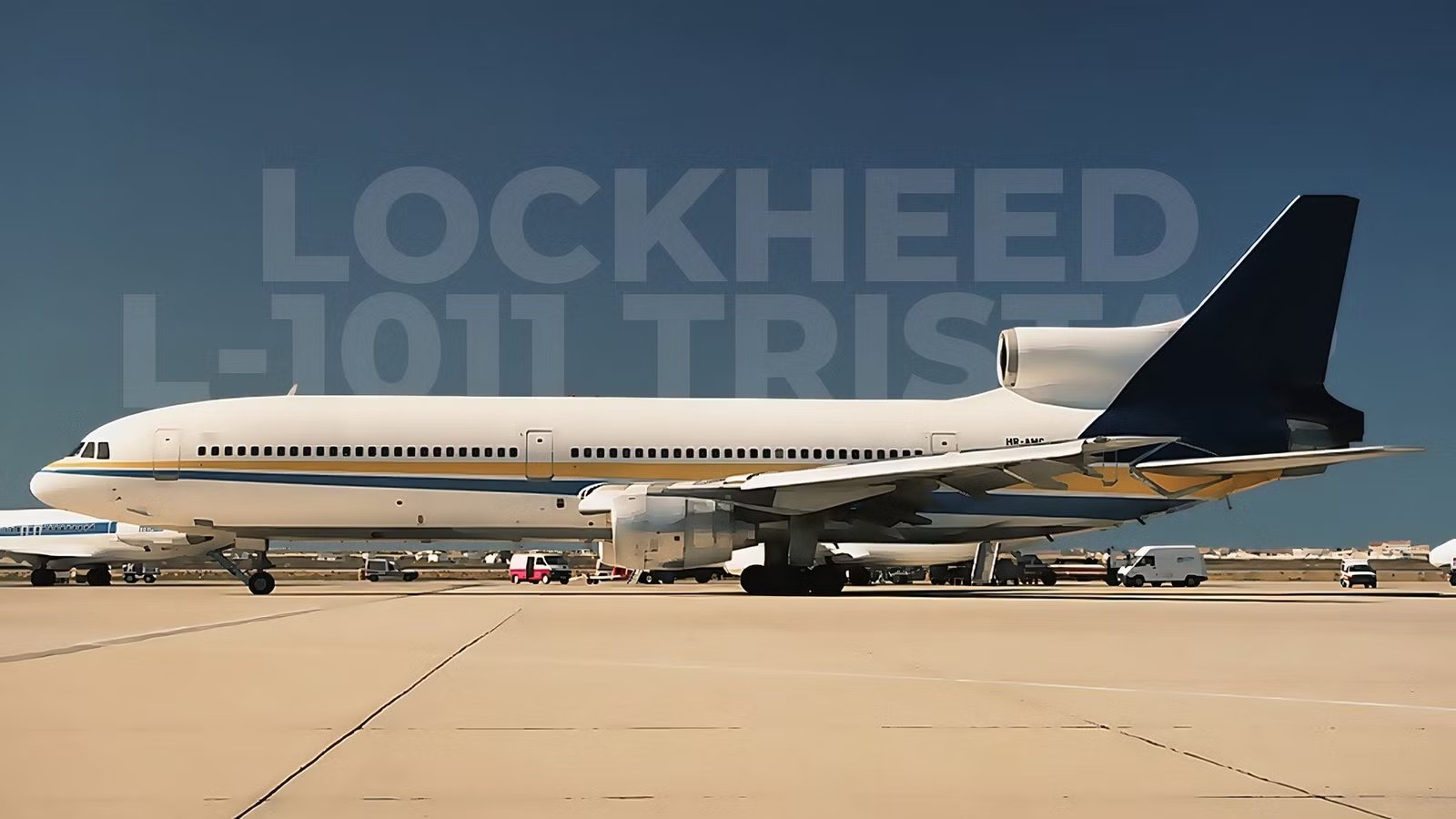
The 1970s saw the birth of the widebody, a radical new aircraft design in which airliners featured two aisles to accommodate more seats per row. The first was the Boeing 747, an iconic double-decker that would go on to become one of the most successful twin-aisle planes of all time, and rival McDonnell Douglas responded shortly afterwards with the three-engined DC-10, which evolved into the MD-11. Airbus would also enter the area in 1974 with the legendary A300.
Elsewhere, also competing in this market was the Lockheed L-1011 Tristar, which debuted in 1972, less than a year after the DC-10 and roughly two years before the Airbus A300. While the other three Western 1970s widebodies were further developed into aircraft that we still see today (later variants of the 747, the DC-10 into the MD-11, and the A300’s cross section still in use with the A330neo), the L-1011 has largely disappeared. Today, there is only one airworthy Tristar still in service.
The Last Lockheed Tristar Still Flying

N140SC is the registration of the only airworthy L-1011 Tristar currently in existence. It’s called the Stargazer, and it’s used by Orbital Sciences (a division of Northrop Grumman) to launch Pegasus rockets carrying satellites. It’s been enlisted in this duty since 1994, competing against the Boeing B-52, the Boeing 747, and the McDonnell Douglas DC-10. In addition to its role as the Pegasus mothership, Stargazer is also available for research flights.
Stargazer has performed nearly 50 launches of the Pegasus rocket in its 32 years in service. Before being acquired by Orbital Sciences, the aircraft previously flew for Air Canada as C-FTNJ. First delivered in 1974, it was briefly leased to Air Lanka in February 1982, before returning to Air Canada, where it would remain for the rest of its commercial service life. Orbital Sciences first acquired the aircraft in 1992, and it spent over two years preparing Stargazer for its new role.
What makes Stargazer especially unique in the aviation world is that it remains the only example of its type that’s still in service. In terms of other veteran airliners, today, there are a handful of Douglas DC-8s still flying, while there are nine McDonnell Douglas DC-10s in service. The Airbus A300 is still widely used by cargo airlines, and the Boeing 707 is still used by numerous governments and militaries, most notably the United States Air Force.
A Deeper Look At The Stargazer

N140SC is a 52-year-old Lockheed L-1011-100 Tristar. It was originally constructed as an L-1011-1, but was upgraded in 1977 with a new center fuel tank and higher gross weights. Data from Planespotters.net indicates that Air Canada configured the jet with 288 seats, consisting of 20 first-class seats and 268 economy seats. It was later reconfigured to seat 306 passengers, split between 14 in first class and 292 in economy.
 Air Canada operated a total of 18 L-1011 Tristars from 1973 to 1996, of which 12 were the base L-1011-1/100/150 model, and six were the shortened L-1011-500. Air Canada replaced the Tristars with the Boeing 767-300ER in the 1990s, phasing out the L-1011-500s before the larger L-1011-1/100/150s. Most of these aircraft would eventually be purchased on the second-hand market, though the Stargazer is the last remaining example.
|
Lockheed L-1011 Tristar Variant |
Brief Description |
|---|---|
|
L-1011-1 |
Initial model |
|
L-1011-50 |
Increased Maximum Takeoff Weight (MTOW), only available as a conversion |
|
L-1011-100 |
Increased MTOW, new center fuel tank, available as a conversion |
|
L-1011-150 |
Increased MTOW, only available as a conversion |
|
L-1011-200 |
Increased MTOW, center fuel tank, RB211-524B engines, available as a conversion |
|
L-1011-250 |
Increased MTOW, center fuel tank, RB211-524BI engines, increased wingspan, more advanced systems, available as a conversion |
|
L-1011-500 |
Fuselage shrink, increased MTOW, center fuel tank, RB211-524BI engines, increased wingspan, more advanced systems, available as a conversion |
The Lockheed L-1011 Tristar was initially offered with the Rolls-Royce RB211-22, but the later L-1011-500 was equipped with the more powerful RB211-524B. The 524 series was also fitted to the Boeing 747-100 and 747-200, and upon acquiring C-FTNJ, Orbital Science upgraded the aircraft with the RB211-524B. It launches the Pegasus rocket from its belly at 39,000 ft, and the rocket can carry up to 977 lbs (443 kg) of payload.
The Odd One Out In The 1970s Widebody War

The Lockheed L-1011 TriStar was the third of four Western widebodies launched in the 1970s, but, while the other three went on to have long service lives and were largely successful, the L-1011 was the ugly duckling of the group. Only 250 were ever made, compared to 386 DC-10s, 561 Airbus A300s, and 1,574 Boeing 747s. Additionally, the 747 was produced until 2023, while the A300’s cross section served as the basis for the A310, A330, and A340, while the DC-10 was developed into the MD-11.
Lockheed ended production of the L-1011 in 1984 and never produced a follow-up. The aircraft was the least successful of the four, and it was the first to disappear from commercial service. The final passenger L-1011 flight was conducted in 2008, and what’s more notable, Lockheed never developed a freighter version. As nearly all first and second-generation airliners still in service fly for cargo airlines, this largely explains why the L-1011 was the first to disappear, especially as no conversion programs were ever offered.
|
Aircraft |
Factory Variants (Not Including Aftermarket Cargo Conversions) |
|---|---|
|
Boeing 747 |
747-100, 747SR, 747-100B, 747SP, 747-200B, 747-200F, 747-200C, 747-200M, 747-300, 747-300M, 747-300SR, 747-400, 747-400ER, 747-400F, 747-400ERF, 747-400M, 747-400D, 747-8i, 747-8F |
|
McDonnell Douglas DC-10 |
DC-10-10, DC-10-10CF, DC-10-15, DC-10-30, DC-10-30ER, DC-10-30F, DC-10-30CF, DC-10-40, DC-10-40D |
|
Lockheed L-1011 Tristar |
L-1011-1, L-1011-50, L-1011-100, L-1011-150, L-1011-200, L-1011-250, L-1011-500 |
|
Airbus A300 |
A300B2-100, A300B2-200, A300B2-320, A300B4-100, A300B4-200, A300-600, A300-620C, A300-600F, A300-600R, A300-600RF, A300-600RC |
While there were four major widebody programs in the 1970s, the L-1011 primarily competed against the McDonnell Douglas DC-10. Not only were both aircraft trijets, but they also boasted similar range figures and were similarly sized. However, the two companies took different approaches to the planes, as McDonnell Douglas looked to minimize development costs by using proven technology. Lockheed, meanwhile, aimed to develop the world’s most advanced airliner.
Why The Lockheed L-1011 Failed

The Lockheed L-1011 competed primarily with the DC-10. Whereas McDonnell Douglas had produced two successful jet airliners and built an extensive customer base, this was Lockheed’s first jet-powered airliner. However, while McDonnell Douglas was able to get its aircraft out the door in a swift fashion, Lockheed faced several delays with its program, primarily centered around issues with the Rolls-Royce RB211.
Both aircraft were largely developed out of a request from  American Airlines for a twin-engine widebody smaller than the Boeing 747. Both companies developed trijets due to restrictions on twin-engine operations over water, and Lockheed put extra effort into the Tristar’s technology. It featured an advanced autopilot, an autoland system, and an automated emergency descent function. This was undoubtedly the most advanced subsonic airliner of its time.
Ultimately, the market for a medium-sized three-engine widebody proved to be too small for both of these similar aircraft. While the L-1011 was most notable for being a financial flop, McDonnell Douglas also lost money on the DC-10. The debut of the Airbus A300, meanwhile, essentially doomed both of these planes. This was the widebody twinjet that airlines had desired all along, and it proved to be the most successful of the three.
The Future Of The Lockheed L-1011 Tristar

The lack of a freighter model and freighter conversion programs essentially killed any hopes of future L-1011 operations. N140SC has been the only airworthy L-1011 for years, and what’s more, the aircraft has a very irregular flight schedule. Data from Flightradar24 shows that N140SC’s last flight was on January 15, operating from Mojave, California.
As the last Tristar celebrates its 52nd birthday, the economics of keeping this unique trijet are becoming more difficult. Because it’s the last of its kind, spare parts are nearly impossible to source, and there are few mechanics qualified to work on the aircraft. Furthermore, pilot training is also difficult and expensive, given the lack of available full-flight simulators. The engines are also becoming difficult to maintain as RB211-equipped aircraft are increasingly being retired.
Beyond the difficulties with operating the L-1011, there’s also concern that the Stargazer itself may be obsolete. With new reusable SpaceX rockets now a reality, the economics for launching spacecraft from a half-century-old airliner are becoming dubious, and it’s quite possible that when the Stargazer is finally put out to pasture, it may be without a replacement. While the L-1011 is not currently scheduled to be retired, the fact remains that it is one of the oldest airliners in the world still flying.
Another Trijet Being Used For A Unique Purpose

N330AU is a McDonnell Douglas MD-10-30 currently configured as an eye hospital. It’s owned by Orbis International, which operates the aircraft as the ‘Flying Eye Hospital.’ The plane is a DC-10 that features a glass cockpit nearly identical to the MD-11, and Orbis relies on volunteer pilots from FedEx Express. This aircraft is even older than the Stargazer, and Orbis uses the aircraft to fly to remote areas and provide classroom training to doctors as well as nurses.
Orbis began operating N330AU in 2016 to replace its prior DC-10-10. Although the plane was constructed during the Nixon Administration, parts still exist, and Orbis has access to MD-11-rated pilots, making it easier to operate than the Stargazer. Orbis has not announced plans to retire the jet, and it’s extremely likely that it will outlive the sole L-1011 Tristar still flying.