dailynewsnblog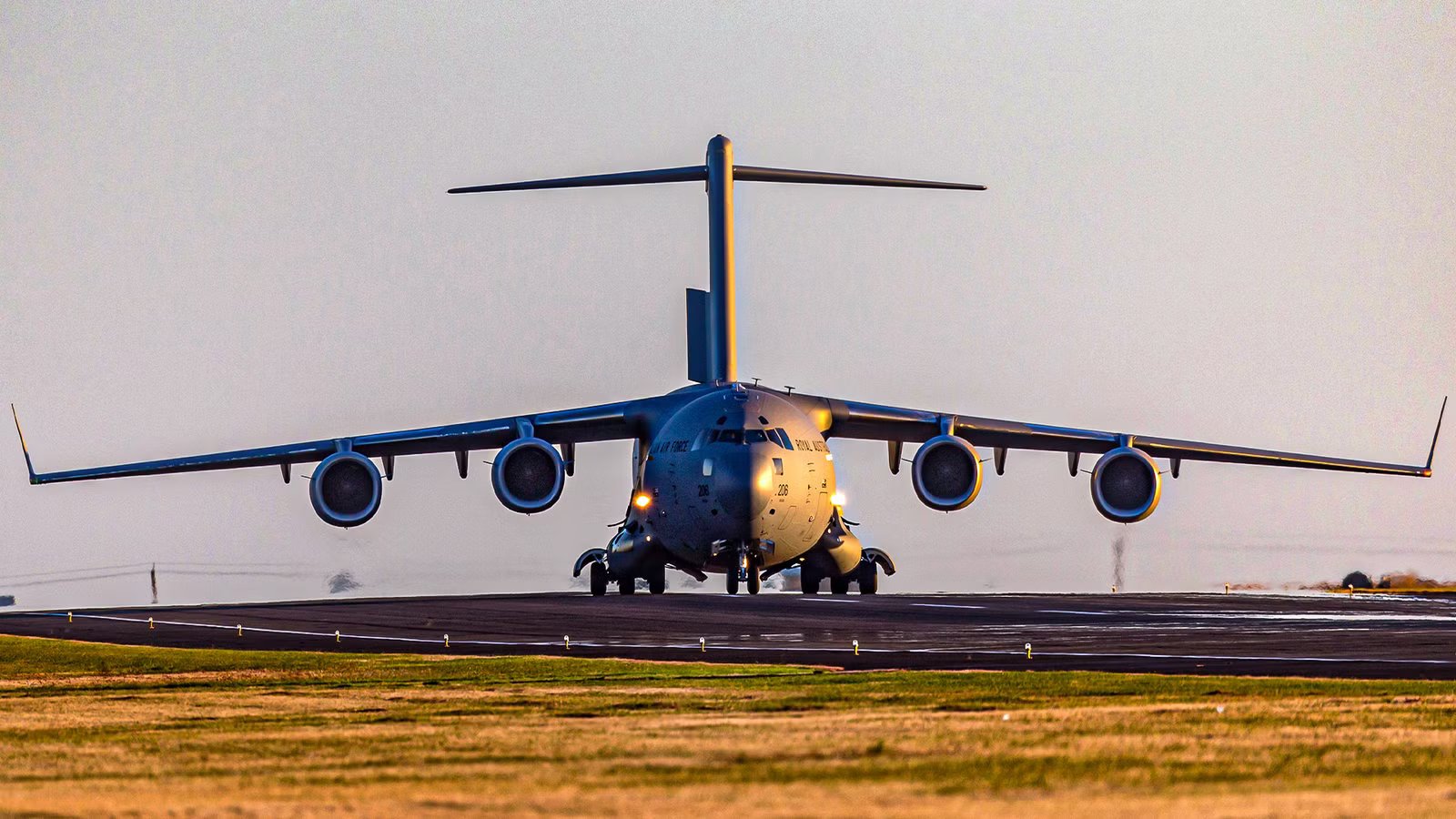
The  BoeingC-17 Globemaster is a marvel of aerodynamic contradictions. It serves as a massive strategic airlifter with a 170-foot wingspan that possesses the nimble, low-speed handling of a much smaller tactical transport. While it is capable of hauling a 69-ton M1 Abrams tank across the Atlantic, its most impressive feat is its ability to fly at altitudes and speeds that would cause other jets of its size to drop out of the sky. This guide explores the engineering secrets behind NASA-developed wings and unique descent rate capabilities that allow this 585,000-pound giant to fly slowly enough to land on short, unpaved runways.
In modern combat, the ability to fly low and slow is a survival mechanism, allowing aircraft to hide behind terrain and deliver cargo with surgical precision to the front lines. This article will clarify how the C-17 bridged the gap between the massive C-5 Galaxy and the rugged C-130 Hercules, creating a platform that redefined the physics of heavy lift.
Built For Tactical Operations

The C-17 was born from a specific 1980s military requirement known as the CX program, which sought to solve a critical logistics gap in the US Air Force fleet. At the time, the military had the massive C-5 Galaxy, which could carry huge loads but required long, paved runways, and the Lockheed C-130 Hercules, which could land anywhere but was too small for oversized cargo. According to historical data from the Air Force Institute of Technology, the goal was to create a direct delivery aircraft, one that could take off from a major hub in the US and land directly on a dirt strip in a combat zone without needing to offload onto smaller planes.
To achieve this, McDonnell Douglas (now Boeing) had to design an airframe that could handle high-speed transoceanic flight while maintaining an approach speed low enough for assault landings. This required a radical departure from traditional wing design. Using research initially tested on the YC-15 prototype, engineers focused on maximizing lift coefficient at low speeds, ensuring the jet could remain stable even when its groundspeed dropped significantly below that of a standard commercial airliner.
The result was a 174-foot-long aircraft that could touch down on a runway only 3,500 feet long and 90 feet wide. This capability transformed the C-17 from a simple cargo hauler into a tactical asset that could reposition an entire army unit, including their tanks and helicopters, directly into a theater of operations. By prioritizing low-speed maneuverability during the design phase, the aircraft became the first heavy jet capable of operating in austere environments that were previously deemed inaccessible to strategic aircraft.
Fast To Slow, No Problem

To achieve high-speed efficiency and low-speed stability, the C-17 utilizes a NASA-developed supercritical wing design. According to Aerospaceweb, a traditional wing creates shockwaves on the upper surface at high speeds, increasing drag and wasting fuel. The supercritical wing, however, features a flattened upper surface and a thickened trailing edge. This unique geometry delays those shockwaves, allowing the C-17 to cruise at 450 knots with the efficiency of a modern airliner, despite its massive, boxy fuselage.
While the wing’s shape handles the fast side, its externally blown flaps handle the slow. The C-17’s 4 Pratt & Whitney engines are strategically mounted so that their exhaust blows directly onto and through the large, double-slotted flaps when they are extended. As detailed in US military documents, this essentially turns the engine thrust into an aerodynamic tool, creating a massive amount of extra lift. This powered lift keeps the 585,000-pound jet airborne at speeds that would cause a traditional wing of the same size to stall.
|
Component |
Function |
Result |
|
Supercritical Wing |
Delays transonic shockwaves |
High-speed cruise efficiency |
|
Leading Edge Slats |
Guides airflow at high angles |
Improved lift at slow speeds |
|
Double-Slotted Flaps |
Redirects engine exhaust downward |
“Powered lift” for short landings |
|
T-Tail (55 ft tall) |
Stays above “wing wash” turbulence |
Consistent pitch control |
This synergy between the engines and the wing surfaces enables the C-17 to fly at approach speeds as low as 150 to 160 knots during standard operations and even slower during tactical maneuvers. By generating its own airflow over the control surfaces, the aircraft doesn’t just rely on forward momentum to stay in the air. This capability is the cornerstone of the C-17’s agility, allowing it to perform 60-degree banks and rapid maneuvers that seem physically impossible for a strategic airlifter.

The Striking Differences Between The C-17 Globemaster & The C-5 Galaxy
From strategic airlift to tactical flexibility, delve into the unique roles of the C-5 Galaxy and C-17 Globemaster III.
Reversing In Flight?

The C-17 has the unique ability to drop out of the sky with terrifying precision to avoid ground-based threats. While a standard commercial airliner typically descends at a leisurely 1,500 to 2,000 feet per minute, a C-17 crew can execute a tactical descent at over 12,000 fpm. This capability allows the aircraft to remain at high, safe altitudes for as long as possible before diving toward a short, austere runway.
The secret to this rapid loss of altitude without reaching dangerous levels of airspeed is the ability to deploy thrust reversers while still in flight. As highlighted in the operational footage below, the engine cowlings shift midair, directing the massive thrust of the 4 engines forward and upward to act as a giant aerodynamic brake. This allows the pilot to maintain a stable tactical airspeed between 115 and 135 knots even while pointed at an aggressive downward angle.
To manage these steep arrivals, pilots must carefully monitor their vertical speed indicator to match the glideslope of the landing zone. In a 5-degree assault approach, the aircraft is essentially flown into the ground rather than flared gently, relying on its 14-wheel landing gear to absorb the massive energy of the impact. This rugged engineering ensures that after a 12,000 fpm drop, the aircraft can still stop within a 3,500-foot runway and immediately begin offloading its cargo.
Flight Systems Are Critical

Managing the complex physics of a 12,000 fpm descent and a slow-speed assault landing requires the digital brain of a quadruple-redundant fly-by-wire system. The C-17 features a unique center-mounted stick, often called a joy-yoke, that sits atop a traditional yoke column. This hybrid design gives pilots the one-handed precision of a fighter jet, allowing for tactile control that is nearly unheard of in strategic airlift.
This electronic control system enables the C-17 to perform aggressive maneuvers safely, such as banking up to 60 degrees or maintaining a roll rate of 40 degrees per second at speeds above 300 knots. The fly-by-wire computers act as a safety envelope, preventing the pilot from inadvertently stalling the aircraft during high-stress tactical turns. This agility is vital for masking the aircraft behind terrain at low altitudes to avoid radar detection, a tactic highlighted in a US military research project as a key survival requirement for modern air mobility.
By automating many of the flight-path corrections through its mission computers, the C-17 eliminated the need for a dedicated navigator or flight engineer. This reduction to a 3-person crew significantly reduces the personnel footprint required for global operations. Furthermore, the integration of dual heads-up displays ensures that pilots can keep their eyes out of the cockpit during critical low-level routes, keeping track of speed and flight path vectors without ever looking down at the instrument panel.
Any Surface Is A Landing Strip

To survive the punishing impact of an assault landing on an unpaved strip, the C-17 is equipped with a massive, high-flotation landing gear system consisting of 14 wheels. The main gear is distributed into two pods of six wheels each, designed to spread the aircraft’s 585,000-pound maximum weight across a larger surface area. This lowers the footprint pressure, allowing the aircraft to operate on soft dirt, gravel, or even the annual sea ice of Antarctica without sinking or damaging the surface.
One of the most tactical features of the C-17 is its ability to be completely self-sufficient on the ground. Unlike commercial jets that require a pushback tug to leave a gate, the C-17 can use its own power to back up. The thrust reversers are uniquely designed to direct engine exhaust forward and upward. This upward angle is critical for austere operations because it prevents the high-velocity air from blowing dust, rocks, and debris into the engine intakes, a common cause of foreign object damage in other aircraft.
This powerback capability, combined with a tight turning radius, allows the C-17 to perform a star turn on narrow runways. Even more extraordinarily, the aircraft can fully reverse direction on a surface width of just 90 feet using a three-point turn. This means the C-17 can deliver its cargo to a remote outpost, back itself up, turn around, and take off again without any ground support equipment, turning a desolate dirt strip into a fully functional strategic airhead.
Call To Action

Beyond its aerodynamic hardware, the C-17’s true value lies in its modular interior, which allows it to transition from a tank-carrier to a flying ICU in minutes. The cargo bay features built-in oxygen and electrical outlets that can support up to 36 stretcher patients and their medical teams. During 120,000-person evacuations like Operation Allies Refuge or disaster relief missions in places like Gaza, the aircraft’s ability to operate without ground infrastructure ensures that life-saving aid reaches its destination before the dust of a conflict even settles.
The key point for aviation enthusiasts and military personnel is that the C-17’s low-speed flight capability is its greatest strategic strength. By mastering the low-speed envelope, the US Air Force allowed for 69-ton loads to bypass major hubs and fly directly to the front lines. For the 3-person crew, the C-17 represents the pinnacle of heavy-lift engineering. It is a jet that handles with the precision of a fighter while delivering the volume of a cargo ship.
Incremental upgrades to its avionics and defensive systems will keep it relevant in increasingly contested environments. While next-generation concepts like blended-wing bodies or autonomous cargo drones are currently in development, the C-17 Globemaster has set a benchmark for versatility that is unlikely to be matched soon. It remains the only platform in history that can launch at a moment’s notice, fly across an ocean, and land on an ice sheet or a dirt strip to deliver hope or strength anywhere on the globe.